


Key Facts
The bipartisan Taxpayer Assistance and Service Act (TAS Act, S.3931), introduced in February by Senator Mike Crapo (R-ID) and Senator Ron Wyden (D-OR), represents a major, needed step toward addressing common challenges faced by taxpayers.
This legislation advances a comprehensive set of reforms that would improve the taxpayer experience from tax filing to dispute resolution, while also focusing on the needs of long underserved taxpayers.
Since its circulation as a discussion draft in early 2025, the TAS Act has undergone changes to account for recent legislative activity as well as stakeholder feedback, including to incorporate NTU suggestions.
Introduction
As the main touchpoint for most Americans with the federal government, the Internal Revenue Service (IRS) plays a critical role in maintaining trust in the nation’s public services. Despite recent reform efforts, the IRS continues to lag behind in commonsense upgrades and, in some cases, has failed to uphold core taxpayer protections established decades ago. As taxpayers wrestle with these challenges daily, reforming our system for tax administration is fundamental to rebuilding trust and restoring fairness.
The bipartisan Taxpayer Assistance and Service Act (TAS Act, S.3931), introduced in February by Senator Mike Crapo (R-ID) and Senator Ron Wyden (D-OR), represents a major, needed step toward addressing these challenges. The broad-based reform package would do more to strengthen taxpayer rights and improve taxpayer service than any legislation since the landmark IRS Restructuring and Reform Act (RRA) of 1998. In fact, several provisions included in the TAS Act serve to reinforce or clarify crucial taxpayer protections originally established by the RRA.
This legislation advances a comprehensive set of reforms that would improve the taxpayer experience from tax filing to dispute resolution, while also focusing on the needs of long underserved taxpayers. The TAS Act includes measures requiring the IRS to modernize its technology, a goal that the IRS has thus far been unable to achieve independently without specific legislated mandates. It also provides more insight into the challenges faced by taxpayers abroad, promotes fairness in Tax Court procedures, and enhances the independence of the Office of the National Taxpayer Advocate and the Independent Office of Appeals.
Importantly, the TAS Act differs from other recent IRS reform efforts, such as the Inflation Reduction Act of 2022, in its strong emphasis on accountability and oversight. This bill includes multiple reporting requirements to Congress on the progress of implementation, requires studies on specific legislative actions to take in the future, and provides clear deadlines with specific benchmarks. While systemic change takes time, these transparency measures will develop greater trust between taxpayers and the IRS.
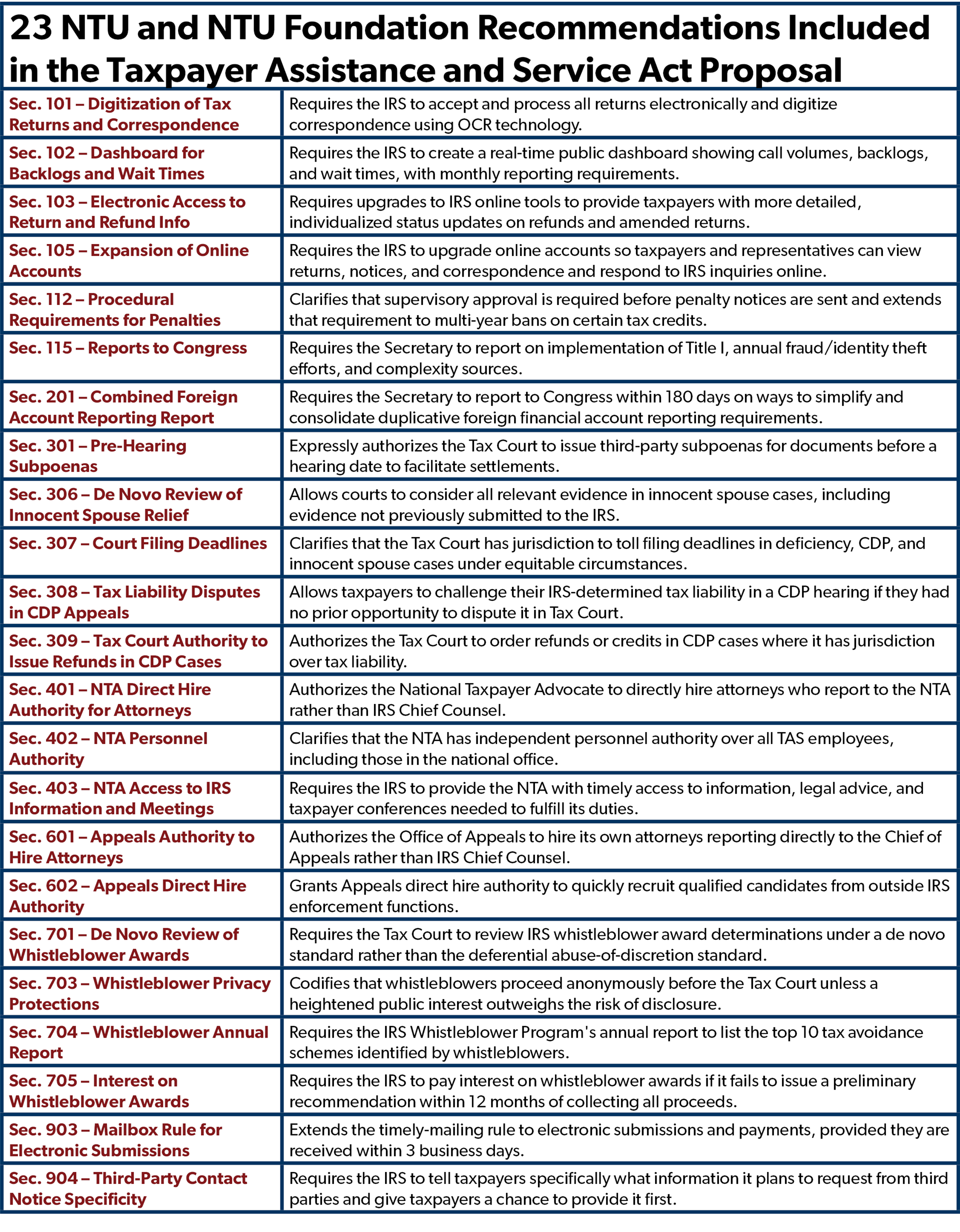
Since its circulation as a discussion draft in early 2025, the TAS Act has undergone changes to account for recent legislative activity and stakeholder feedback. NTU appreciates the Senate Finance Committee’s recent inclusion of many of our recommendations, including our suggestions to require annual reporting on tax complexity and to allow for electronic supervisory signature during the penalty assessment process. Overall, this package includes 23 proposals that NTU has recommended in recent years.
While the job of improving tax administration will never truly be complete, as currently written, the TAS Act makes excellent progress in reinforcing the Taxpayer Bill of Rights and providing badly-needed future direction for the IRS.
Recent Legislative Achievements
Both houses of Congress have been actively engaged with IRS reforms in the past year, passing several key TAS Act provisions unanimously, with others progressing through the legislative process.
One important early success is the IRS Math and Taxpayer Help Act (IRS MATH Act, P. L. 119-39), introduced by Senators Warren (D-MA) and Cassidy (R-LA). This law clarifies math error notices, which are the most common notice taxpayers receive and a frequent source of taxpayer confusion. P.L. 119-39 requires plain-language explanations of where taxpayers made a calculation error as well as line-item description of the error. Furthermore, it requires response dates to be in bold typeface and mandates the inclusion of direct contact information for taxpayers to reach the IRS.
Taxpayers facing natural disasters have also been provided with tax relief through recent passage of TAS Act provisions. The Filing Relief for Natural Disasters Act (P. L. 119-29) and the Disaster Related Extension of Deadlines Act (P. L. 119-64) work together to expedite disaster declarations and ensure that related deadline extensions are honored across the board throughout the tax process.
Several other critical elements of the TAS Act discussion draft have gone through markup in the House Committee on Ways and Means or passed the full House of Representatives. These include bills to require barcode scanning of tax returns, to enhance taxpayer due process, and to allow the Office of the National Taxpayer Advocate to directly hire legal counsel. In fact, the Ways and Means Committee has continued to approve critical TAS Act reforms since the package’s introduction. These include the Taxpayer Experience Improvement Act (H.R. 7971), which would provide taxpayers with better access to their tax return status online, and the IRS Whistleblower Program Improvement Act (H.R. 7959), which would encourage more whistleblowers to come forward.
Changes from Discussion Draft to Legislative Text
In addition to provisions removed from the final version of the TAS Act due to their recent standalone enactment, other elements of the bill have undergone changes as a result of stakeholder feedback.
Tax Complexity Reports
The TAS Act ensures accountability through Section 115 requiring reports to Congress on the status of the bill’s implementation, along with consultation with the National Taxpayer Advocate, the Treasury Inspector General for Tax Administration, and the Comptroller General of the United States. The bill also requires the IRS to provide annual reports on its efforts to combat tax fraud and identity theft.
One key NTU priority included in the final version of the bill is the addition of an annual report to Congress on sources of complexity in the tax code. RRA directed the IRS to provide Congress with an analysis of tax code complexity and the Joint Committee on Taxation to conduct Tax Complexity Analyses in certain circumstances. Yet, in the decades since the RRA was signed into law, the IRS has rarely issued the statutorily required annual report (with a date of March 1 of each year), and many important tax laws have foregone a complexity analysis by the Joint Committee of Taxation.
This section clarifies that the National Taxpayer Advocate’s annual reports to Congress detailing serious challenges faced by taxpayers do not fulfill the statutory requirements of the RRA and emphasizes that the IRS must resume this practice. National Taxpayers Union Foundation’s annual analysis of tax complexity shows that the amount of time taxpayers spend on tax filing and associated costs have ballooned in recent years, with average Americans spending 13 hours and $290 to file. While Congress bears responsibility for adding complexity to the tax code year after year, clearly identifying where complexity occurs in the tax administration process is also critical to resolving this issue in the future.
Supervisory Signature
The TAS Act also includes changes to reinforce the requirement established by the RRA ‘98 to require IRS agents to obtain the signature of their supervisor prior to assessing taxpayer penalties under Section 6751(b). In recent years, the IRS has sidestepped this requirement, leading the Tax Court to frequently dismiss penalties due to missing or even backdated supervisory signatures. Rather than enforcing adherence to the law, the IRS has proposed an egregious rule to water down the definition of immediate supervisor and the timing of the initial determination of a penalty. This rule would effectively allow any other IRS employee to sign off on a penalty at any stage of the penalty process—even up until the Tax Court enters a final judgment on the matter.
The recently introduced version of the TAS Act includes a key NTU recommendation to require the signature to be obtained in writing on an electronic form. Electronic signature may work similarly to the attestation on a 1040 form and would allow for greater certainty of identity verification and signature timing. The provision requires the signature to be provided by either a supervisor or the Office of Servicewide Penalties and defines the timing when the supervisory signature must be obtained as prior to sending taxpayers an appealable notice of penalty.
IRS Modernization
Technological modernization is essential to the success of nearly every function at the IRS, and technological interfaces are increasingly expected by the public in interactions with the government or the private sector. Despite decades of concern over the IRS’s aging technological infrastructure, recent efforts to drive meaningful transformation have fallen far short of expectations.
The Inflation Reduction Act of 2022 represented a critical missed opportunity to force modernization at the IRS. The legislation provided an unprecedented influx of funding for the IRS with the intention that it would be used to upgrade processing systems, yet gave little instruction for what steps should be taken and what measurable benchmarks should be established. The result of this lack of direction was a hodgepodge of incomplete initiatives and practically no progress replacing the most outdated systems, such as the 60-year-old Individual Master File. The TAS Act takes an entirely different approach to encourage IRS modernization by prescribing specific actions to be completed by a set date alongside various transparency measures.
One important inclusion in the bill is the mandate for the IRS to develop a dashboard with real-time information about call wait times, the availability of callbacks, and call volume. The IRS would also be required to produce monthly reports on its taxpayer assistance via telephone. Providing this information directly to taxpayers in real time would help individuals to better plan when and how to contact the IRS, reducing frustration for everyone involved.
The TAS Act also requires the IRS to expand use and function of taxpayer-facing technologies that will reduce inquiries and streamline access to important information. This includes upgrading the “Where’s my Refund?” and “Where’s my Amended Return?” tools and improving Online Accounts. The new version of the bill includes several modest yet necessary adjustments to these sections since its introduction as a discussion draft. For instance, the requirement to expand Online Accounts is now extended to ensure taxpayers outside the U.S. have access to their tax information online.
Banks, public utilities, and other essential services used by nearly all taxpayers routinely provide access to account and service information online, making the IRS an outlier due to inadequate use of technology. This legislation will close the gap between public expectations and the services provided.
Taxpayers Abroad
Taxpayers residing abroad are often underserved by the current system of tax administration, largely due to complex tax laws. The U.S. is one of the only countries in the world with citizenship-based taxation rather than residence-based taxation, forcing Americans abroad to pay taxes to the U.S. instead of the country they live and work in. Furthermore, these taxpayers are subject to overlapping reporting requirements under the Foreign Account Tax Compliance Act (FATCA), filing Foreign Bank and Financial Accounts (FBAR) forms with FinCEN, and regular tax filing with the IRS.
The TAS Act takes several steps toward improving the taxpayer experience for taxpayers abroad. This bill requires the Secretary of the Treasury to suggest to Congress, after consulting with the National Taxpayer Advocate and U.S. citizens abroad, legislative actions to simplify filing for taxpayers abroad. While this stops short of what was included in the prior version of the bill allowing taxpayers to file FATCA and FBAR forms with the IRS instead of reporting these to FinCEN separately, the latest provisions will still elevate these issues and pave a path toward future legislation.
The bill also takes numerous other steps to simplify filing for taxpayers abroad. This includes increasing the exemption for foreign currency gains, increasing the threshold for taxpayers to claim a “simplified” foreign tax credit, and giving taxpayers abroad additional time to respond to math error notices.
Judicial Review
Taxpayers’ right to appeal IRS decisions in an independent forum is a fundamental protection to guarantee the fair administration of tax law. The TAS Act makes several changes to the judicial process for taxpayers by closing the gap between Tax Court procedure and that of other federal courts.
The bill expands the Tax Court’s pre-trial discovery power by empowering it to issue third-party subpoenas so that litigants can receive important information prior to hearings. It also affirms the Tax Court’s ability to apply equitable tolling, allowing the Court to extend taxpayer deadlines in unique circumstances. In the Supreme Court case Boechler, P.C. v. Commissioner, the IRS argued that missing a deadline should preclude taxpayers from taking cases to court and that allowing flexibility for deadlines would disrupt essential revenue collection. The TAS Act affirms the Supreme Court’s unanimous decision that filing may be equitably tolled.
In addition, the bill advances several other commonsense judicial reforms. For example, it would provide vital options for taxpayers who currently cannot access the Tax Court in certain collection due process cases and in hearing suits for refunds or credits. It also enhances innocent spouse relief by allowing the Court to review all relevant evidence rather than just the evidence presented in de novo review.
Procedural restrictions in the judicial process should not act to shield the government from legitimate disputes. The TAS Act resolves this by shifting the burden of proof back to the IRS in several instances where taxpayers have in recent times been unduly burdened.
Tax Return Preparers
Heavy-handed regulation or licensing of tax preparers has been a controversial issue for many years, and has included court rulings in 2013 and 2014 that rightfully struck down the IRS’s assertion of authority to establish large fees, onerous (and often pointless) exams, and other requirements on these service providers. Drawing upon these negative but instructive lessons, the TAS Act takes a more measured approach to matters involving tax preparer conduct by raising existing penalties for preparer misconduct, forbidding examinations as a condition for receiving or renewing a Preparer Tax Identification Number (PTIN), establishing new continuing education standards not to exceed 18 hours annually, and creating a solid appeals process for preparers who have their PTINs suspended or revoked.
As with many other issues affecting tax administration, ultimately the best approach to addressing tax preparation concerns is to make the laws less complex and easier for everyone to understand. Until then, and, if the TAS Act becomes law, the preparer provisions should be implemented thoughtfully, with meaningful opportunities for input from stakeholders outside government. NTU will be an active participant and watchdog in this regard.
Other Essential Reforms
The current structure of the IRS, which was largely created as the result of the RRA, includes several offices that are meant to protect taxpayers in theory yet are unable to do so in practice due to statutory limitations. This bill strengthens the independence of both the Office of the National Taxpayer Advocate and the Office of Independent Appeals by allowing each to directly hire their own attorneys rather than relying on the legal analysis of those working for the IRS Office of Chief Counsel. This prevents attorneys from acting on behalf of both the IRS and the taxpayer simultaneously. In addition, the TAS Act allows both of these offices to directly hire other personnel and includes several other changes to these offices. These changes would be complemented by disallowing attorneys from the Office of Chief Counsel from sitting in the Office of Independent Appeals’s hearings with taxpayers and prohibiting ex parte communication on pending matters between officers in the Independent Office of Appeals and other IRS employees.
Efforts to strengthen the taxpayer right to appeal frequently face resistance from the IRS, long predating the Office of Independent Appeals’ codification under the Taxpayer First Act of 2019. Notably, a rule finalized in early 2025 effectively undermined congressional intent behind the law by formalizing dozens of exceptions to taxpayers’ right to appeal. By carving out 24 exceptions to the right to appeal, the rule prevents certain taxpayers from accessing the review process. While this legislation does not revoke those exceptions, it does attempt to redirect emphasis back toward taxpayer rights.
Taxpayers will welcome this and other recent progress to improve the appeals process. Especially promising are efforts to expand access to the Alternative Dispute Resolution (ADR) process which provides a faster, more efficient, and more collaborative forum to resolve disputes. In 2024, after seeking public comments regarding how to modify the program, the IRS created a separate Alternative Dispute Resolution (ADR) office within the Independent Office of Appeals. This was followed by the announcement of a two-year pilot program in 2025 to enhance and expand access to ADR for numerous taxpayers. The National Taxpayer Advocate notes that taxpayer use of ADR has increased in recent years in light of these actions.
The TAS Act includes several other reforms, including enhanced whistleblower protections and the application of the “mailbox rule” to electronic payments, both of which address longstanding priorities of NTU. The IRS whistleblower provisions would allow for new evidence to be added to the record in appeals heard by the U.S. Tax Court, increase privacy protections for whistleblowers before the Court, provide interest to whistleblower awardees if they are not paid within a year of IRS collection, improve tax treatment of program attorney fees, and make needed changes to program annual reporting to Congress.
One important element in the success of any IRS transformation under TAS or future laws could be the revitalization of the IRS Oversight Board, an entity created by the RRA. Whereas other oversight groups provide input on specific technical issues or analyze the IRS’s adherence to current law, as demonstrated by the Electronic Tax Administration Advisory Committee (ETAAC) and the Government Accountability Office (GAO) respectively, the Oversight Board has a broader mandate. The IRS Oversight Board was intended to focus on the long-term vision for the IRS by supervising and guiding the implementation of strategic plans, yet has been effectively dormant for decades due to lack of presidential appointment and Senate confirmation to the Board. Recent efforts to revitalize the Board came from former Senators Ben Cardin (D-MD) and Rob Portman (R-OH) in their IRS Customer Service and Transformation Act of 2022. This bill made several vital changes to the procedures for constituting, maintaining, and operating the Board that would restore its role in a tripartite arrangement alongside the National Taxpayer Advocate and Treasury Inspector General for Tax Administration.
Conclusion
The TAS Act ranks with the RRA and the Taxpayer First Act in improving services provided to taxpayers by the IRS, strengthening taxpayer rights, and restoring accountability by mandating transparency throughout the Service. This legislative package, including legislation enacted since its initial release as a discussion draft, incorporates nearly two dozen proposals recommended by NTU in recent years, which is one big reason why the current TAS Act has our support.
While it would be difficult for any single piece of legislation to address every challenge faced by taxpayers, this bill is the result of commendable bipartisan efforts to build upon prior monumental reforms and avoid the mistakes of recent missed opportunities for transformational change. Its timely passage in this Congress would, instead, embrace this transformational change.