

When President Donald Trump imposed broad-based tariffs under Section 122 of the Trade Act of 1974 earlier this year, he wisely exempted many fertilizer imports from the new duties. According to the White House Fact Sheet accompanying his tariffs, “Some goods will not be subject to the temporary import duty because of the needs of the U.S. economy.” Included on that list are fertilizers that cannot be produced in the United States in sufficient quantities to meet domestic demand.
More recently, Trump issued a Jones Act waiver to facilitate the transportation of goods including fuel and fertilizer.
While President Trump deserves to be congratulated for these actions to reduce input prices for farmers, there is more that can be done.
Phosphate fertilizer from Morocco and Russia remains subject to costly countervailing duties (CVDs) imposed during the Biden Administration. These tariffs are currently undergoing a legally required five-year review. The Trump Administration is reportedly considering scrapping them entirely. Rep. Mariannette Miller-Meeks (R-IA) has introduced an amendment to the farm bill to prohibit CVDs on phosphate fertilizer.
Such action is urgently needed. Phosphate fertilizer duties are exacerbating input prices for U.S. farmers. Farmers who grow crops like corn, cotton, and soybeans are particularly reliant on phosphate fertilizer.
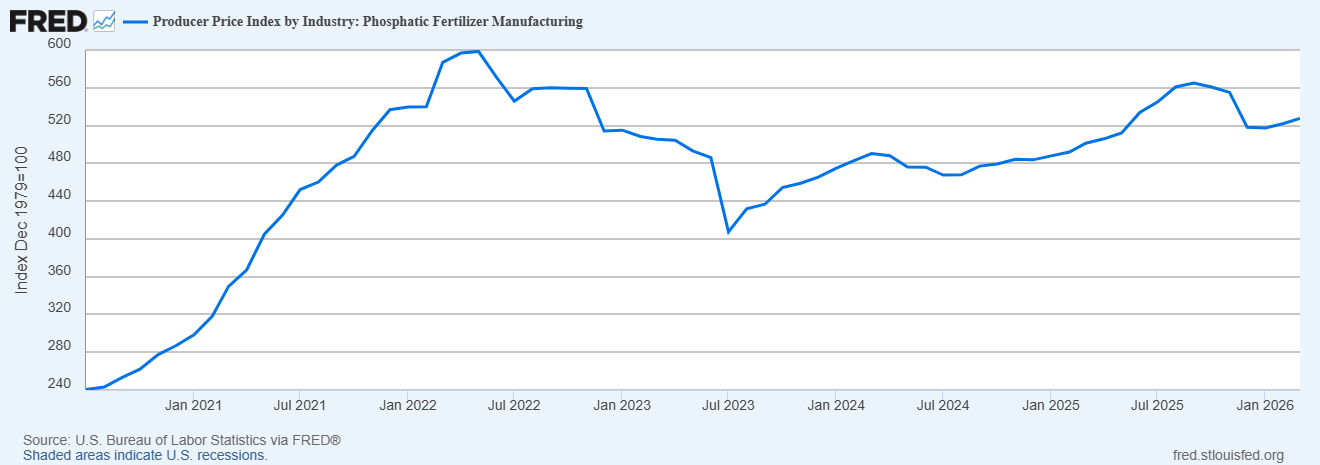
After the Commerce Department announced its investigation into phosphate fertilizer imports in 2020, prices soared. As of March 2026, the Producer Price Index (PPI) for phosphatic fertilizer manufacturing remained twice what it was in 2020. A study by Texas A&M’s Agricultural and Food Policy Center estimated CVDs increased the cost of phosphorus fertilizers by $6.9 billion from 2021 to 2025.
Higher ag input costs and reduced farm yields also contribute to higher prices at the grocery store.
In addition, some critics of fertilizer tariffs contend they primarily shift imports to different countries. According to a submission to the U.S. International Trade Commission on behalf of Philadelphia-based International Raw Materials LTD, “this case appears to be an attempt by Mosaic, the sole petitioner, to shut out imports from Morocco and Russia so that it can supply its U.S. customers with its own imports.” From 2020 to 2025, imports subject to CVDs from Morocco and Russia declined by $380 million, while imports from other countries increased by $765 million.
Some farm groups have sought increased federal aid to offset high input costs. Not only would that put a hefty bailout on the backs of taxpayers, such a subsidy could fuel even higher prices for farm inputs. A better approach is to adopt supply side reforms to keep input prices down. That’s why the decisions by President Trump to exempt fertilizer from Section 122 tariffs and to provide a Jones Act waiver are so important.
The Trump Administration and Congress should also consider the importance of Morocco to U.S. security interests. The State Department describes Morocco as a “vital U.S. partner on a wide range of regional security issues, with a shared goal of a stable, secure, and prosperous Middle East.” In 2018 and 2019, prior to the COVID-19 pandemic, Morocco accounted for over half of U.S. phosphate fertilizer imports. By 2025, Morocco’s share of imports had fallen to less than 1%.
To reduce input prices for farmers and remove a barrier to affordable food for American families, the federal government should end CVDs on phosphate fertilizer.