


The yield on U.S. Treasury debt has increased dramatically in recent months. Between December 31, 2025, and September 30, 2026, the yield on 10-year Treasury Notes increased from 4.18% to 5.29%, an increase of 111 basis points.[1]
Policymakers should understand what is driving these increases in yields so they can respond appropriately to mitigate the impact and improve budget sustainability.
Analysis shows that, while inflation expectations contributed to higher interest rates, the increase in Treasury yields was driven predominantly by higher expected real interest rates and greater required compensation for the risks of holding long-term debt. A Federal Reserve model attributes about three-quarters of the increase to real-yield components and one-quarter to expected inflation and inflation risk compensation.
Higher interest rates have a significant impact on the federal budget. Net interest outlays totaled $1.052 trillion in fiscal year 2026, making interest the third largest item in the budget.
Congress should control spending and reduce budget deficits to reduce the upward pressure on real interest rates and the government’s borrowing costs.
Understanding the Higher Yields on Treasury Debt
To understand the changes in Treasury yields in more detail, we can use a model originally created by Federal Reserve economists Stefania D’Amico, Don Kim, and Min Wei (referred to as the DKW model) and updated by Kim, Wei, and Cait Walsh. The Federal Reserve releases updated DKW data on a monthly basis.
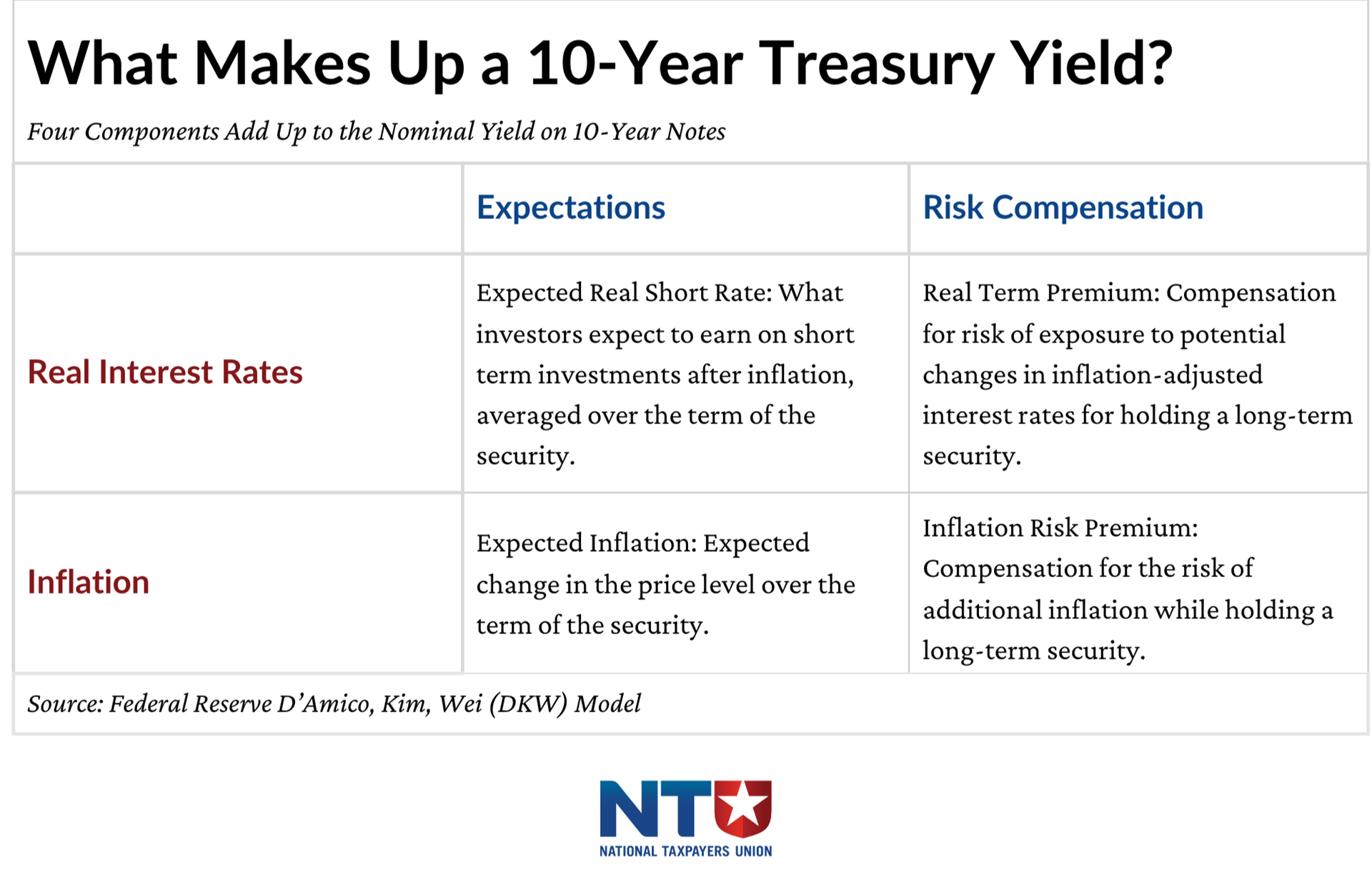
The DKW model divides a nominal yield into four components based on investors’ expectations about inflation and interest rates as well as the compensation required for bearing risk during the term of the Treasury security:
- Expected inflation: The average annual projected increase in the price level over the term of the security.
- Inflation risk premium: Compensation for the risk of additional inflation over the term of the security.
- Expected average future real short rate: Inflation-adjusted return expected on short term investments, averaged over the term of the security.
- Real term premium: Compensation for the risk of changes in inflation-adjusted interest rates while holding a long-term bond.
Adding the four components together produces the nominal yield estimated by the model. These components are shown in Table 1 below.
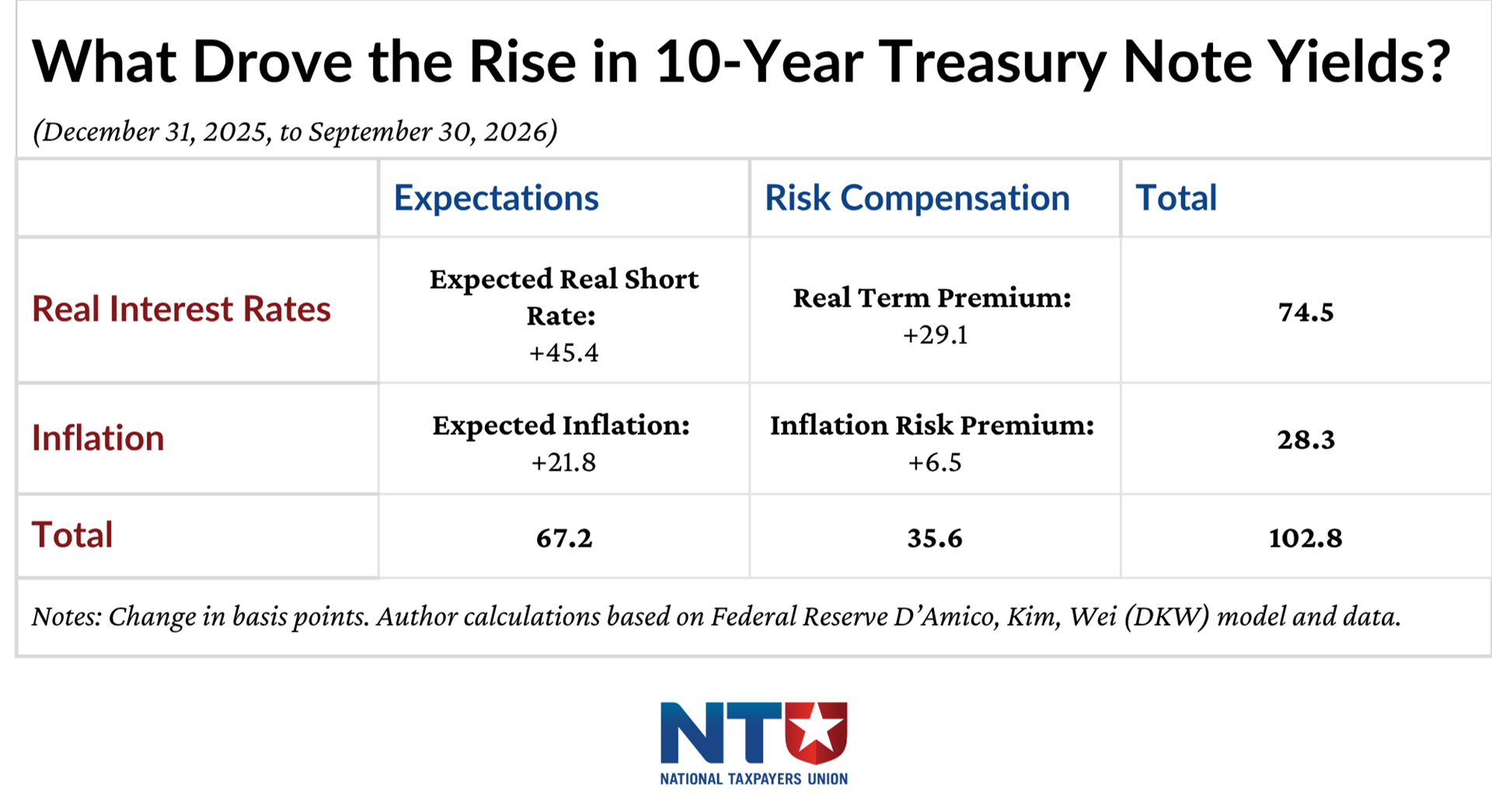
Changes in these components between December 31, 2025, and September 30, 2026, help explain the increase in 10-year Treasury yields.
In the modeled analysis, the total yield grew by 102.8 basis points.[2] The inflation components, including expected inflation and the inflation risk premium accounted for 28.3 basis points of yield growth. Increases in real (inflation-adjusted) interest rates accounted for 74.5 basis points.
The single largest component of yield growth was the expected future real short rate, consistent with investors anticipating a more restrictive Federal Reserve monetary policy and a higher path for short-term real interest rates.
Concerns about the federal government’s fiscal trajectory can contribute to increases in the real term premium. A recent Federal Reserve study found that an expected one percentage point increase in the debt to GDP ratio leads to an increase in the real term premium of two to three basis points. The September Quarterly Review from the Bank for International Settlements states that rising yields are “partly driven by rising term premia that reflected fiscal pressures rather than inflation concerns.”
Treasury yields increased sharply between late August and September 30. More than half of the net cumulative increase in the model estimated yield occurred since August 27, with the yield increasing 53.2 basis points from 4.77% to 5.30% on September 30, 2026. Within this total, increases in the expected real short rate accounted for 24 basis points, the real term premium accounted for 14.6 basis points, expected inflation accounted for 11.4 basis points, and the inflation risk premium accounted for 3.1 basis points.
Federal Reserve Chairman Kevin Warsh’s August 28, 2026, speech at the Jackson Hole Economic Policy Symposium was perceived by markets as signaling that rate hikes were more likely. The Fed subsequently increased the target for the federal funds rate by 25 basis points at the September 16 meeting.
The Federal Reserve’s monetary policy influences long-term Treasury yields through expectations about future short-term interest rates. Long-term yields generally reflect the expected path of short-term rates plus a term premium, which is additional compensation for the risk of taking on longer-term debt. Short-term rates are highly correlated to the federal funds rate set by the Federal Reserve. So, if the markets expect the Fed to hike interest rates, investors will demand higher yields on both short and long-term debt.
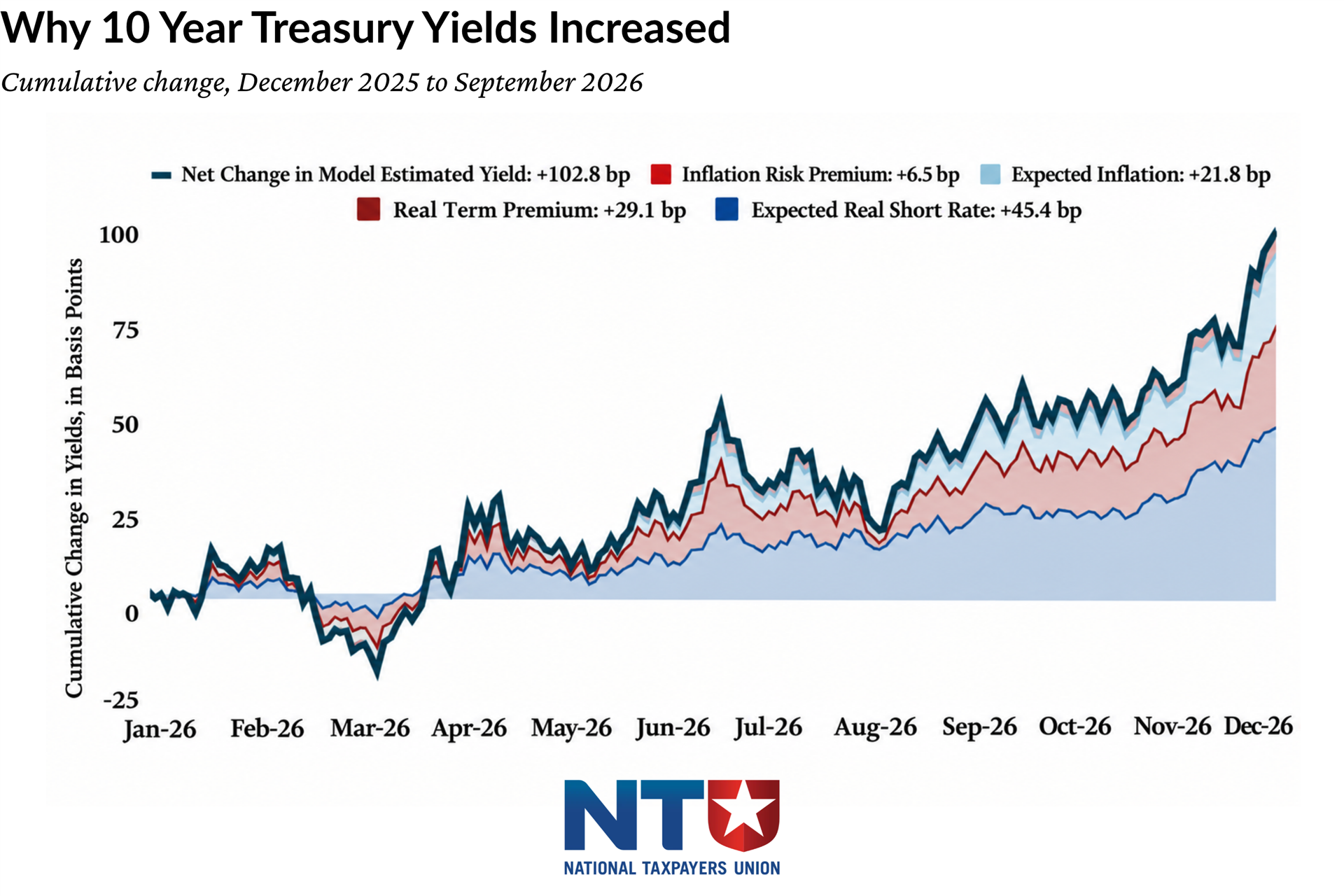
The outbreak of the conflict with Iran beginning on February 28 is also correlated with an increase in Treasury yields. Prior to the conflict, yields had actually decreased relative to the levels at the beginning of the year. However, yields quickly rose more than 35 basis points by the time the first ceasefire agreement was announced on April 7, driven by higher expected real short rates as investors expected the Fed to postpone anticipated interest rate reductions and a higher real term premium, which the Federal Reserve attributed as “likely reflecting factors such as the greater general uncertainty induced by the conflict in the Middle East and shifts in investor positioning.” After that initial ceasefire collapsed, yields began to rise again.
Higher Interest Rates Mean Higher Deficits
Interest rates are significantly higher than the Congressional Budget Office’s (CBO) projections. In its February 2026 baseline, CBO estimated that the interest rate on 10-year Treasury notes would average 4.16% in the third quarter of 2026. The actual average interest rate was 4.76%, with the final reading of 5.29% on September 30, 2026.
Interest rates have significant impacts on the federal budget. If higher rates persist, the federal government will face higher borrowing costs as existing debt is refinanced and trillions of dollars of new debt are issued.
If average interest rates across Treasury maturities remain 100 basis points above the baseline projected interest rate, then CBO’s models estimate deficits would be $3.8 trillion higher over the FY 2027 to 2036 period. If interest rates remain 50 basis points above the baseline, deficits would be $1.9 trillion higher over the next decade.
The federal government’s exposure to higher interest rates will grow as the Treasury refinances maturing debt and adds additional borrowing to finance $2 trillion of annual deficits. More than $10.6 trillion of Treasury debt, about one-third of marketable debt outstanding, is scheduled to mature within one year. Higher borrowing costs increase interest payments, which adds to deficits and requires additional borrowing. Net interest outlays in FY 2026 were already equivalent to 37% of total individual income tax collections.
Congress should control primary spending (spending other than interest) and reduce deficits to limit future interest costs and put the federal budget back on a sustainable trajectory.
[1] 100 basis points equals one percentage point.
[2] The DKW model uses a model-fitted 10-year zero-coupon yield, while the more commonly used figure cited at the beginning of this report represents a 10-year constant-maturity par yield. Differences in payment timing, compounding conventions, and yield-curve estimation mean their measured increases over the same period may not exactly match.