


April 2, 2026, will mark the anniversary of President Donald Trump’s Liberation Day Tariffs. Here are three things that happened after Liberation Day tariffs were imposed:
➡️ The trade deficit increased. The goal of Trump’s tariffs was spelled out in the title: Regulating Imports with a Reciprocal Tariff to Rectify Trade Practices that Contribute to Large and Persistent Annual United States Goods Trade Deficits. Trump’s executive order asserted that persistent goods trade deficits are a national emergency, and the Administration’s cure was to hike tariffs to the highest level since the 1930s.
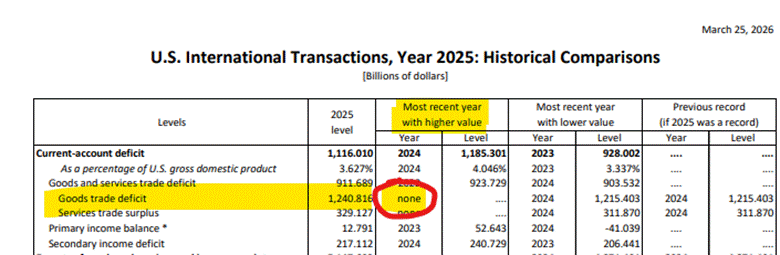
The result? On March 25, the Bureau of Economic Analysis reported that the U.S. goods deficit increased to an all-time high in 2025.
➡️ The manufacturing sector suffered. According to Trump’s Liberation Day executive order, “The decline of U.S. manufacturing capacity threatens the U.S. economy in other ways, including through the loss of manufacturing jobs.” Here’s what happened next:
- Under Liberation Day tariffs, the ratio of manufacturing workers to total nonfarm employment fell to the lowest point since 1939, when the Bureau of Labor Statistics started tracking this data.
- The U.S. manufacturing sector shed 100,000 jobs from January 2025 to April 2026.
- U.S. manufacturers hired 388,000 fewer workers in 2025 than in 2024.
- According to the ISM Manufacturing Index, a monthly survey of U.S. manufacturing purchasing managers, manufacturing contracted for nine consecutive months after Liberation Day tariffs were imposed before rebounding slightly in January and February 2026.
Figure 2: Manufacturing Employment

➡️ Farmers paid dearly. According to President Trump’s Liberation Day Fact Sheet, President Biden’s policies generated an all-time high agricultural trade deficit. But data from the Foreign Agriculture Service show the ag trade deficit increased from $37 billion in 2024 to $41 billion in 2025.
- Tariffs hit farmers and ranchers with a double-whammy of lower exports and higher input prices. Under Liberation Day tariffs, U.S. agricultural exports declined and the 2025 agricultural trade deficit increased by 10.8%. From February to October 2025 alone, tariffs increased the cost of goods like farm machinery and agricultural chemicals by $958 million.
- The failure of this tariff policy is reflected in a recent letter from the country’s leading farm organizations, which warns: “America’s farmers, ranchers, and growers are facing extreme economic pressures that threaten the long-term viability of the U.S. agriculture sector. An alarming number of farmers are financially underwater, farm bankruptcies continue to climb, and many farmers may have difficulty securing financing to grow their next crop.”
These results were entirely predictable.
- There was no reason to expect Liberation Day tariffs to reduce the trade deficit. Tariffs reduce the growth of both imports and exports, with no definitive impact on the overall trade balance.
- Over half of U.S. imports in 2025 were industrial supplies or capital goods used to make things in the United States. Tariffs on those goods made it harder for U.S. manufacturers to afford the goods they need to survive and grow.
- During President Trump’s first term, the Department of Agriculture created the Market Facilitation Program to bail out farmers affected by the ramifications of Trump’s Section 301 tariffs—tariffs that were much smaller than Liberation Day tariffs. Now the government is considering even larger farm bailouts.
Federal officials should learn from their tariff mistakes.
Many factors other than tariffs influence the U.S. economy, and it would be a mistake to assign blame or credit to tariffs for everything that happened in 2025. However, the data should demonstrate to the Trump Administration that its measures of success are inherently flawed.
History shows that it’s easy to reduce the trade deficit: simply engineer a wealth-destroying recession. Trade deficits are not a cause for concern when they are driven by the desire of our trading partners to invest in a thriving U.S. economy or our ability to afford more imports. The Trump Administration and Congress should continue to focus on tax and regulatory reforms that strengthen our economy, regardless of their impact on the trade deficit.
History also shows that manufacturing job losses as a share of total employment should not be a cause for concern when they are driven by productivity improvements that create better jobs and boost manufacturing growth, as opposed to when they result from destructive federal economic polices—like taxing steel, aluminum, and other needed inputs.
One year after Liberation Day, the evidence is in: tariffs failed even by the Trump Administration’s own terms. They did not shrink the trade deficit, did not revitalize manufacturing, and did not help farmers. It would be a mistake to replace one set of failed tariffs with another.