


Congress should vote to end “emergency” tariffs imposed by President Donald Trump on Americans who import goods from Canada. Since taking effect, tariffs imposed on Canada under the International Emergency Economic Powers Act (IEEPA) have had a significant impact:
Tariffs are up: Even though imports that comply with the U.S.-Mexico-Canada Agreement (USMCA) are largely exempt from IEEPA tariffs, the overall average U.S. tariff rate on imports from Canada increased from 0.1% in November 2024 to 3.7% in November 2025. The average tariff on cars and trucks from Canada increased from 0.03% to 14.5%.
Exports are down: Monthly exports of goods to Canada fell significantly from March to November, the most recent month for which export statistics are available. Manufacturing exports to Canada have fallen by 23%.
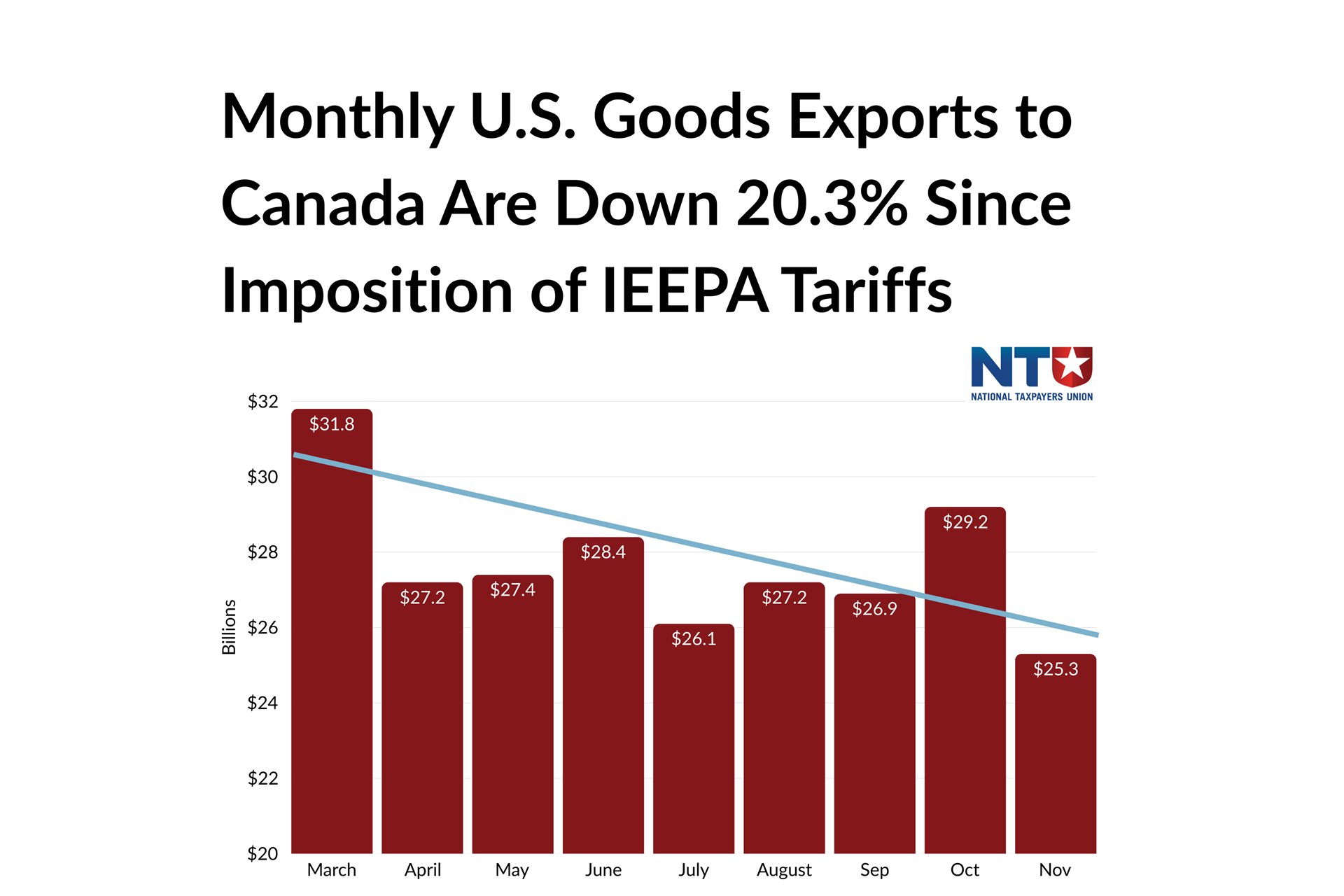
Source: Total exports via dataweb.usitc.gov.
Exports of liquor to Canada from March to November 2025 fell by more than half compared to the same period in 2024.
Tourism from Canada is also down significantly. Return trips to Canada from the United States by car were 30.7% lower in December 2025 than in December 2024. Return trips by air declined by 18.7%.
Florida’s tourism agency estimates that just 507,000 Canadians visited the state during the third quarter of 2025, down from 597,000 in the third quarter of 2024 and the lowest level since the global pandemic. Ski reports and border towns report that visits from Canada are down. Canadian visits to Hawaii have declined by double digits.
A survey of Canadian travelers found that 76% of those whose travel is influenced by U.S. policies cited tariffs and economic policies as a negative influence.
IEEPA tariffs were intended to address the flow of illicit drugs across our northern border. These flows remain low. Fentanyl seizures at the northern border accounted for less than 1% of total fentanyl seizures in Fiscal Year 2025. Total drug seizures by weight at our northern border accounted for less than 3% of all drug seizures.
The legality and constitutionality of IEEPA tariffs is currently under review by the U.S. Supreme Court. National Taxpayers Union Foundation (NTUF) submitted an amicus curiae brief urging the Court to reject the executive branch’s unprecedented use of IEEPA to impose sweeping tariffs.
In the meantime, Congress has an opportunity to act. A precondition of the existing IEEPA tariffs is the declaration of a national emergency by the President. The National Emergencies Act requires that, every six months after a national emergency is declared, Congress shall consider a vote on a privileged joint resolution on whether to terminate the national emergency. In 2025, the House of Representatives repeatedly changed its rules to circumvent this requirement. It has not yet done so for 2026.
As a result, the House may soon vote on H.J. Res. 72, introduced by Rep. Gregory Meeks (D-NY). This resolution would terminate the national emergency underlying IEEPA tariffs on Canada. The Senate passed similar resolutions twice last year, which means a successful House vote would likely lead to the resolution being sent to the President to approve or veto.
A strong show of support for H.J. Res. 72 in the House of Representatives would send a clear message to the Supreme Court, President Trump, the American people, and our ally to the north: Congress does not view trade with Canada as a national emergency.