


Earlier this year, U.S. Trade Representative (USTR) Jamieson Greer bragged about the impact of the Trump Administration’s policies on exports: “If you look at January, February and March of this year, U.S. exports were over $300 billion in each month. Those are the highest figures in 250 years of American history. This doesn’t happen organically. This is something that comes from all the deals that President Trump has been striking.”
Export growth in the first quarter of the year had absolutely nothing to do with the nonreciprocal trade deals the Trump Administration has been striking.
A look at export growth from Q1 2025 to Q1 2026
USTR Greer’s $300 billion-a-month statistic overstates exports because it includes re-exports of goods originating in other countries. Over half of the increase in exports he referred to was accounted for by re-exports of foreign goods.
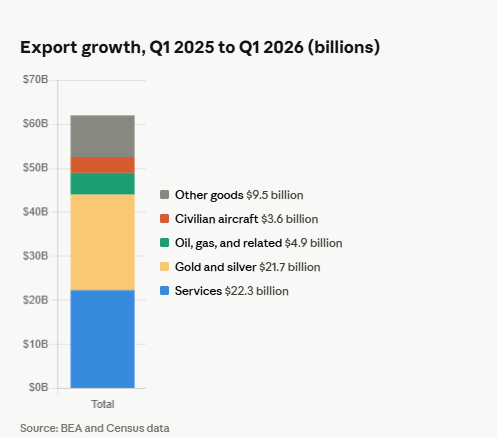
For the remaining U.S.-made goods and services, 85% of export growth occurred in sectors that were unaffected by so-called Agreements on Reciprocal Trade negotiated last year. Specifically:
- Services exports, which were not subject to foreign tariffs, increased by $22 billion. The Trump Administration’s trade agreements have done little to secure new markets for services exports. Instead, USTR failed to secure an extension of the moratorium on the taxation of cross-border digital transmissions that had been in place since 1998, and it neglected to include protections for U.S. digital services providers in its agreement with the European Union.
- Exports of gold and silver increased by nearly 350%, accounting for over half of the overall increase in U.S. goods exports. This massive increase has less to do with U.S. economic strength than with foreign uncertainty about the global economy. Exports of gold and silver to our biggest foreign markets did not face tariffs.
- Energy exports led by oil and natural gas accounted for 7.8% of U.S. export growth. This increase had nothing to do with the Trump Administration’s trade deals, since foreign tariffs on oil, fuel, and coal were already zero.
- Exports of civilian aircraft accounted for 5.8% of U.S. export growth. Most of these exports faced a foreign tariff of zero under the 1980 Agreement on Trade in Civilian Aircraft. Exports increased even after accounting for a 31% drop in exports to China. A May deal between the United States and China included a pledge from China to buy 200 Boeing aircraft. While that is less than the number U.S. producers were anticipating, it does provide hope that the decline in aircraft exports to China resulting from retaliation against U.S. tariffs may subside.
Figure 1: Most export growth in the first quarter of 2026 was unrelated to USTR’s Agreements on Reciprocal Trade
If not due to nonreciprocal trade deals, why did exports increase?
Exports are higher than they were in the first quarter of 2025—or in 2020, 1960, or 1853 for that matter—because economic growth allows us to produce more, and it allows people in other countries to afford more of our products. No one should be surprised that exports have increased as our economy has grown.
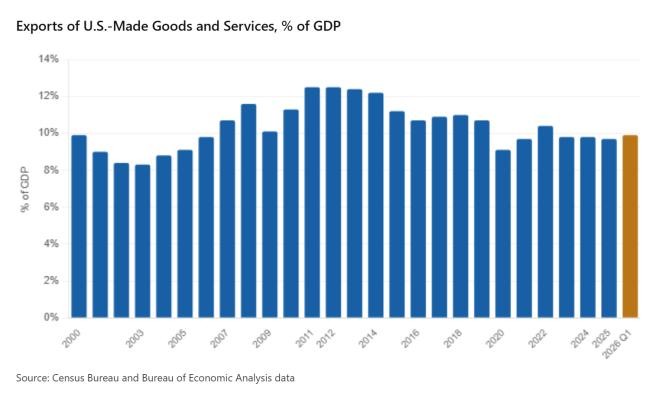
Looking at it from a different perspective, exports as a share of the economy for the first quarter of the year are actually lower than the average for 2000 to 2025—additional context that weakens USTR Greer’s boast about record U.S. exports.
Figure 2: Compared to the size of the U.S. economy, exports for the start of 2026 were unremarkable
A surefire way to boost exports
Exports and imports are closely correlated. Every dollar Americans spend on imports allows our trading partners to spend or invest a dollar in the United States. Since 1976, each dollar in import growth corresponded to an average of 79 cents in new exports. Fewer imports means fewer exports. This conclusion is backed by an April 2026 National Bureau of Economic Research study of U.S. trade policy since 1840 that found every 1 percentage point increase in tariffs led to an average 2% decline in exports.
Figure 3: U.S. policies that reduce import growth reduce export growth
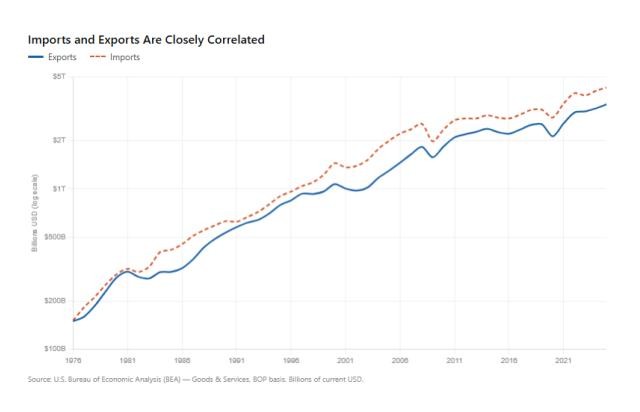
The obvious implication is that a surefire way to boost exports is to reduce barriers to imports. The Trump Administration has, of course, been doing the opposite. The centerpiece of USTR Greer’s historically bad deals are high, nonreciprocal tariffs that make it harder for people in other countries to earn the dollars they need to buy our exports.
USTR and President Trump should remove the biggest barrier to U.S. exports
It’s encouraging to hear Administration like USTR Greer officials talk about exports instead of the trade deficit for a change. Trade deficits are primarily a result of the desire of our trading partners to invest in our economy, and are not a sign of U.S. weakness.
The Trump Administration’s Agreements on Reciprocal Trade are not responsible for export growth. Most of the increase from Q1 2025 to Q1 2026 reflected global demand for gold, long-standing zero-tariff foreign treatment of energy, aircraft, and services, and the simple fact that growing economies trade more. Instead of boosting exports, the double-digit tariffs embedded in every one of these deals will leave our trading partners with fewer dollars to spend on American goods and services, impeding the very U.S. production that the Administration says it wants to encourage.