

The House’s 12 proposed fiscal year 2027 appropriations bills would provide $1.894 trillion in net budget authority, which is $162 billion, or 9.4%, above FY 2026.
The House Appropriations Committee has reported all 12 regular FY 2027 appropriations bills. The House has passed three bills: Agriculture; Military Construction and Veterans Affairs; and National Security, Department of State, and Related Programs.
Gross total new budget authority (before applying offsets from changes in mandatory programs and rescissions) would total $1.925 trillion. That is $134 billion, or 7.5%, above FY 2026.
The spending increase is driven by a $234 billion, or 25.9%, increase to base defense funding. Base non-defense funding would be slightly reduced by $9 billion, or 1.3%.
The FY 2027 House appropriations bills do not extend $66 billion of emergency-designated advance appropriations that were provided by the Infrastructure Investment and Jobs Act and the Bipartisan Safer Communities Act. If Congress renews these programs and provides new emergency-designated appropriations, FY 2027 net budget authority would reach $1.961 trillion, $229 billion, or 13.2%, above FY 2026. Gross total new budget authority would reach $1.991 trillion, $200 billion, or 11.2%, above FY 2026.
The FY 2026 enacted appropriations bills intentionally excluded normal appropriations for Immigration and Customs Enforcement (ICE) and Customs and Border Protection (CBP). The Secure America Act instead provided $69.5 billion in mandatory funding for these border security agencies meant to sufficiently replace base funding through FY 2029. The House FY 2027 Homeland Security bill would provide an additional $10 billion in discretionary funding for ICE and $18 billion for CBP. When combined with the recently provided funding from the reconciliation bill, these appropriations would effectively double the normal annual funding for border security enforcement.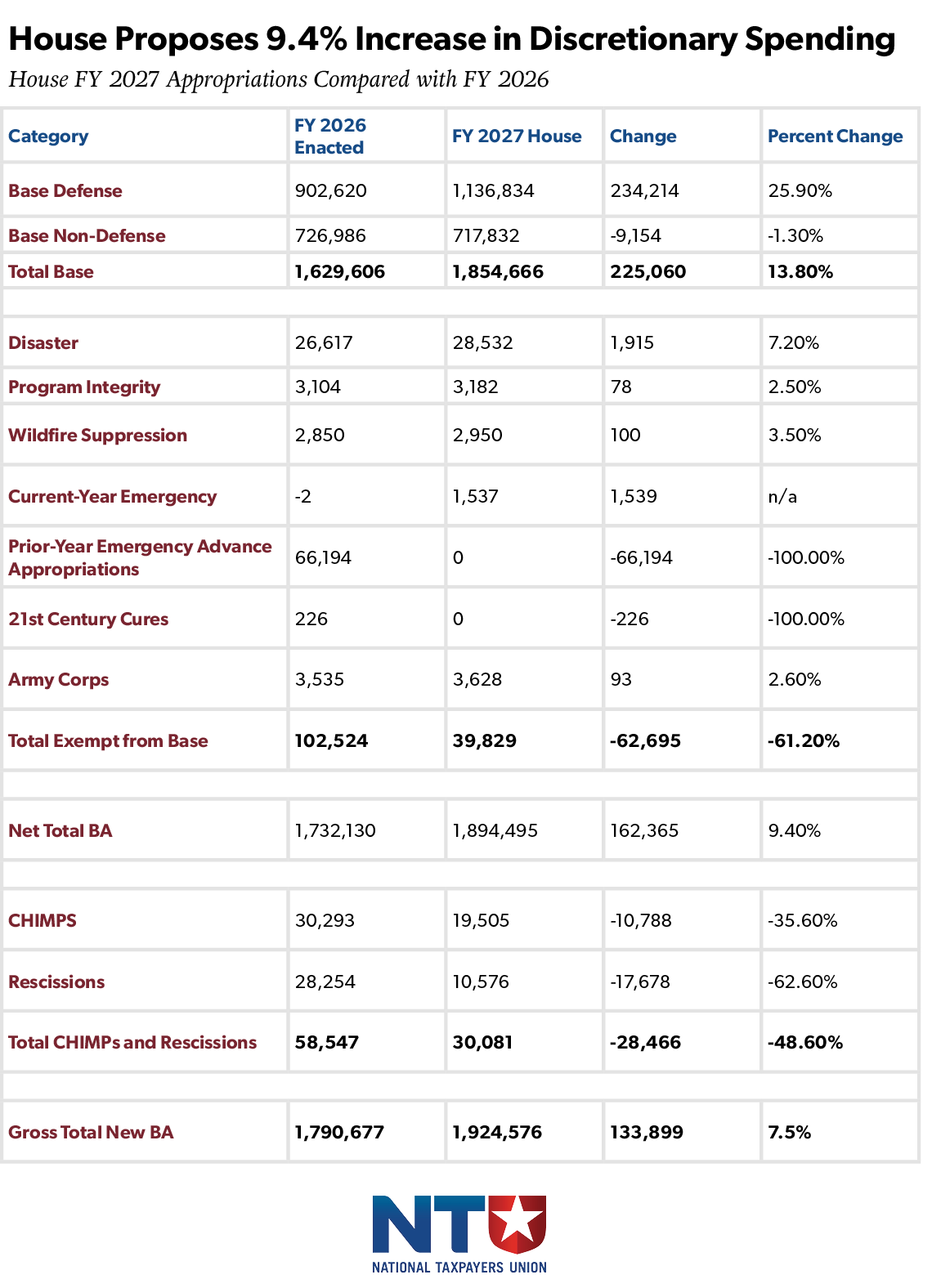
The Senate Appropriations Committee has not released or marked up any of the regular FY 2027 appropriations bills. The Senate has not considered or passed any of the FY 2027 appropriations bills.
To prevent a funding lapse when FY 2027 begins on October 1, the House passed a continuing resolution (CR) on July 21 that would extend current funding through December 4. The Senate has not yet taken action on a CR.
Understanding the Appropriations Categories
Discretionary budget authority is divided into several categories for scorekeeping purposes. The Budget Control Act of 2011 established statutory spending caps on base spending and permitted adjustments for certain purposes. The Fiscal Responsibility Act of 2023 extended caps for FY 2024 and FY 2025.
Although the statutory caps expired after FY 2025, cCongressional budget and appropriations scorekeeping continues to use many of the same categories for budget enforcement.
Below are explanations of the different categories of appropriations used in the table above:
Base funding is the normal annual operating funding for agencies. Base funding is categorized as either defense or non-defense.
Categories of discretionary spending that are exempt from base funding include:
- Disaster funding is for the Federal Emergency Management Agency’s (FEMA) Disaster Relief Fund (DRF). The allowable amount is based on a formula reflecting disaster funding required in recent years.
- Program Integrity includes funding for certain anti-fraud programs, including continuing disability reviews conducted by the Social Security Administration and the Health Care Fraud and Abuse Control Program at the Department of Health and Human Services.
- Wildfire Suppression includes funding for wildfire response efforts at the Department of Agriculture and the Department of the Interior.
- Emergency funding is exempt from budgetary enforcement. Emergency funding is intended to be for an unanticipated situation requiring appropriations “for the prevention or mitigation of, or response to, loss of life or property, or a threat to national security.”
- Prior-Year Emergency Advance Appropriations includes funding provided by the Infrastructure Investment and Jobs Act and the Bipartisan Safer Communities Act. These laws provided certain funding as advance appropriations that were designated as emergency requirements.
- The 21st Century Cures Act specified that certain funding for cancer and other medical research is not to be counted for official budgetary scorekeeping.
- The Coronavirus Aid, Relief, and Economic Security (CARES) Act specified that certain appropriations for the Army Corps of Engineers that are derived from the Harbor Maintenance Trust Fund are not to be counted for official budgetary scorekeeping.
Net Total Budget Authority is the sum of base budget authority and appropriations exempt from base caps listed above.
Appropriations bills often include budgetary gimmicks that act as scorekeeping offsets, while allowing higher discretionary spending levels:
- Under the scorekeeping guidelines, Changes in Mandatory Programs (CHIMPs) included in appropriations bills can be used as gimmicks that look like they reduce mandatory budget authority on paper, but are really meant to increase discretionary spending.
- Rescissions cancel previously appropriated budget authority before it is spent. Rescissions in an appropriations bill can be used to hide spending increases elsewhere in the bill as a gimmick allowing total outlays to increase.
Gross Total New Budget Authority equals the net total new budget authority plus the additional spending allowed by the offsetting CHIMPs and rescissions. The gross total represents the fullest measure of new discretionary spending authority provided to the Executive Branch.
Congress Should Restrain Spending and Demand Transparency
The House FY 2027 appropriations bills would increase net budget authority by $162 billion, driven by a $234 billion increase in base defense funding. The House bills would responsibly reduce base nondefense funding by $9 billion.
The proposed 9.4% increase in net budget authority is more than twice the Congressional Budget Office’s (CBO) projected 4.4% growth in nominal GDP from FY 2026 to FY 2027. Government spending cannot sustainably outpace economic growth over the long term. Higher deficit spending will increase inflationary pressures and put upward pressure on interest rates. Interest costs to service the $39.7 trillion national debt have already risen to the second largest item in the federal budget, exceeding national security, Medicare, and Medicaid.
Congress should carefully review all federal spending to root out waste, fraud, and abuse to put the budget on a sustainable trajectory.
Congress should also insist on much-needed transparency about the cost of appropriations legislation. The CBO does not provide formal cost estimates about appropriations bills, due to a loophole in Section 402 of the Congressional Budget Act. CBO Director Phill Swagel recently testified that “CBO will begin posting detailed reports for the fiscal year 2026 appropriation bills soon after they are enacted.” Unfortunately, the CBO has failed to publicly provide this promised analysis.