


Key Takeaways
• Sales tax exemptions for purchases of raw materials and equipment are a longstanding feature of most state tax codes. While not perfectly applied everywhere, these exemptions for business to business transactions prevent pyramiding of sales taxes during the production process, so that only the final good or service is subject to tax at retail.
• 41 states exempt machinery and other manufacturing equipment from sales tax "by right", meaning no strings attached. (Five states' tax systems do not tax sales at all). By contrast, only two states exempt data center equipment by right.
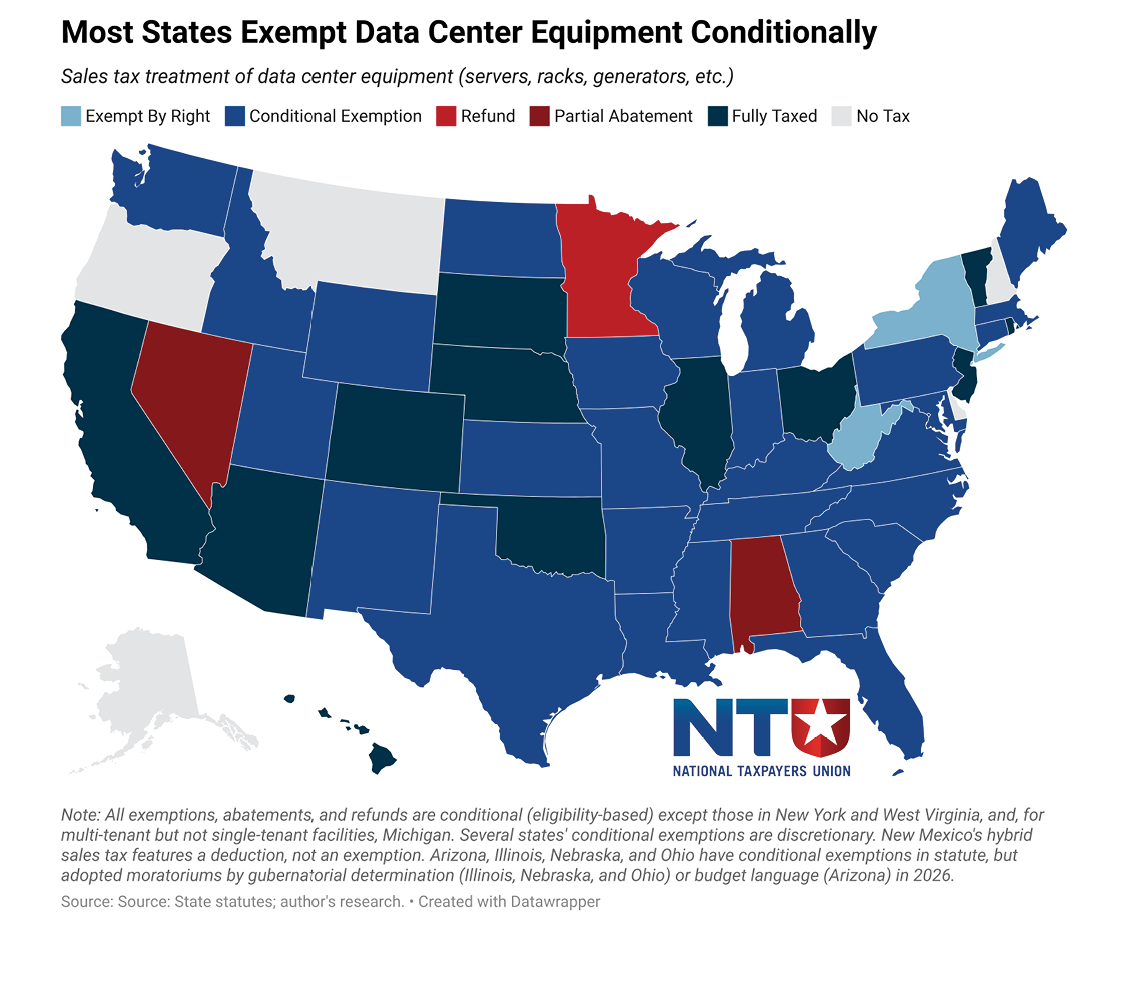
• 33 states provide sales tax exemptions for data center equipment, but those exemptions are conditional or discretionary, often requiring considerable paperwork. Some are even unavailable to new applicants because of moratoriums.
• Not exempting data center equipment purchases from sales tax creates absurd effective tax rates that deter future economically beneficial investment, not only from this area of the tech sector but from other types of business as well.
• Data centers should receive the same sales tax treatment as other industries. Current law in most states already falls short of that aim. But states should avoid policies that impose unique and highly consequential penalties on a single industry.
Foreword
By Pete Sepp, President, National Taxpayers Union
From New York to Nebraska, from Arizona to Virginia, states and localities are enacting laws to repeal, reduce, or pause what they variously call taxpayer subsidies, tax incentives, or tax breaks for data centers. They are making mistakes with generational consequences for their economies and their peoples’ well-being.
Government officials, all too willing to shift blame for longstanding fiscal policy problems of their own creation, portray these moves as rational responses to often-amorphous concerns over energy usage, water consumption, the impact on local services from economic development, and even AI itself.
Some of these concerns have genuinely arisen from affected members of communities; others amount to sound and fury from self-styled activists who oppose change in any form. A few others, as the New York Times recently put it, may amount to “a push by foreign adversaries to seize on what polls have shown is deep ambivalence — verging at times on hostility — about the spread of the data centers needed to power A.I. in the United States and elsewhere.”
Whatever the motivation of these concerns, all of them tend to suffer from one defect: a murky interpretation of business tax policy in general, and business tax policy toward data centers in particular.
Over National Taxpayers Union’s 57-year history, our team members have seen up close and personally what “taxpayer subsidies, tax incentives, and tax breaks” look like. And, in most cases, tax policy toward data centers doesn’t resemble such pejorative terms at all. That’s why NTU is initiating a new project to build an online library on data center tax policy that citizens, business leaders, and government officials alike can access.
In this first of three comprehensive papers, renowned tax expert Jared Walczak explains how the intensifying impulse to yank away sensible tax treatment for purchases of data center equipment will take policy backwards. He notes that, historically, raw materials and machinery that businesses buy for generating goods services are exempt from state and local sales tax, so as to prevent “pyramiding” that will embed costs at each stage of production. Without this key consideration of inputs, or “business to business” transactions, consumers would be paying far more at the cash register than a one-time retail sales tax.
This principle, while not perfectly applied, has largely prevented sales tax pyramiding in our economy. But, as the author recounts, standard “by-right” sales tax treatment taken for granted in other industries did not take hold for data centers, which usually have to claim the exact same exemptions through more complex procedures that depend on government officials’ permission. This in turn has contributed to public misperception of how data centers are taxed, fueling bogus narratives that these facilities are resulting in “revenue losses.” The simple fact is, data centers already face sales tax discrimination in numerous jurisdictions, and recent edicts from governments are making matters worse.
In future publications, NTU will explore complex matters such as business property taxes and their impact on data centers. We will focus on distinguishing rhetoric from reality, and translating the theoretical to the practical, all with the aim of ensuring that, in this critical debate, the voice of informed taxpayers will be heard first, last, and always.
From the smallest rural community whose residents are wondering how their finances will be impacted, to the world stage where the United States is competing for technological leadership, data centers are the central infrastructure in this new Information Age. Getting tax policy right is key to our success, and the proper direction to take is forward, not backward.
Introduction
Virginia adjourned its 2026 regular session without adopting a budget due to a dispute over the state’s sales tax exemption for data centers. In Ohio, the governor has imposed an exemption moratorium. These are just two touchpoints in a debate taking place in state capitals across the country.
Most states exempt data center equipment (including servers, racks, chillers, electrical equipment, and backup generators) from the sales tax. Initially largely uncontroversial, these provisions have come under increasing scrutiny, often characterized as subsidies or framed as costing states revenue. In reality, these exemptions are simply the extension of ordinary sales tax treatment of equipment, which is, for good reason, almost always exempt. These exemptions are not tax preferences. On the contrary, their elimination would represent an economically harmful sales tax distortion.
These misconceptions are rooted in historical contingency. Manufacturing machinery is almost invariably exempt by right. Policymakers have largely recognized that an ideal sales tax falls on final consumption, and, while real-world sales taxes diverge from this ideal, lawmakers have typically agreed that machinery and equipment used in production are outside the scope of a retail sales tax. But the definitions used for machinery and equipment did not apply cleanly to data centers, even though they also use equipment for production. The principles were the same, but statutory definitions had not anticipated high-intensity production of digital rather than tangible goods. By the late 2000s, as data center projects grew in size and significance, states acknowledged the inconsistency and began to exempt servers and other data center equipment much like they exempted equipment producing tangible goods, but with one key difference: they structured the exemptions as incentives.
Traditional manufacturers do not have to commit to a certain level of capital investment, pledge to create a given number of jobs, or meet any other benchmark for their machinery and equipment to be exempt (Nevada is the only exception). These exemptions are considered structural features of the sales tax. But, as demand for data centers grew and states began competing for them, lawmakers made data centers’ sales tax exemptions contingent on meeting eligibility requirements. Large hyperscale data centers can often meet these requirements easily, though they create additional compliance costs. By framing them as an incentive rather than a by-right exemption, however, lawmakers inadvertently signaled that the exemptions represented a tax preference that diverged from the proper sales tax base, when in fact they are a logical and appropriate extension of the principles that define the appropriate sales tax base. A data center server is production equipment, just like metalworking equipment, and should be treated the same way.
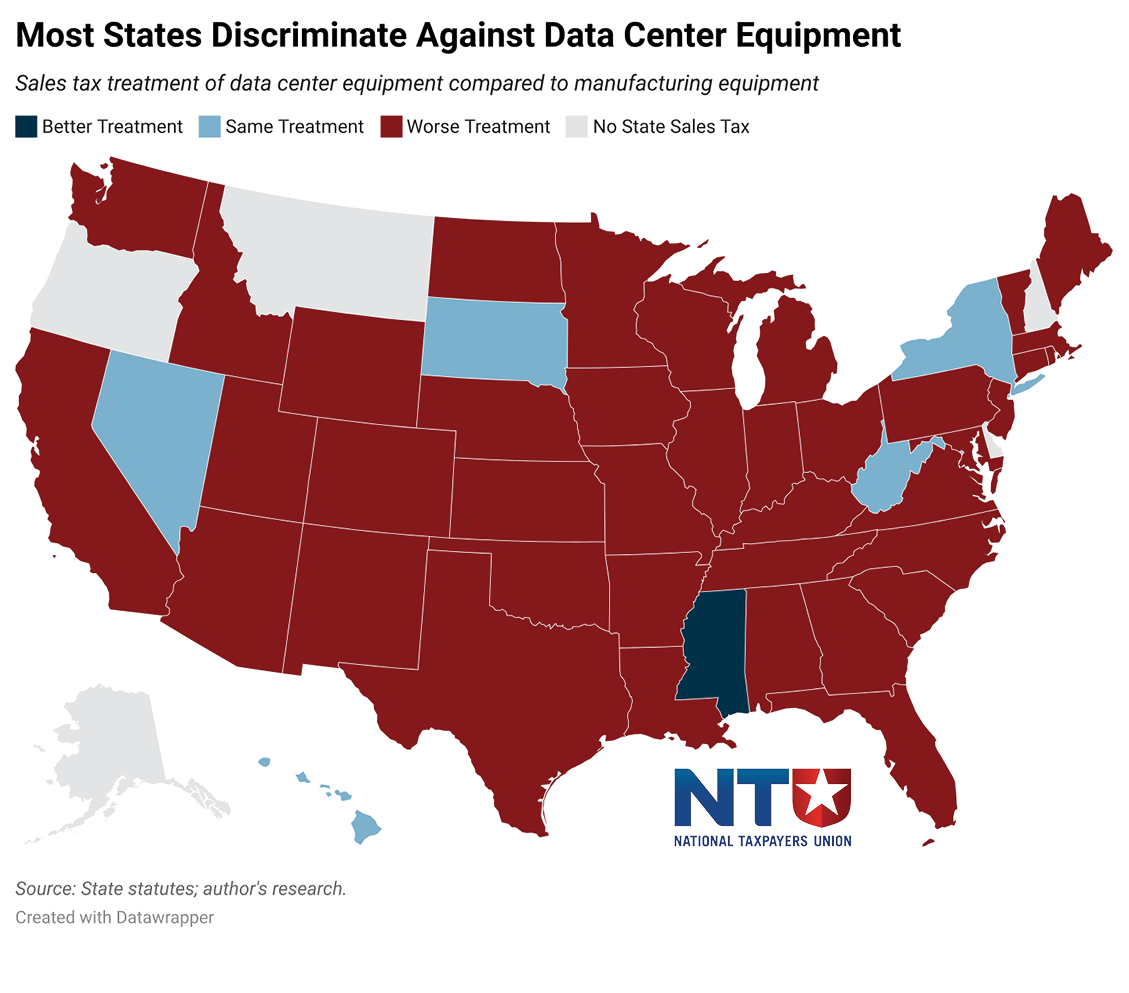
Today, 38 states exempt new data center equipment purchases or forgo a general sales tax, but only two provide a by-right exemption to all data centers. In several states, relief is discretionary or currently unavailable to new applicants under a moratorium. By contrast, 46 states exempt manufacturing machinery by right or forgo a sales tax.
This paper explains why production equipment does not belong in the sales tax base, documents the fact that states consistently follow this principle with by-right exemptions for manufacturing machinery and equipment but typically extend similar treatment to data center equipment through contingent incentives and sometimes on less favorable terms, and explores the economic implications of the new push to impose sales tax on data center equipment.
Data centers should receive the same sales tax treatment as other industries. Current law in most states already falls short of that aim. But states should avoid policies that impose unique and highly consequential penalties on a single industry.
Equipment Exemptions
How Incentive-Based Data Center Exemptions Emerged
Virginia was not the first state to offer incentive-based sales tax exemptions for data centers, but the Commonwealth is widely credited for popularizing the approach.
Northern Virginia was a natural destination for data centers. It offers abundant, affordable water and energy. It boasts a prime geographic location serving the Northeast and, in particular, the federal government in Washington, DC. It is only a few hundred miles from access to undersea cables connecting Europe and South America. And, perhaps most importantly, it benefited from significant network effects.
In 1987, the first commercial internet service provider, UUNET, was founded in Northern Virginia, a logical location given that the internet grew out of a project of the Arlington, Virginia-based Defense Advanced Research Projects Agency (DARPA) and early internet use was highly concentrated in government and academia. Following several mergers and acquisitions, it became the internet backbone of the Northern Virginia-based MCI WorldCom. In 1989, a Vienna, Virginia, company called Quantum Computer Services launched a nationwide computer network called America Online (AOL). And, in the early 1990s, Vienna became home to Metropolitan Area Ethernet (later Metropolitan Area Exchange-East, MAE-East), designated as one of the internet’s first Network Access points.
As AOL grew, it moved its operations to Loudoun County and MAE-East followed. Telecom providers laid high-capacity fiber lines throughout the region to meet demand, which in turn led Equinix to build its first data center nearby. Soon, any company that wanted affordable, low-latency internet connections (telecoms, credit card and other financial transaction networks, internet providers, etc.) sought to colocate in and around Ashburn (in Loudoun County), which established itself as a de facto capital of the internet and earned the moniker “Data Center Alley.”[1]
But, by the late 2000s, something had gone wrong. Virginia was increasingly losing out on data center projects to North Carolina and other states. As data center capital investment became increasingly costly and fiber network growth expanded location options, the industry’s poor tax treatment emerged as a more important factor. Investments flowed to states that abated some of those costs, whether through exemptions, targeted incentives, or lower rates. Suddenly, despite its first-mover advantages, Virginia was losing out to other states.[2]
Virginia lawmakers sought to reverse the tide, and they did so with incentive packages. A sales tax exemption, not previously offered in Virginia, was part of the package.[3] When other states witnessed Virginia’s remarkable success in attracting data centers, they copied the approach—not just the sales tax exemption, but the way it was extended, through incentives. There was an obvious political appeal to this approach, because it involved data center projects entering into memoranda of understanding (MOUs) with the state, allowing officials to point to specific investments their policies had facilitated. Yet these policies were not special favors to the industry. They were, in fact, an additional procedural hurdle required to achieve the same treatment that other industries generally received by right.
Why Exemptions Are Appropriate
The incentive-based availability of data center sales tax exemptions is not ideal, but the exemptions they confer are good policy and align with how the sales tax applies to other industries. The appropriate tax treatment of data centers is the same as that of other industries, as tax policy should be neutral toward investment.
Economists and public finance scholars broadly agree that an ideal sales tax falls exclusively on final consumption and is not imposed on intermediate transactions.[4] As a practical matter, all sales tax bases include at least some business inputs, though most at least avoid taxing raw materials, machinery and equipment used in production, and other “purer” business inputs. In recent decades, computer hardware utilized in the course of business have been recognized by many states’ tax laws as business inputs, and they are also treated as inputs for capital expensing purposes at the federal level. To the extent that business inputs are included in the sales tax base, that portion of the sales tax is converted into a production tax rather than a consumption tax.
Sales taxes on business-to-business purchases yield two harms. First, they lead to tax pyramiding, in which the same final good or service is taxed at multiple stages along the production chain. This means that the sales tax ultimately embedded in the price consumers pay for a final product is substantially higher than the statutory tax rate. The real rate is hidden from view, varies from one product or industry to the next, and encourages economically inefficient choices to limit pyramiding, such as vertically integrating to reduce the number of stages of production subject to tax or shifting activity to other states.
Second, taxes on intermediate rather than final products make a state a worse place to invest. Sales taxes on final consumption have very little effect on businesses’ decisions to locate or invest in a state, because sales taxes are typically destination-based, meaning that they are imposed where a product is purchased or used, not where it is produced. As long as the sales tax falls on final consumption, a business is not at a competitive disadvantage compared to out-of-state rivals when located in a high-sales tax state, because each consumer pays their own state’s sales tax, regardless of which business they patronize. But, when sales tax is imposed on business purchases, it raises production costs, putting businesses in those states at a disadvantage relative to competitors not subject to similar taxation in their own states. It also fundamentally distorts the sales tax, since it taxes transactions that do not represent final sales.
Traditional manufacturers are typically exempt from sales tax on raw materials, machinery, equipment, fuels, and other production components. They and other businesses are mostly, though not perfectly, exempt from taxes on other business services as well, like accounting, marketing, and distribution. Wholesale transactions are likewise exempt. All these exemptions reflect the sales tax’s intended purpose as a retail consumption tax. While sales taxes also feature exemptions made for specific policy or political reasons, the exemptions considered here are not policy preferences. They are just the sales tax functioning as a sales tax. Sales taxes are intended to fall on final consumption, and diverging from that principle imposes a tax on production rather than consumption, and leads to tax pyramiding.
There is no principled reason to apply sales tax to data center equipment when other industries’ equipment is—appropriately—excluded from the sales tax base. Servers and other data center equipment are clearly intermediate transactions. No one buys racks of servers for personal use any more than households buy their own manufacturing machinery. The servers, cooling systems, generators, switchgear, and batteries purchased by data centers are not final consumption. They are capital equipment used to produce something else: data processing, storage, networking, and related services.
Critics sometimes observe that many data center outputs (particularly business purchases of data processing, storage, and cloud services) are likewise outside the sales tax base, suggesting that this justifies business input taxation in this case. But, just as states would not be justified in taxing raw materials because manufacturing machinery, distribution, and wholesale-for-retail sales are exempt, taxing data center equipment cannot be justified because some of its outputs are also components of production chains. This is precisely the sort of tax pyramiding that properly designed sales tax exemptions are meant to avoid.
Modernizing tax bases periodically to encompass evolving patterns of consumer purchases is appropriate; taxing inputs is not. In the case of data centers, it is important to identify who the “final consumer” is, because data centers’ outputs are often utilized by other businesses to create their own products or services offered at retail. In today’s economy, businesses use digital processing and digital automated systems at every stage of the production process, and taxing the inputs to those digital services embeds multiple layers of tax in virtually everything consumers purchase.
And, while some final consumption of digital products is unpriced (e.g., free, ad-supported online services to consumers) and thus not subject to sales tax, this is poor justification for taxing an upstream proxy. The effect is dramatically overbroad, taxing in the wrong place and to the wrong extent, particularly since these free services constitute only a small portion of the output of data services, on the order of about 15%.[5]
That the sales tax does not apply to consumption without a transaction, like free access to an online service, is not a defect to be remedied through aggressive taxation of intermediate transactions any more than it is a defect that the sales tax does not apply to the consumption value of living in one’s own home, doing unpaid household labor, or receiving unpriced banking and credit services.
Data center services are heavily embedded in the production of goods and services on which sales tax is already remitted—and on those that are expressly exempt from sales tax for policy reasons. Most states, for instance, exempt groceries from the sales tax base. Taxing data center equipment, however, embeds the sales tax into the cost of groceries at many stages of the production process.
A grocery chain relies on data center services at every level of its operations. At the store level, cloud-hosted systems process point-of-sale transactions, update inventory as items are sold, accept digital coupons, and manage customer loyalty accounts. At a different level of operations, pricing systems distribute changes across stores, and forecasting systems help ensure that stores have adequate inventory on hand. Beyond that level, digital management systems determine shipments, monitor distribution, handle accounting and payroll, and guide procurement.
The groceries on the shelves, meanwhile, have their own long chain of interaction with modern data systems. A box of breakfast cereal is produced at a facility where data processing stands behind production scheduling, regulatory compliance, supply chain and inventory management, predictive maintenance, packaging, and shipping. The grains are sourced from farms where cloud-based systems are increasingly embedded into agricultural operations, with crop management software connected to modern tractors and harvesters that transmit data on soil quality, irrigation, and crop yield. At countless steps along the way, data processing is deeply integrated into the operations that put a box of cereal—or anything else—on the shelves.
When data center equipment is taxed, each of these operations becomes more expensive, and some of that cost, incurred at each of these many stages, is passed along to consumers. If policymakers do not want a particular final product (such as groceries) to be taxed, that defeats their policy by embedding a hidden sales tax. And, if the final product is subject to sales tax, each prior layer of tax represents duplicative, hidden taxation.
This issue is unique to U.S. state sales tax systems. Consumption taxes in other countries fall only on the additional increment of value (value-added) at each stage of production, ensuring that the price on which the consumption tax is imposed does not exceed the market value of the final good or service. Because sales taxes lack such mechanisms to avoid double taxation, it is important that intermediate transactions be excluded from the sales tax base wherever possible. When a company sells a product to a consumer, that final consumer transaction is appropriately subject to sales tax. Neither the company’s data processing activity nor other components of production should be taxed in addition to that final taxable transaction.
Because data centers are highly capital-intensive businesses, sales tax treatment is an important consideration in location decisions. Data center capital investment often runs into billions of dollars, and servers and networking equipment must be refreshed frequently, yielding significant ongoing capital costs. For a cutting-edge data center, servers are likely to be cycled out within three years. The older servers are typically repurposed for less demanding processing tasks, where they can be used for another two or three years, but their market value in those final years is quite low. By contrast, manufacturing machinery often lasts several decades. State tax policies that penalize data centers and other businesses reliant on innovative, short-lived technology will have a strong deterrent effect on future investment. These policies encourage companies to retain outmoded, less efficient equipment for longer.
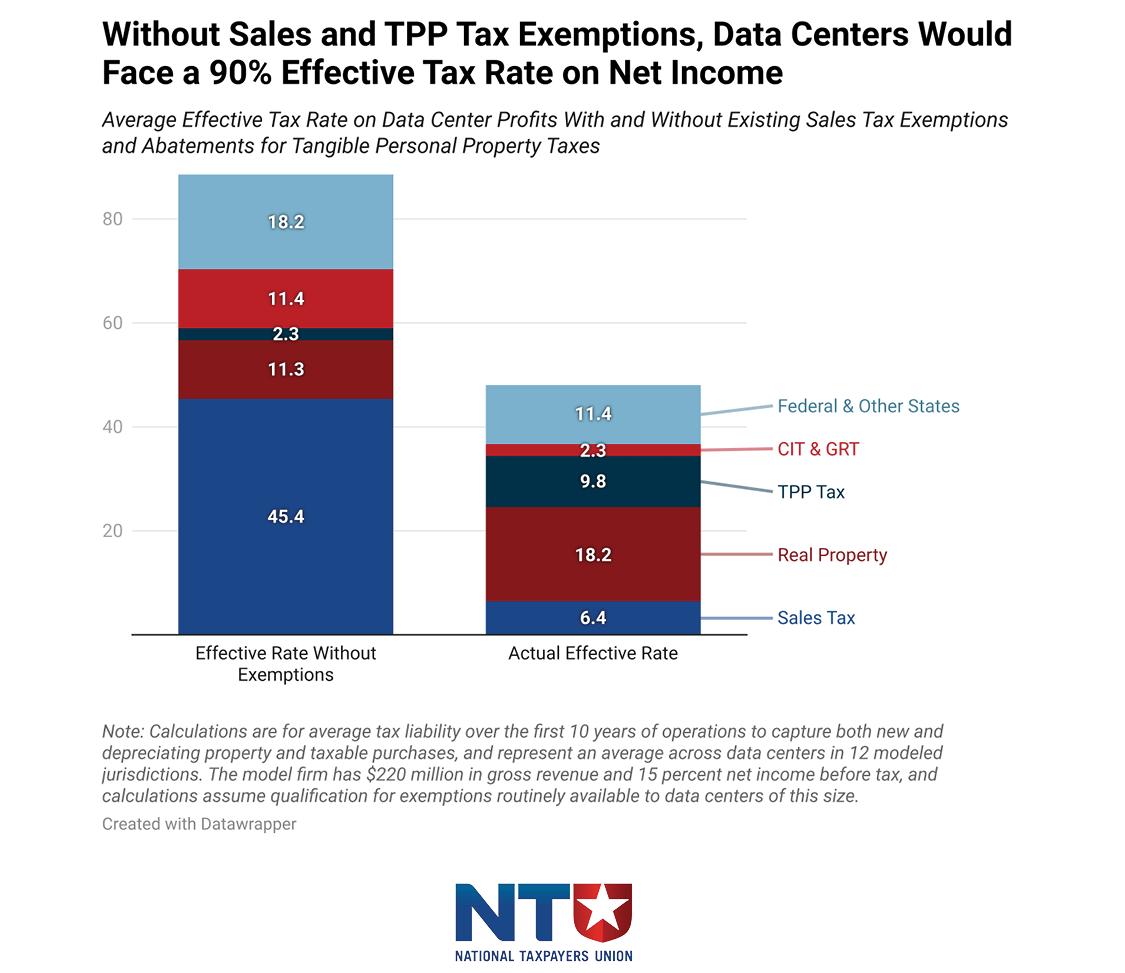
As modeled in a Tax Foundation analysis, a data center with $1 billion in capital investment, $220 million in annual gross revenue, and $33 million in annual profits would pay an estimated $58.3 million in first-year sales tax and an average of $9.7 million each year thereafter, if subject to the average state and local combined sales tax rate on its equipment purchases. Sales tax on refresh costs alone would consume an estimated 29% of pre-sales tax profits, and first-year sales tax costs would consume almost two years of average profitability.[6] Over the first ten years of operations, eliminating sales tax exemptions could yield an estimated effective federal, state, and local tax rate of 88.6% on data center profits.[7] As noted in the Tax Foundation analysis:
One study on the sales taxation of business inputs found that if states were able to reduce their taxation of business inputs by even 25 percent while making up the revenue with a commensurately higher rate applied to the rest of the sales tax base, they would boost capital accumulation (the amount of machinery, equipment, and overall capital investment in the state) by 1.2 percent and increase gross state product by 0.4 percent. Nationwide, that would represent an additional $115 billion a year in economic output. With data centers, the choice may be even starker, as for many operators, it could be a binary choice: invest in a state that taxes these inputs, or in one of the many other viable alternative locations that do not.[8]
The perspective of economists is aptly summed up by Alan Viard, who wrote, “Unsurprisingly, many observers have described sales taxation of business purchases in harsh terms. In 2002 Charles E. McLure Jr. identified the taxation of business purchases as one of many ‘nutty’ features of state and local tax systems. Hellerstein et al. list the taxation of business purchases as a ‘structural flaw’ of state sales taxes . . . David Brunori noted the ‘near unanimity among public finance scholars’ against the practice and nominated it as one contender for the most egregious flaw of state tax systems.”[9]
Critics of data center sales tax exemptions have branded them as subsidies or tax preferences. This is misguided, but unsurprising given how most states have structured their sales tax exemptions. In most states, exemptions for data center equipment are provided through criteria-based incentive programs. Crucially, however, the treatment provided by these exemptions is ordinary treatment. Data centers are not getting special treatment but rather slightly worse treatment, as they must meet eligibility standards to claim an exemption that should be available by right and is available for equipment used in manufacturing, agriculture, and other sectors.
Data centers employ relatively few people directly, though the jobs they create are high-paying jobs. But data center investment is important for communities in other ways. The rapid refresh cycle yields ongoing employment in construction, mechanical, electrical, and other fields. The property tax revenue generated by data centers is significant and can be transformative in many areas, enabling lower property tax rates for residents even as services expand. In Loudoun County, Virginia, for instance, data centers generate almost 45% of county revenue from only 3% of the county’s land area.[10] They require far fewer local government services than the average business yet contribute an outsized share of local tax revenue.
Additionally, multi-tenant facilities are important for regional tech companies. And distortionary, discriminatory taxes on data centers increase costs for businesses and individuals who use digital services (email, cloud storage, streaming, data processing, and more) throughout their business processes and daily lives, while undercutting an industry that is key to U.S. economic growth. Harvard economist Jason Furman estimated that information-processing equipment and software (a category that is broader than just data centers) accounted for 92% of national GDP growth in the first half of 2025.[11]
Finally, while by-right exemptions would be preferable to the incentive-based approaches adopted by many states, most of these incentive programs involve long-term agreements and guarantees that would be abrogated if exemptions were eliminated. By going back on prior assurances, state governments risk scaring away large-scale business investment from other industries as well. Taxing data center equipment is bad policy with real-world consequences.
Sales Tax Treatment of Data Center and Manufacturing Equipment
This paper provides state-level detail on the tax treatment of data center and manufacturing equipment in the top 20 states for data center investment, and a summary analysis for the remaining states, which collectively attract relatively little data center investment. The top 20 states for data centers were identified using the Data Center Map database,[12] which primarily tracks colocation and cloud service providers but also includes hyperscale operators, mapping 4,287 data centers across the U.S. This analysis is based on facility count, not expenditures or capacity.
These data were cross-checked with two analyses based on investment rather than facility count, PwC’s “Economic Contributions of Data Centers in the United States” report (produced for the Data Center Coalition),[13] and the Colliers 2026 “Data Center Marketplace Report,” which reports on 19 key data center markets across 14 states.[14] These three datasets, which use different metrics, yield substantial, though not complete, overlap. Sixteen states make the top 20 ranking on both the PwC and Data Center Map lists, and only one state (Utah) ranks outside the top 20 under one of those lists but appears on the Colliers list as an emerging data center market.
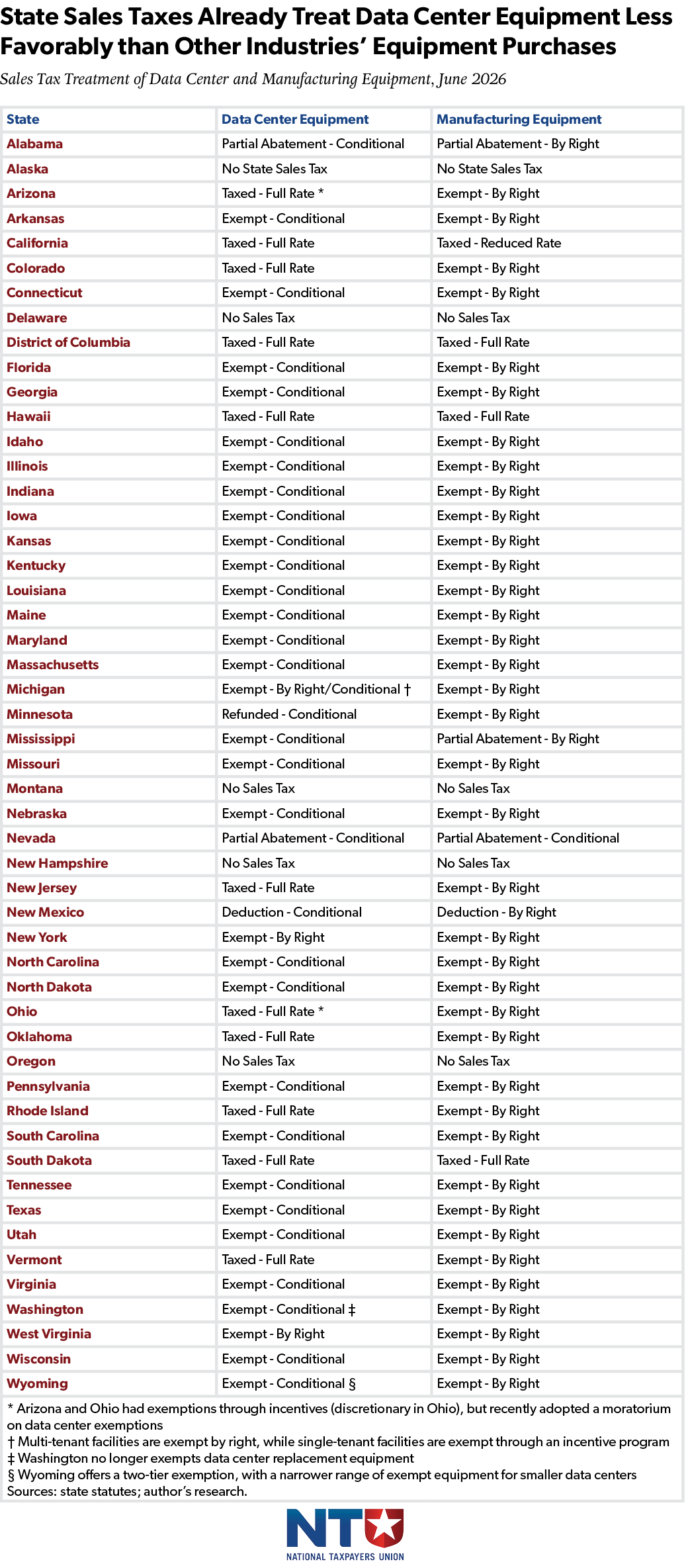
Manufacturing equipment receives a by-right exemption in 41 of the 45 states (plus the District of Columbia) that levy state-level sales taxes, while only two states—the unlikely duo of New York and West Virginia—offer a by-right equipment exemption to all data centers. Michigan also offers a by-right exemption, but only for multi-tenant facilities.
Ten states and the District of Columbia tax data center equipment at the full sales tax rate, counting Arizona and Ohio, which have imposed a temporary moratorium on data center sales tax exemptions. Alabama and Nevada provide partial abatements conditioned on eligibility, and Minnesota offers a conditional refund after the tax is initially paid.
Among sales-taxing states, 39 treat data center equipment worse than manufacturing equipment, 5 states and the District of Columbia treat it identically, and 1 (Mississippi) arguably treats it better, at least initially. With limited exceptions, data centers are already treated unfavorably compared to other industries, though most data center investments qualify for exemptions. Stripping those away would not eliminate a “tax break” but would instead introduce marked discrimination against a particular industry.
Sales Tax Treatment in the Big Seven
Seven states currently dominate the data center landscape. Virginia and Texas are the undisputed top two, with California, Illinois, Georgia, Ohio, and Arizona also hosting a significant share of data center facilities. California, however, despite its historic strength due to Silicon Valley, is rapidly losing ground. According to a Pew Research analysis of proprietary data, California has 11.7% of the Big Seven’s current data centers, but accounts for only 3.7% of the planned future data centers across those states.[15] In fact, California and Indiana (a state well outside the top seven) currently have the same number of planned future data centers, in an indication of California’s slide. Not coincidentally, California is the only state in the top seven that fully taxes data center equipment under the sales tax, though of course this is hardly the only cost driver in the Golden State.
Arizona and Ohio, meanwhile, have been among the fastest-growing markets, but that could change with newly implemented pauses on new data center sales tax exemptions. All other states in the top seven provide by-right exemptions for manufacturing machinery and equipment, but only exempt data center equipment through incentive programs.
Virginia
In Virginia, the equipment of both data centers and traditional manufacturers is exempt from sales tax. For manufacturers, machinery and equipment are exempt by right,[16] and were not analyzed as tax expenditures when the Commonwealth undertook a study of sales tax exemptions from 2007 to 2011.[17] The parallel exemption for data center equipment, however, is structured as a time-limited targeted incentive and has been the subject of intense political debate, particularly in 2026 budget deliberations. Lawmakers ultimately opted to retain the current exemption, but imposed a new tax on data center electricity consumption.[18]
Virginia’s data center incentive, which currently runs through June 30, 2035, offers a sales tax exemption for computer equipment and enabling software, including “servers, routers, connectors, and other enabling hardware” like chillers and backup generators. Eligibility for the incentive requires entering into a memorandum of understanding (MOU) with the Virginia Economic Development Partnership Authority certifying that the project will result in capital investment of at least $150 million and create at least 50 new jobs, with reduced thresholds for investment in distressed localities. MOUs also specify repayment obligations if these thresholds are not met. Both single- and multi-tenant data centers are eligible.[19]
An impasse over the exemption was one of the primary reasons why Virginia’s legislature adjourned its 2026 regular session without a budget, with House Democrats committed to retaining the exemption while Senate Democrats sought its elimination.[20] Virginia’s robust data center industry has roots in the Ashburn area’s importance in the early days of the internet, and the exemption, which lawmakers committed to in 2010, was meant to provide assurances at least through 2035. Because data centers must regularly refresh servers, networking equipment, and other components, the budget debate raised the prospect that large-scale capital investments undertaken with the assurance that sales tax would not apply to server replacements would face dramatically higher costs—a prospect now postponed, but not eliminated.
Texas
Texas exempts both manufacturing and data center equipment from state-level sales tax—manufacturing equipment by right, and data center equipment through a certified incentive. Manufacturing machinery and equipment is also exempt from local sales tax, whereas data center equipment is only exempt at the local level if the project qualifies as a “large data center project.” Both the state-level and state-and-local exemptions, moreover, are only available to single-tenant data centers, not multi-tenant (colocation) facilities, and the exemptions are time-limited.
To qualify for the state-level sales tax exemption, a data center must have at least 100,000 square feet in a single building operated by a single tenant, and the operator must commit to $200 million in capital investment and the creation of at least 20 qualifying jobs that pay at least 120% of the county average weekly wage, among other requirements. The exemption lasts 10 years, increased to 15 years if capital investment exceeds $250 million over the first five years.[21] Large data center projects, involving at least $500 million in capital investment, 250,000 square feet of floor space, 40 qualifying jobs, and at least 20 megawatts of transmission capacity receive both state and local sales tax exemptions for 20 years.[22]
Texas’s exclusion of multi-tenant facilities is notable, as is the limit on the duration of the sales tax exemptions, which accentuates the distinction between the state’s incentive-based exemption for data center equipment and its by-right exemption of traditional manufacturing equipment. Data center servers, storage, GPUs, and networking equipment have short asset lives and must be replaced every few years, whereas the shell (the building itself) and other equipment and fixtures can last decades. Particularly under the 10-year exemption for smaller data centers, investor-operators know that future cycles of server replacement will be subject to state sales tax, exposing them to unusually high tax costs they may not bear elsewhere.
By contrast, Texas has a broad state and local sales tax exemption for property used in manufacturing, with no eligibility restrictions or time limits.[23] Media coverage in Texas has often called the data center exemption a “tax break” and one of the state’s “costliest incentive programs.” Critics claim the state will “lose out” on more than a billion dollars in revenue each year,[24] highlighting the degree to which the exemption’s eligibility requirements—which make it more restrictive than exemptions for other industries—cause it to be treated as a tax break rather than ordinary treatment under a retail sales tax. The exemption for property used in manufacturing amounts to $11.5 billion per year[25] but (rightly) faces no opposition, because it is widely understood that machinery, equipment, and materials used to manufacture a final product do not belong in the sales tax base.
California
California provides no exemption whatsoever for data center equipment, which is taxed at full state and local sales tax rates. Manufacturing machinery and equipment is also taxed, albeit at a reduced rate, and full exclusion is available under a competitive incentive program for advanced manufacturing and clean energy projects. Manufacturing equipment that does not qualify for the incentive is taxed at a reduced state rate of 3.3125%,[26] whereas data center equipment is taxed at the full rate of 7.25%. Additionally, local sales tax applies to both data centers and traditional manufacturers.
The California approach is highly anomalous. Few states include manufacturing machinery and equipment in the sales tax base, even at a reduced rate. Additionally, most states provide an exemption for data center equipment, even if mediated through a targeted incentive program. Only ten states and the District of Columbia lack such an exemption (including Arizona and Ohio, where temporary moratoriums are in place), and California is one of only two, with New Jersey, to make the top 20 states for data center investment without an exemption.
California’s success in attracting data center investment despite its poor treatment of servers and other data center equipment is entirely about proximity to Silicon Valley. It is notable, however, that even during the AI boom, California remains dramatically behind Virginia and Texas in data center locations, and only moderately above states like Arizona, Georgia, Illinois, and Ohio. The Golden State can retain some data center investment because it is California, and its overall rank—based on total data center facility counts—is also enhanced by the state’s sheer size, but despite its built-in advantages, California is losing ground to smaller but more competitive states.
Illinois
Like most states, Illinois exempts both data center and manufacturing equipment from the sales tax. But, as is often the case, the exemption for manufacturing machinery and equipment is available by right, whereas data centers only obtain the sales tax exemption through an incentive program administered by the state’s Department of Commerce and Economic Opportunity. To be eligible for the exemption, a data center and its tenants must collectively make a capital investment of at least $250 million over five years, create at least 20 full-time-equivalent jobs with total compensation at or above 120% of the median county wage, and the data center must be carbon neutral or achieve a designated green building standard certification (like ENERGY STAR, BREEAM, or LEED certification). The exemption duration is set in an MOU and cannot exceed 20 years.[27]
No similar requirements are imposed on traditional manufacturing. Additionally, as a condition of the exemption, data centers must enter into a project labor agreement that attaches additional labor rules and requirements not ordinarily imposed on a private-sector project.[28] Illinois sales and use tax is, unusually, divided into four distinct but interrelated taxes, and both the manufacturing exemption and the data center incentive-driven exemption apply against all four components of the sales tax.[29]
Georgia
Georgia follows the persistent pattern of exempting manufacturing machinery and equipment by right, with a built-in statutory exemption,[30] while exempting data center equipment through a certified incentive. The data center exemption is available subject to certification by the Georgia Department of Economic Development and has different eligibility conditions based on the population of the county in which a data center is located.
For counties with a population over 50,000, the incentive is available to data centers with $250 million in aggregate expenditures that create at least 25 new jobs paying at least 110% of the county average wage. A $25 million capital investment is sufficient to secure the High-Technology Data Center Equipment Exemption for facilities located in the smallest counties. Recently, moreover, the legislature required data centers to pay 10% of the otherwise applicable sales tax on the $15 million of equipment purchases each year.[31] The current exemption sunsets at the end of 2031.[32] In the current environment, where data center exemptions have become more fraught, the looming sunset of the existing exemption could factor into siting decisions for what has, to date, been a highly attractive market for data center investment.
Ohio
In Ohio, data center equipment is only exempt from sales tax by negotiated agreement,[33] whereas manufacturing machinery and equipment is exempt by right.[34] While state statutes establish minimum requirements for the Ohio Tax Credit Authority to approve a complete or partial exemption for data center server and other equipment purchases, approval is discretionary. On May 27, 2026, Governor Mike DeWine announced that he had directed the chair of the Ohio Tax Credit Authority not to consider any new data center tax exemption requests until the Ohio General Assembly’s Joint Data Center Committee studies the growth of data centers in the state.[35]
Minimum eligibility requirements for the data center sales tax exemption include $100 million in investment over a three-year period and annual compensation of at least $1.5 million, with the exemption percentage—either full or partial exemptions are possible—and the duration negotiated in an agreement with the Tax Credit Authority.[36] The final projects approved before the current moratorium involved a 50%, 10-year sales tax exemption.
The moratorium comes amid complaints from lawmakers that sales tax exemptions now total about $1.6 billion, nearly 12 times the initial estimates made before Ohio began attracting robust data center investment.[37] Lawmakers appear to view this as a budgetary cost and see higher-than-expected investment as incurring additional costs. This contrasts sharply with the (appropriate) business-as-usual approach to the by-right exemption for manufacturing machinery and equipment.
Some tax incentives carry a budgetary cost. Tax credits for job creation, for instance, reduce tax collections from their ordinary level, and refundable credits can not just eliminate liability for some taxpayers, but dip into the budget for additional spending. That is not how sales tax exemptions work. Data centers expanding faster than expected have not “cost” Ohio any revenue. Meanwhile, Ohio’s revenues and budgets have continued to grow. The state’s general fund has grown from $34.19 billion in FY 2021 to an estimated $46.57 billion in FY 2027.[38]
Arizona
Arizona’s transaction privilege tax (the state’s near-equivalent of a sales tax) provides a full statutory exemption for manufacturing machinery and equipment,[39] while data center servers and equipment have only enjoyed an exemption under a specific incentive that requires a minimum investment of $50 million over the first five years in its two largest counties, or $25 million in other counties. Exemptions were to be approved by the Arizona Commerce Authority, and no new exemptions were to be certified after December 31, 2033.[40]
On June 13, 2026, Governor Katie Hobbs signed a budget containing a three-year moratorium on the issuance of new data center incentives, imposing the sales tax on equipment purchases by new data center facilities.[41]
Sales Tax Treatment in Other Competitive States
Florida
Florida exempts manufacturing machinery and equipment from the sales tax by right.[42] While similar exemptions for data center servers and IT property are conditional, the legislature recently increased eligibility thresholds substantially. The exemption previously required $150 million in capital investment and 15 MW of critical IT load (defined as electric power capacity reserved solely for operating server equipment, not cooling or other ancillary electric utility use), but, as of August 2025, the IT load requirement was raised to 100 MW, applying only to large data centers. For multi-tenant data centers, the 100 MW total must be achieved by dedicating at least 1 MW to each individual owner or tenant.[43] Florida’s system is unusual because it uses critical IT load as a proxy for the size of the operation, implicitly favoring higher energy consumption.
Indiana
In Indiana, data center sales tax exemptions require a minimum qualified investment that varies by county population, ranging from $25 million in the smallest counties to $150 million in large counties.[44] Legislation was proposed in 2026 to repeal the exemption to fund sales tax exemptions for residential utilities, but the bill did not advance.[45] The state exempts manufacturing machinery and equipment by right.[46]
Iowa
Iowa fully exempts manufacturing machinery and equipment from the sales tax by right,[47] and eliminates liability for data center machinery and equipment through a targeted incentive for data centers with capital investment of at least $200 million over the first six years and a footprint of at least 5,000 square feet.[48]
Michigan
Michigan provides a by-right exemption for the servers and equipment of multi-tenant (colocation) data centers that generate at least 75% of their revenue from unaffiliated businesses, and recently adopted an incentive-based exemption for single-tenant (enterprise) data centers.[49] The by-right exemption incorporated two potential sunsets if the industry failed to meet statewide employment targets, but is now set to run through 2050.
The certified exemption requires at least $250 million in capital investment, creation of 30 qualified full-time jobs of at least 150% of the regional median wage, green building certifications and clean energy procurement requirements, and other conditions. At present, no new certificates may be issued after 2029, though data centers with an exemption can maintain them—subject to continued eligibility—through the 2050 program sunset date.[50] Manufacturing machinery and equipment in Michigan enjoys a by-right exemption through the industrial processing exemption.[51]
Minnesota
Minnesota exempts manufacturing machinery and equipment by right,[52] but only exempts data center equipment through a refund mechanism. To be eligible, data centers must have at least 25,000 square feet of building space, invest $30 million or more in “enterprise information technology equipment” and computer software within four years, and meet other requirements. Large-scale data centers with at least $250 million in capital investment that pay prevailing wages to construction workers and mechanics and attain certification under sustainable design or green building standards can obtain an exemption rather than a refund. If the Department of Employment and Economic Development later determines that sustainability standards were not maintained, the exempted sales tax must be repaid.[53]
Missouri
Missouri offers a data center-specific incentive-based exemption for approved data center projects, based on investing at least $25 million and creating at least 10 new jobs paying at least 150% of the county average wage.[54] By contrast, manufacturing machinery and equipment are exempt by right.[55]
Nevada
Nevada provides a discretionary partial abatement for both data center equipment and traditional manufacturing machinery and equipment. The duration of the abatement depends on the size of the investment: at $25 million in capital expenditures and 10 full-time resident employees paid at least the average statewide wage, the partial abatement can run up to 10 years. By meeting additional conditions, including $100 million in capital investment, at least 50 full-time resident employees, a paid family and medical leave program, and a construction workforce consisting of at least 50% Nevada residents, the abatement can run up to 20 years.[56]
The rate cannot be reduced below 2%. The lowest rate is fully discretionary, requiring a two-thirds approval vote by the Governor’s Office of Economic Development (GOED) board. If a data center meets all requirements but does not receive GOED approval, the abatement yields a 4.6% rate.
Nevada is among the rare states where data centers and traditional manufacturing are at least nominally on equal footing,[57] though (1) this is achieved by improperly taxing manufacturing machinery and equipment, not extending a by-right exemption to data centers; and (2) the discretionary, board-determined nature of exemptions may not yield equal treatment across industries in practice.
New Jersey
New Jersey is the only state other than California to make the top 20 states for data center investment without an exemption for data center equipment. Servers, chillers, power equipment, and the like are all subject to sales tax, whereas manufacturing machinery and equipment are statutorily exempt.[58] That an industry presence persists is a testament to the state’s geographic significance, with data centers providing ultra-low-latency service to Wall Street and boasting direct access to transatlantic subsea cables. In 2024, the state also authorized substantial incentives under a $500 million transferable tax credit program for hyperscale AI operations, though the program is currently on hold, with no new applications being accepted.[59]
New York
New York exempts both data center and manufacturing machinery and equipment by right. The state includes tangible personal property sold to data centers as a subset of the broader machinery and equipment subject to the standard statutory exemption.[60] On July 14, New York imposed a one-year moratorium on the construction of new large data centers, though this does not affect the tax treatment of existing data centers.[61]
North Carolina
North Carolina exempts data center equipment for qualifying data centers, defined as those investing at least $75 million over five years and meeting applicable county wage and benefit standards.[62] Manufacturing machinery and equipment enjoy a by-right exemption.[63]
Oregon
Oregon does not impose a general sales tax.
Pennsylvania
In Pennsylvania, manufacturing machinery and equipment are exempt by right,[64] while data center equipment is exempt based on meeting investment and job creation targets that are tiered by county population, with investments in counties with a population over 250,000 requiring at least $100 million in new investment and the creation of 45 new full-time jobs, and $75 million and 25 jobs in smaller counties. The incentive currently provides an exemption, but was originally designed as a sales tax refund. The exemption is available for 25 years, or for 10 years for eligible tenants of colocation facilities.[65]
Washington
Washington exempts eligible new data center server and power infrastructure equipment subject to meeting employment and square footage requirements,[66] but, under legislation enacted in 2026, server replacement and equipment refurbishment for existing data centers are no longer exempt.[67] This significantly disadvantages existing data centers, which invested based on an understanding that the sales tax exemption lasted through at least June 30, 2048. Data centers are required to submit an annual tax performance report. The state provides a built-in statutory exemption for manufacturing machinery and equipment.[68]
Sales Tax Treatment in All Other States
Among the remaining states, twenty-three either provide an exemption or forgo a sales tax altogether. West Virginia provides the exemption by right, while other states structure the exemptions as incentives.[69] In New Mexico, which imposes a modified sales/gross receipts tax, the incentive is structured as a deduction rather than an exemption. Wyoming offers a two-tier exemption: only computer equipment and software are exempt for smaller data centers, while larger data center investments are also exempt on backup generators, HVAC, battery backups, and other equipment.[70]
Colorado, Hawaii, Oklahoma, Rhode Island, South Dakota, Vermont, and the District of Columbia impose sales tax on data center equipment, with no standard exemption either by right or through a widely available data center incentive, though some data center investments may still be eligible for other investment incentives. Of these, Hawaii, South Dakota, and the District of Columbia also deny exemptions to manufacturing machinery and equipment. Alabama offers a negotiated partial abatement for data center equipment, and taxes manufacturing machinery at a reduced 1.5% rate.
Mississippi, meanwhile, has a reduced 1.5% rate for manufacturing machinery and equipment, while eligible data center investment yields a full incentive-based exemption for 10 years. This makes Mississippi the only state where “typical” treatment of data center equipment purchases is more favorable than for manufacturing equipment, but, even here, Mississippi’s data center exemption is conditional and short-lived, whereas the reduced rate for manufacturing machinery and equipment is unconditional and permanent.
Outside California and New Jersey, Colorado is the only other state without a data center sales tax exemption that still attracts appreciable data center investment. It ranks outside the top 20 in our primary ranking source, but makes the PwC and Colliers list based on data centers scattered across the Front Range. Denver and Colorado Springs are sufficiently large and regionally important to support some data center investment, though the state’s tax disadvantages, along with resource and energy constraints, lead it to underperform regionally.
Conclusion
States overwhelmingly provide by-right sales tax exemptions for manufacturing equipment, but typically only provide parallel treatment to data centers through conditional incentives. This framing has led many to treat data centers’ equipment sales tax exemptions as a tax preference, when in fact these policies represent a slightly worse way to enshrine ordinary, appropriate treatment of data centers’ business inputs. Such treatment aligns with exemptions for equipment in other industries.
Until recently, exemptions for data center equipment have been broadly available. That may be changing. Denying exemptions to data centers deprives communities of local tax revenue and economic investment and growth. It also repudiates an important principle of sales taxation and reflects a change in thinking about what the sales tax is. No state’s sales tax wholly avoids taxing intermediate transactions for any industry, but machinery and equipment used in production have long been regarded as clearly outside the sales tax base.
States should uphold those exemptions rather than opening the door to denying them on an industry-by-industry basis. Ideally, they would convert conditional exemptions into by-right exemptions, but, at a minimum, they should honor existing MOUs and maintain policies that largely exempt equipment purchases in this highly competitive and highly tax-sensitive industry.
[1] See, e.g., Jonathan Hunley, “The Legacy of AOL,” Ashburn Magazine, Dec. 11, 2023, https://www.ashburnmagazine.com/features/the-legacy-of-aol-a-look-back-at-the-companys-impact-locally/; Peter Judge, “Upgrading the Birthplace of the Commercial Internet,” Data Center Dynamics, March 29, 2019, https://www.datacenterdynamics.com/en/analysis/upgrading-birthplace-commercial-internet/; Laurie Flynn, “A Quantum Leap on the Internet,” New York Times, Feb. 5, 1995.
[2] Virginia Joint Legislative Audit and Review Commission (JLARC), “Data Center and Manufacturing Incentives,” Economic Development Incentives Evaluation Series, JLARC Report 18, 3, https://jlarc.virginia.gov/pdfs/reports/Rpt518-1.pdf.
[3] H.B. 1388, Gen. Assemb., Reg. Sess. (Va. 2008); H.B. 302, Gen. Assemb., Reg. Sess. (Va. 2010).
[4] Peter A. Diamond and James A. Mirrlees, “Optimal Taxation and Public Production I: Production Efficiency,” The American Economic Review 61:1 (March 1971): 8-27; Charles E. McLure Jr., “Rethinking State and Local Reliance on the Retail Sales Tax: Should We Fix the Sales Tax or Discard It?,” BYU Law Review 2000:1 (Mar. 1, 2000): 77; John Mikesell, “A Quality Index for State Sales Tax Structure – Measuring the States Against an Ideal Standard,” Tax Notes State, Jan. 26, 2005.
[5] No precise estimate exists, but it is possible to infer one based on the share of network traffic associated with advertising, with commonly ad-supported services like search and social media, or with different aspects of non-enterprise cloud computing. Each approach yields estimates of about 10%, but each is under-inclusive. An assumption of 15% is reasonable based on available data, but it lacks precision. See M. Pärssinen, M. Kotila, R. Cuevas, A. Phansalkar, and J. Manner, “Environmental impact assessment of online advertising,” Environmental Impact Assessment Review 73 (2018): 177-200; NGLC Research, “Inside the Black Box: Who Actually Uses U.S. Data Centers, and How Much Power Does Each Use Case Consume?”, April 7, 2026, https://nextgenlandco.com/research/data-center-power-consumption-by-workload/; Cisco, “Cloud Service Adoption Creates New Data Center Demands,” Feb. 5, 2018, https://investor.cisco.com/news/news-details/2018/Global-Cloud-Index-Projects-Cloud-Traffic-to-Represent-95-Percent-of-Total-Data-Center-Traffic-by-2021/default.aspx;
[6] Jared Walczak, “State Taxation of Data Centers,” Tax Foundation, Dec. 19, 2025, https://taxfoundation.org/research/all/state/data-centers-taxation/.
[7] Id., “Data Centers Are Heavily Taxed. How Much is Too Much?” The SALT Road, Dec. 29, 2025, https://thesaltroad.net/p/data-centers-are-heavily-taxed-how.
[8] Id., “State Taxation of Data Centers.”
[9] Alan D. Viard, “Sales Taxation of Business Purchases: A Tax Policy Distortion,” State Tax Notes 56:12 (June 21, 2010): 970, https://papers.ssrn.com/sol3/papers.cfm?abstract_id=2218678.
[10] Judge Glock, “The Surprising Heart of the Data-Center Boom,” City Journal, Spring 2026, https://www.city-journal.org/article/loudoun-county-virginia-data-centers-construction.
[11] Nick Lichtenberg, “Without Data Centers, GDP Growth Was 0.1% in the First Half of 2025, Harvard Economist Says,” Fortune, Oct. 7, 2025, https://fortune.com/2025/10/07/data-centers-gdp-growth-zero-first-half-2025-jason-furman-harvard-economist/.
[12] “USA Data Centers,” Data Center Map, https://www.datacentermap.com/usa/, count as of June 2026.
[13] PwC, “Economic Contributions of Data Centers in the United States, 2023-2024,” May 2026, https://www.centerofyourdigitalworld.org/2026-impact-study.
[14] Raul Saavedra and Steig Seaward, “2026 Data Center Marketplace Report,” Colliers, March 25, 2026, https://www.colliers.com/en/research/nrep-usdc-data-center-marketplace-2026.
[15] Skyler Seets and Kaitlyn Radde, “Most New Data Centers in the U.S. Are Coming to Rural Areas,” Pew Research Center, April 13, 2026, https://www.pewresearch.org/short-reads/2026/04/13/most-new-data-centers-in-the-us-are-coming-to-rural-areas/.
[16] VA Code Ann. § 58.1-609.3(2).
[17] Virginia Department of Taxation, “Sales and Use Tax Expenditure Study,” Nov. 23, 2011, https://www.tax.virginia.gov/sales-and-use-tax-expenditure-study.
[18] Kelly R. Taylor, “Virginia Approves First-of-Its-Kind Data Center Power Tax,” Government Technology, July 8, 2026, https://www.govtech.com/artificial-intelligence/virginia-approves-first-of-its-kind-data-center-power-tax.
[19] VA Code Ann. § 58.1-609.3(18).
[20] Markus Schmidt, “Virginia Lawmakers Are Set to Return to Richmond as Budget Deadline Nears,” Virginia Mercury, June 1, 2026, https://virginiamercury.com/2026/06/01/virginia-lawmakers-are-set-to-return-to-richmond-as-budget-deadline-nears/.
[21] V.T.C.A., Tax Code § 151.359.
[22] V.T.C.A., Tax Code § 151.3595.
[23] V.T.C.A., Tax Code § 151.318.
[24] Paul Cobler, “Texas is Giving Data Centers More than $1 Billion in Tax Breaks Each Year,” The Texas Tribune, April 8, 2026, https://www.texastribune.org/2026/04/08/texas-data-centers-sales-tax-break-billion-dollars/.
[25] Texas Comptroller of Public Accounts, “Tax Exemption and Tax Incidence Report,” January 17, 2025, https://comptroller.texas.gov/transparency/reports/tax-exemptions-and-incidence/2025/96-463.pdf, 4.
[26] CA REV & TAX § 6377.1.
[27] 20 ILCS 605/605-1025.
[28] 14 Ill. Adm. Code 521.20.
[29] These four taxes, which collectively form the state’s sales and use tax system, are the retailers’ occupation tax, the use tax, the service occupation tax, and the service use tax.
[30] Ga. Code Ann., § 48-8-3.2.
[31] For classification purposes, we have chosen to treat this as a conditional exemption rather than a partial abatement, since the amount owed is capped, but the exemption is not complete.
[32] Ga. Code Ann., § 48-8-3(68.1).
[33] R.C. § 122.175.
[34] R.C. § 5739.02(B)(42)(g).
[35] Governor of Ohio, “Governor DeWine Announces Pause of Data Center Tax Exemption,” May 27, 2026, https://governor.ohio.gov/media/news-and-media/governor-dewine-announces-pause-of-data-center-tax-exemption.
[36] R.C. § 122.175.
[37] Samantha Hendrickson, “Ohio Oks Last Data Center Sales Tax Break Before DeWine’s Pause Begins,” The Columbus Dispatch, June 1, 2026, https://www.dispatch.com/story/marketplace/jobs/2026/06/01/central-ohio-cologix-data-center-gets-last-of-sales-tax-breaks-before-pause/90358842007/.
[38] Legislative Budget Office of the Legislative Services Commission, “Main Operating Budget House Bill 96 – As Enacted: Budget in Brief,” 2026, https://www.lsc.ohio.gov/assets/legislation/136/hb96/en0/files/hb96-budget-in-brief-as-enacted-136th-general-assembly.pdf; Ohio Office of Budget and Management, “The State of Ohio Executive Budget Fiscal Years 2022-2023: Budget Highlights,” 2022, https://archives.obm.ohio.gov/Files/Budget_and_Planning/Operating_Budget/Fiscal_Years_2022-2023/ExecutiveBudget/Book3_BudgetHighlights/BudgetHighlights_FY2022-2023.pdf.
[39] A.R.S. § 42-5061(B)(1).
[40] A.R.S. § 41-1519. The threshold is a population of 800,000 or more. Currently, only two counties, Maricopa and Pima, exceed that threshold, with the third most populous county (Pinal) at around 470,000 people.
[41] Caitlin Sievers, “Arizona’s $18.3B Budget Passes with $1.4B in Trump Tax Cuts and a Data Center Freeze,” Arizona Mirror, June 11, 2026, https://azmirror.com/2026/06/11/arizonas-18-3b-budget-passes-with-1-4b-in-trump-tax-cuts-and-a-data-center-freeze/.
[42] West's F.S.A. § 212.08(5)(b).
[43] West's F.S.A. § 212.08(5)(r).
[44] IC § 6-2.5-15 et seq.
[45] S.B. 83, 124th Gen. Assemb., 2d Reg. Sess. (Ind. 2026).
[46] IC § 6-2.5-5-3.
[47] I.C.A. § 423.3(47).
[48] I.C.A. § 423.3(95).
[49] M.C.L.A. 205.54ee.
[50] M.C.L.A. 205.54ee.
[51] MCL 205.54t.
[52] M.S.A. § 297A.68, Subd. 5.
[53] M.S.A. § 297A.68, Subd. 42.
[54] V.A.M.S. 144.810.
[55] V.A.M.S. 144.054(2).
[56] N.R.S. 360.754.
[57] N.R.S. 360.750.
[58] N.J.S.A. 54:32B-8.13(a).
[59] New Jersey Economic Development Authority, “Next New Jersey Program – AI,” https://www.njeda.gov/nextnjai/.
[60] McKinney's Tax Law § 1115(37)(i).
[61] Jasper Ward, “New York Becomes the First State to Impose a Data Center Moratorium,” Reuters, July 14, 2026, https://www.reuters.com/world/new-york-becomes-first-state-impose-data-center-moratorium-2026-07-14/.
[62] N.C.G.S.A. § 105-164.13(55a).
[63] N.C.G.S.A. § 105-164.13(5e) et seq.
[64] 72 P.S. § 7201(k)(8).
[65] 72 P.S. § 9931-D et seq.
[66] West's RCWA 82.08.986.
[67] S.B. 6231, 69th Leg., Reg. Sess. (Wash. 2026).
[68] RCW 82.08.02565.
[69] Utah’s exemption has a minimum investment requirement but is otherwise structured more like a by-right exemption.
[70] W.S.1977 § 39-15-105(S).