

Members of the Missouri General Assembly
State Capitol
Jefferson City, Missouri
Dear Members of the Missouri General Assembly:
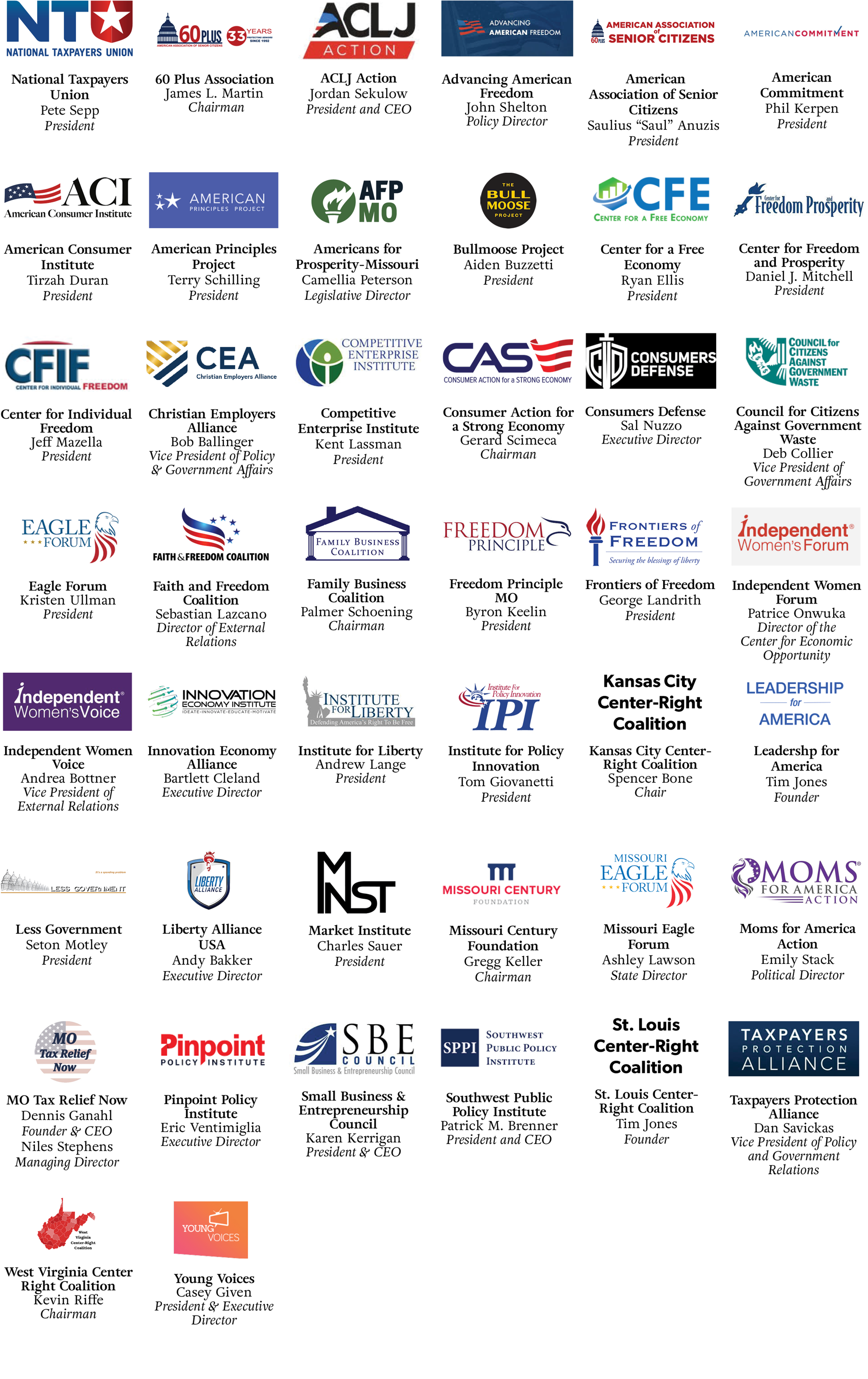
On behalf of the undersigned organizations, we write to express our strong support for Governor Mike Kehoe’s Missouri Promise to responsibly phase out the state individual income tax and replace the 1931-era tax code with one that reflects how Missourians live and work today.
To understand why this effort matters, it helps to look back at the world for which Missouri’s tax system was written. In 1931, “wireless” radios were cutting-edge technology, the Great Depression was gripping the country, and the interstate highway system wouldn’t exist for another 25 years. St. Louis ranked among the ten largest cities in America, Missouri held 16 seats in Congress, and the average Missourian earned only a few hundred dollars a year.
Yet the state is still operating under the basic structure built for that era.
Today, any Missourian who earns more than roughly $9,000 a year is automatically taxed at the top rate. That threshold may have made sense when the average income was only a few hundred dollars, but it makes no sense today.
Sales tax laws are also sorely in need of reform. Missouri now has 216 sales-tax exemptions, more than 2,526 separate sales-tax jurisdictions, and decades of carveouts secured by industries seeking special treatment.
What began as a simple Depression-era tax code has become a dense, outdated patchwork that no longer serves the needs of the state’s modern workforce or economy.
This is not the time for another temporary patch. That is why Governor Kehoe’s willingness to look under the hood and pursue a real structural fix is urgently needed.
The national trend: Missouri is late to the game
In recent years, there has been a broad, bipartisan movement across the country toward lower and simpler income taxes:
- Nine states now levy no broad-based individual income tax at all: Alaska, Florida, Nevada, New Hampshire, South Dakota, Tennessee, Texas, Washington, and Wyoming.
- Over the last decade, more than two dozen states have reduced individual income-tax rates, while many others have adopted or expanded flat taxes and temporary rebates.
Taxpayers across America are voting with their feet and their legislatures. This is not a risky fringe idea—it is now the new mainstream of state fiscal policy.
Even more striking, leaders in both blue and red states are openly campaigning to get to zero and then governing that way:
- Mississippi: Gov. Tate Reeves has already signed legislation establishing a statutory path to fully phase out the personal income tax, describing it as ending “the tax on work.”
- Oklahoma: Gov. Kevin Stitt and the legislature enacted HB 2764, cutting the rate and explicitly putting the state on a “true path to zero income tax.”
- Kentucky: Lawmakers adopted a trigger-based plan that ratchets down the flat income tax and, by law, continues until it reaches zero as fiscal benchmarks are met.
- Arkansas: Gov. Sarah Huckabee Sanders has reaffirmed that it is “still [her] goal to phase out the personal income tax” and has already signed multiple rounds of cuts.
- North Dakota, West Virginia, and others have enacted large cuts paired with triggers and have discussed using that structure to ultimately eliminate income-tax burdens for most or all taxpayers.
- Even Colorado’s Democratic governor, Jared Polis, has said his state’s income-tax rate “should be zero” and that moving away from taxing income would be “a very pro-growth policy.”
Multiple governors have not only talked about getting to zero, but have signed laws writing that goal into statute. Missouri should be leading this movement, not watching from the sidelines.
Too often we see politicians campaign on bold change only to retreat when the work gets hard and special interests defend their carveouts. It is encouraging to see a governor who is not backing away from his promise to Missourians.
Kansas is the past, not the future
Critics will point repeatedly to the early 2010s Kansas experiment. That episode is well known: large, immediate rate cuts were enacted without the spending discipline, base broadening, and guardrails needed to keep the budget on solid footing, and the legislature ultimately reversed course.
But a decade has passed, and even Kansas is now “over Kansas.” In 2024, in bipartisan fashion and with a Democratic governor’s signature, Kansas adopted a new, more disciplined reform package that lowers rates and moves the state toward a simpler single rate structure.
Meanwhile:
- States like North Carolina, Iowa, Indiana, Arizona, Utah, and Louisiana have adopted multi-year, trigger-based reforms that cut rates while protecting core services and growing their economies.
- Mississippi, Kentucky, and Oklahoma have shown that states can design an orderly, transparent path to zero anchored in clear fiscal benchmarks, not wishful thinking.
Kansas is a cautionary tale about how not to structure a reform, not a reason to accept permanent mediocrity. And now even Kansas is following the national trend toward lower, simpler taxes. The overwhelming majority of recent state income tax changes look nothing like the old Kansas plan, and Missouri’s should not either.
The growth gap: zero-income-tax states are pulling ahead
The economic data is clear: states that do not tax personal income are outperforming the highest-tax states across nearly every major measure.
Over the past decade:
- Population growth in zero-income-tax states averaged 11.8%, compared with 4.6% in the nine highest-tax states.
- Net domestic migration averaged +6.4% in zero-tax states, while the highest-tax states saw an average 2.5% decline.
- Job growth reached 15.9% in zero-tax states—nearly double the 8.4% rate in high-tax states.
- Personal income rose 67.1% in zero-tax states, compared with 51.8% in the highest-tax states.
- Gross State Product grew 66.6% in zero-income-tax states—well above the 49.7% growth in high-tax states.
These aren’t marginal differences; they represent a fundamental performance gap.
There is also a clear lesson from the states that adopted income taxes decades ago. Among the 11 states that introduced an income tax from 1961 to 1991, every single one has seen its share of national population, economic output, and tax revenue shrink. Some declines are dramatic:
- Ohio: population share down 40.5%, economic-output share down 49.2%.
- Michigan: population share down 39.2%, economic-output share down 60.8%.
- West Virginia: population share down 55.9%, economic-output share down 60.9%.
Not one of these states gained ground.
The trend is unmistakable: Americans are consistently choosing states that reward work and investment—and leaving states that tax them heavily. Missouri now faces a choice: join the states attracting people, jobs, and opportunity, or continue watching others pull ahead.
We urge you to:
- Publicly endorse the goal of phasing out the state individual income tax as part of a comprehensive approach to streamlining Missouri’s tax system;
- Work with the Governor to design a responsible “path to zero” that includes revenue triggers, spending discipline, and structural simplification; and
- Reject attempts to derail reform by protecting narrow carveouts or using Kansas as an excuse for inaction.
Missouri has the chance to be the next great success story as a state that moved from a Depression-era tax structure to a 21st-century model that rewards work, attracts families and businesses, and provides sustainable revenue for core services.
We stand ready to work with Governor Kehoe and with you to make the Missouri Promise a reality.
Respectfully,