

The House’s fiscal year 2027 appropriations bills include 51 rescissions totaling at least $13.7 billion in budget authority. These rescissions cancel previously enacted funding, but, rather than using those savings to reduce the deficit, the cuts are being used as offsets for higher spending elsewhere in the bills. Congress should instead consider these rescissions as standalone spending reductions that can eliminate unnecessary budget authority, and, to the extent the funds would otherwise be spent, reduce future deficits.
What Are Rescissions?
A rescission cancels budget authority that was previously appropriated. This prevents the funds from ever being spent. Budget authority that has not yet been obligated can be rescinded by a new law passed by Congress.
The Impoundment Control Act (ICA) created a process that allows the President to propose rescissions. Rescissions proposed by the President are considered by Congress under an expedited process that bypasses the Senate filibuster. Because presidentially-initiated rescissions can be passed through the Senate with a simple majority, the ICA is a powerful tool to control waste and abuse. Despite this potential, presidentially-initiated rescissions have been rare in recent decades, although President Donald Trump has revived the practice.
Congress can also initiate rescissions on its own, just like any other legislation. Congressionally-initiated rescissions are often included in appropriations bills. According to the Government Accountability Office (GAO), Congress initiated an average of 96 rescissions annually between FY 2000 and 2020. In the FY 2026 enacted appropriations bills, Congress included more than 100 rescissions totaling $55 billion.
Standalone Rescissions Can Reduce the Deficit; Rescissions in Appropriations Bills Are Often Gimmicks That Increase Spending
By canceling budget authority, rescissions prevent federal agencies from incurring obligations and expending funds that were previously appropriated. To the extent that the rescinded budget authority would otherwise have been spent, this reduces the deficit by preventing future outlays.
However, rescissions that are included in appropriations bills often act as budgetary gimmicks that allow Congress to increase net total spending.
Rescissions in appropriations bills often target old, unneeded budget authority that the agencies may never fully spend. That means the unneeded, unspent budget authority can be replaced by new budget authority that is more likely to be fully spent. Furthermore, a rescission that is used to offset new spending in an appropriations bill is “used up,” meaning it cannot be enacted as a standalone spending cut to reduce the deficit.
Rescissions in the House FY 2027 Appropriations Bills
The House Appropriations Committee has reported all 12 regular FY 2027 appropriations bills. The House has passed three bills: Agriculture; Military Construction and Veterans Affairs; and National Security, Department of State, and Related Programs. The House’s 12 proposed fiscal year 2027 appropriations bills would provide $1.894 trillion in net budget authority, which is $162 billion, or 9.4%, above FY 2026.[1]
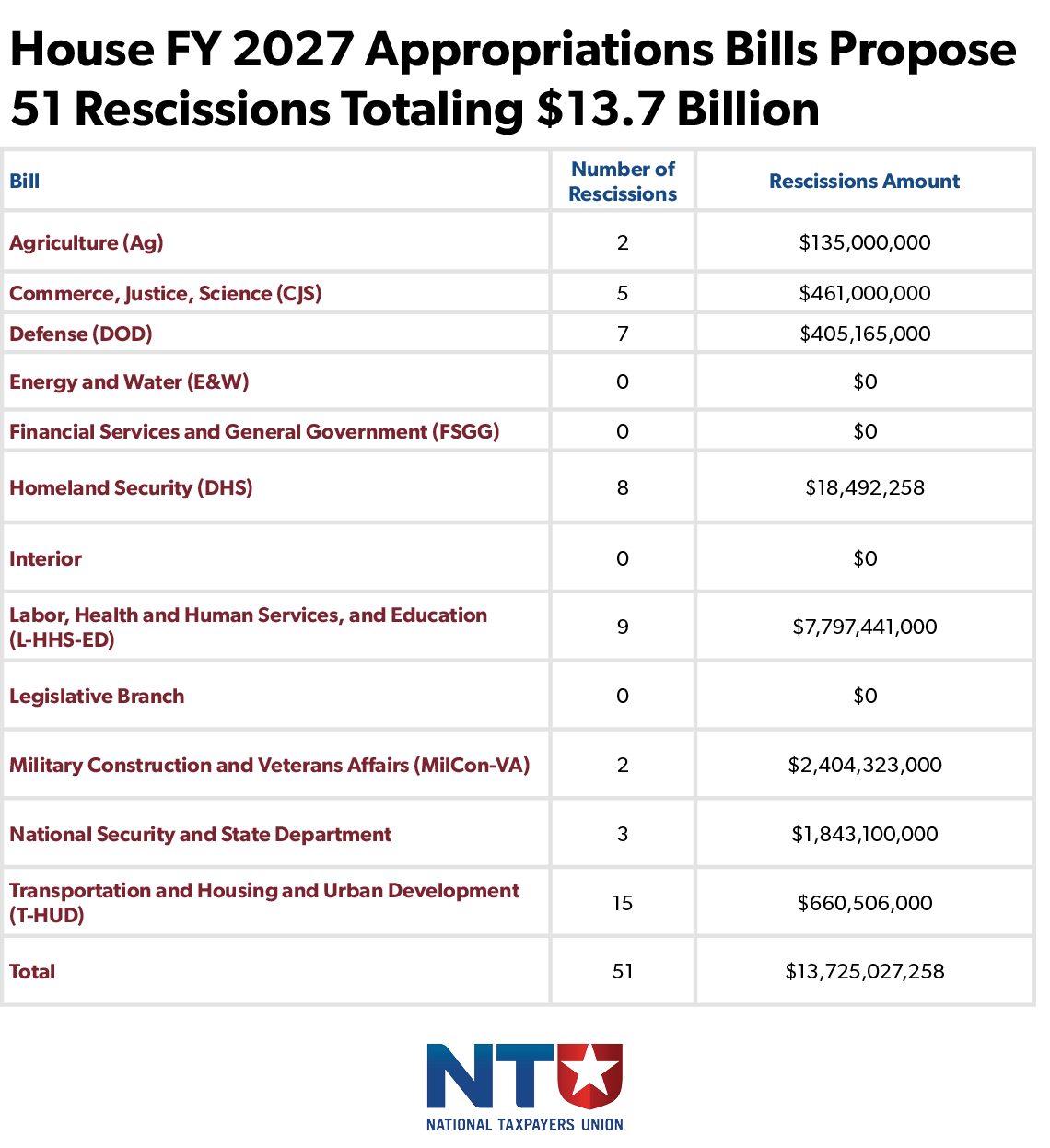
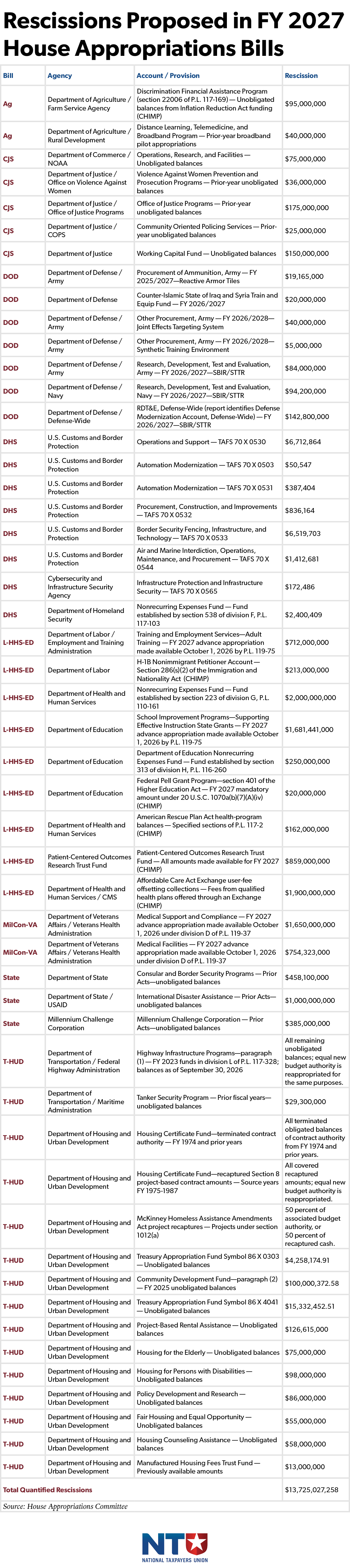
The House’s FY 2027 appropriations bills propose 51 rescissions, which would reduce budget authority by $13.7 billion.[2] These reductions are used as offsets for higher spending elsewhere in the bills. A full catalog of the rescissions in the House appropriations bills is included in the Appendix.
The Labor, Health and Human Services, and Education bill leads the way, with nine rescissions totaling $7.8 billion. Four bills do not include any proposed rescissions (Energy and Water, Financial Services and General Government, Interior, and Legislative Branch).
Rescissions Should Be Used to Reduce Waste and Deficit Spending
Rescissions should be used to reduce the deficit, not as budgetary gimmicks to increase appropriations.
President Trump and Office of Management and Budget (OMB) Director Russ Vought deserve praise for rebuilding the rescissions muscle memory. Congress passed a $9 billion rescissions package using the ICA process in July 2025. The Administration should prioritize proposing and enacting additional rescissions.
The President is required to use the ICA process. The law provides that the President shall submit a rescission proposal to Congress:
Whenever the President determines that all or part of any budget authority will not be required to carry out the full objectives or scope of programs for which it is provided or that such budget authority should be rescinded for fiscal policy or other reasons (including the determination of authorized projects or activities for which budget authority has been provided), or whenever all or part of budget authority provided for only one fiscal year is to be reserved from obligation for such fiscal year.
This requirement means that the Administration should have a process in place to review unspent budget authority. Any funds that are determined to be wasteful or not needed should be officially proposed for rescission. When the congressional spending committees propose cutting budget authority, that should be a clear indicator that the funds are a strong candidate for rescission.
Substantial unobligated balances of budget authority remain available for potential rescission. The level of unobligated balances has grown substantially in recent years. At the end of FY 2015, $199 billion in unobligated balances remained. In contrast, $551 billion in unobligated budget authority was available at the end of FY 2025. At the end of the third quarter of FY 2026, $1.078 trillion was unobligated. Just because the budget authority has not yet been obligated does not mean that it necessarily should be rescinded, but it should be evaluated by agencies, OMB, and congressional oversight committees.
The House Appropriations Committee has identified more than 50 rescissions that would reduce budget authority by nearly $14 billion. But, rather than using these rescissions to reduce spending, the resulting budgetary offsets are being used to support higher spending elsewhere in the FY 2027 appropriations bills.
The federal budget is on an unsustainable trajectory. Congress and the President should use rescissions to eliminate unnecessary budget authority, not to finance higher spending elsewhere.
Appendix: Rescissions Proposed in FY 2027 House Appropriations Bills
[1] The Senate Appropriations Committee has not released or marked up any of the regular FY 2027 appropriations bills.
[2] Six of these rescissions, totaling $3.2 billion, are also classified as changes in mandatory programs (CHIMPs) for budget scorekeeping purposes.