


To: Members of the House Budget Committee
From: National Taxpayers Union
Date: July 16, 2026
Subject: NTU’s views on the July 16 Markup
I. Introduction
On behalf of National Taxpayers Union, the nation’s oldest taxpayer advocacy organization, we write to express our views on legislation slated for consideration before the House Budget Committee on July 16, 2026.
II. Legislation
H.Con.Res. ___, the Fiscal Year 2027 Budget Resolution
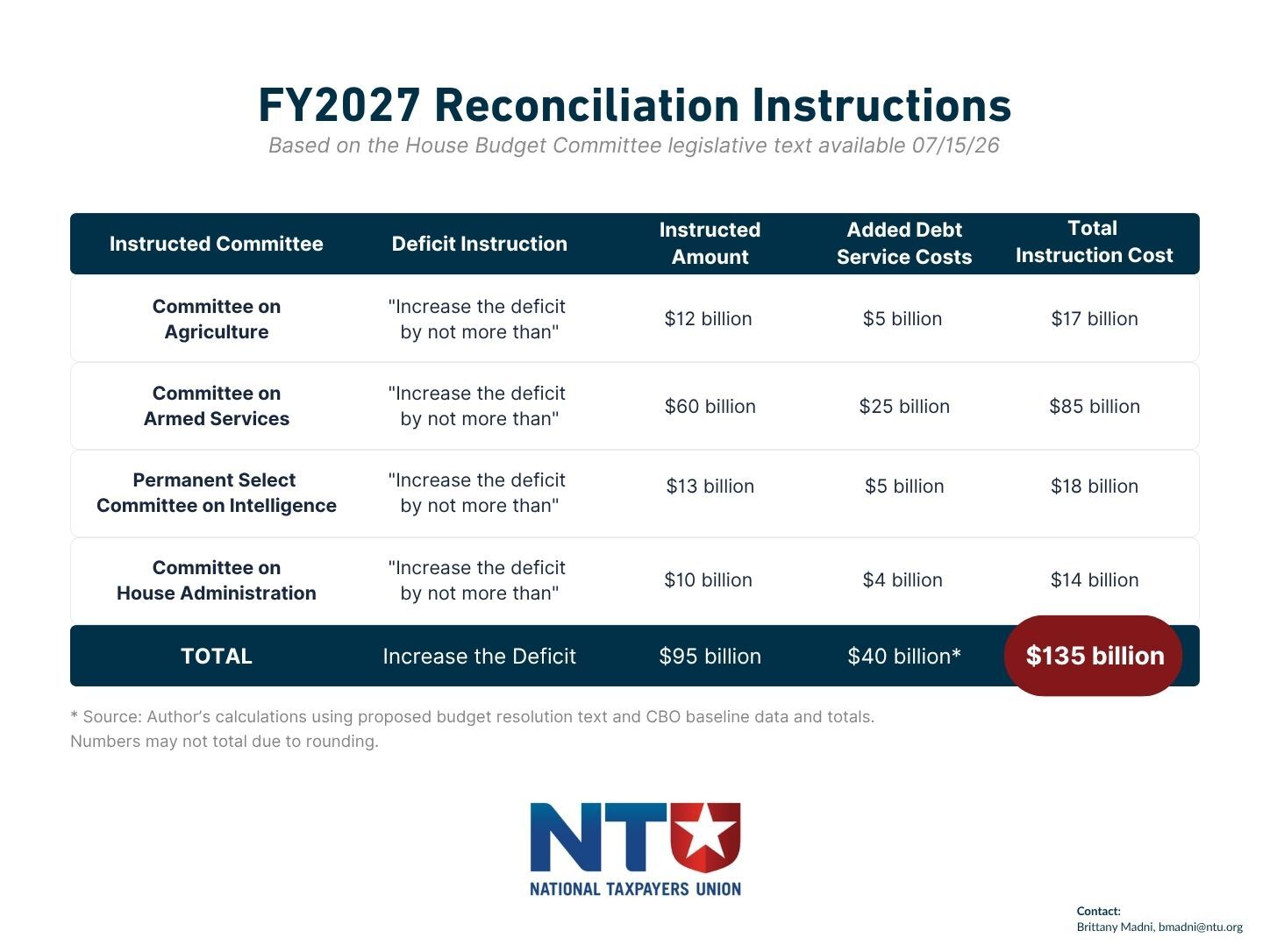
This budget resolution provides instructions to four House committees—Administration, Agriculture, Armed Services, and Intelligence—to increase the deficit by a combined $95 billion for the purpose of another reconciliation package. This does not include debt service costs associated with higher deficit spending; when included, added interest brings the total on the taxpayers’ tab to $135 billion.
This Congress inherited a fiscal disaster. It would be unfair to expect this problem to be resolved in just two years. Yet we urge you to avoid exacerbating the crisis through more unsustainable deficit spending.
On the first day of this Congress—January 3, 2025—total public debt stood at $36.2 trillion. It has since grown to $39.4 trillion and counting. Recent data from the Congressional Budget Office shows that the deficit for the current fiscal year stands at $1.4 trillion, which is $35 billion higher than last year’s deficit at this time—driven by a 3% increase in outlays. In other words, the fiscal condition of the country is worsening.
Rather than building on the generational wins of the Working Families Tax Cuts reconciliation bill passed last year, it appears that Congress is considering backsliding. Taxpayers deserve better, and yet the budget resolution before the Committee will put us on a glide path to increasing deficits by over $100 billion including added interest.
This is a policy choice, not an inevitability. Congress has at its disposal no shortage of options for cutting spending and improving program integrity. According to the Government Accountability Office (GAO), the federal government loses between $233 billion and $521 billion annually to waste, fraud, and abuse. My colleague Matthew Dickerson has outlined tens of billions in savings that the Agriculture Committee alone could achieve by clamping down on waste, fraud, and abuse.
NTU strongly urges the Budget Committee to substantially revise the current resolution to offset the higher spending enabled within the legislative text released on July 15, 2026. To that end, NTU offers the following policy guidelines for consideration while crafting fiscally responsible Reconciliation 3.0 instructions. These guidelines would also help ensure that key recommendations from instructed authorizing committees of jurisdiction have a high probability of passing the Byrd Rule tests.
1. Offset New Spending. Any reconciliation provisions increasing outlays, including through the Tax Code, should be fully offset by corresponding decreases in outlays on a dollar-for-dollar basis.
Offsets should be “real” and avoid gimmicks like timing shifts, fake short-term expirations, rescissions of dollars not expected to be spent, and other provisions that will not deliver tangible savings.
In offsetting new spending, the total to be offset should include the associated debt service burden. Interest payments harm the taxpayer as much as principal outlay increases.
Offsets should be achievable and upfront, meaning they should not be “backloaded” in the second half of the budget window. Immediate spending should be immediately offset.
2. No “Off the Table” Deficit-Driving Waste, Fraud, and Abuse. With the clear exception of Social Security so as not to violate the Byrd Rule, all major autopilot spending programs should be reviewed for potential policy improvements that are reconcilable and from which taxpayers would benefit.
The vast majority of waste, fraud, and abuse occurs in a select set of welfare and entitlement programs that are not currently within the instructed committees’ jurisdiction. This includes programs within the jurisdictions of the House Ways and Means Committee, the House Energy and Commerce Committee, and the Senate Finance Committee. Fear of opening the door for bad policy decisions down the line is not a responsible way to draft the budget resolution at the current stage—particularly as several prominent senators are publicly seeking offsets.
Waste, fraud, and abuse must be faced head on within Reconciliation 3.0. The committees of jurisdiction should take a broad view of what constitutes waste, fraud, and abuse, which is in line with how American taxpayers interpret the phrase. More stringent reporting requirements on grant programs could, for example, be a practical policy to include in several areas of jurisdiction. This option can be applied across committees not currently instructed.
3. Preserve Article I by Minimizing Autopilot Spending. Every effort should be made to keep budget line items that are currently discretionary programming within the jurisdiction of the Appropriations Committees rather than shifting them to autopilot (“mandatory”) spending.
Autopilot spending is corrosive to both our nation’s fiscal health and to the constitutional power of the purse. Increasing autopilot spending or moving what would otherwise be discretionary spending into the autopilot side dangerously removes regular, annual congressional oversight and reconsideration of those dollars.
4. Consider Impacts on Discretionary Toplines. Moving funds into reconciliation should be paired with the removal of those funds from other budgetary lines. If spending is included in the reconciliation package for purposes that would otherwise be considered either base or supplemental appropriations, then the corresponding 302(a)—and later the 302(b)s set by the Appropriations Committee—should be reduced at a commensurate rate to prevent duplicative funding allowances.
In particular, defense spending should be closely tracked for duplication prevention, especially as taxpayers would not be well-served by the creation of a new “Overseas Contingency Operation”-style offbook funding stream. While there are arguments to be made for Iran conflict-related funding, refilling American arms stockpiles and readiness provisions should be treated like base defense discretionary spending.
Likewise, enactment of Reconciliation 2.0 means “regular” funding for Homeland Security should be removed from toplines as already spent. Should additional “base” Homeland Security money be deemed requisite for inclusion, the presumption should be that the corresponding reduction should be seen in the budget functional category and discretionary toplines.
None of this movement eliminates the need to provide offsets for any increases in funding levels above the baseline.
5. Provide Senate Instructions. The House can and should include instructions to the Senate committees rather than leaving a hole open, particularly given that the Senate and House are publicly not in alignment. The House should send the strongest possible budget resolution to the Senate, which requires including Senate instructions that make clear where members of the House stand. This holds true for all policies the House considers important enough to do in reconciliation, from the SAVE America Act to offsetting provisions.
With no Senate instruction, it appears this is not a law-making exercise. Lacking Senate instructions indicates that the House is perfectly accepting of the Senate rewriting the reconciliation plan from a blank slate, which will likely lead to even greater deficit spending and very little stability on the SAVE America Act’s prospects.
On the technical front, only the Senate instructions matter when it comes time to engage with the Senate Parliamentarian on questions of privilege during the Byrd bath. Not having Senate instructions in the House’s opening move is an immediate concession that the House does not expect new spending to be offset or promises to be kept on policy. This effectively strips all meaningful input from the House regardless of handshake agreements.
NTU stands ready to assist your efforts to improve the budget resolution and craft a fiscally responsible reconciliation package.
Should you have any questions, please contact me at barnold@ntu.org.
Sincerely,
Brandon Arnold
Executive Vice President
National Taxpayers Union