


Senate Republicans recently released legislative text for their border security and immigration enforcement package, which will use the reconciliation process to bypass the filibuster. The proposals, advanced by the Senate Judiciary and Homeland Security Committees, would allocate more than $71.7 billion to border security priorities.
This funding would come on top of resources already provided through the FY2026 Homeland Security appropriations measure, as well as the roughly $170 billion included in the Working Families Tax Cuts package. Taken together, the additional spending raises questions about prioritization and whether reconciliation is being used to advance long-term fiscal discipline or to layer on new expenditures.
The stated purpose of using reconciliation is to keep open controversial federal agencies through the rest of President Trump’s second term, particularly Immigration and Customs Enforcement (ICE) and Customs and Border Patrol (CPB). However, doing so raises several concerns for taxpayers. As we noted in a letter last month, utilizing reconciliation “ bypasses the normal appropriations process and effectively requires the recategorization of discretionary funds as mandatory funds.”
A better alternative would be to fund ICE and CPB only through the remainder of 2026 at current spending levels, as a multiyear vehicle creates a precedent that will undoubtedly be used again in the future to undermine fiscal responsibility to the detriment of American taxpayers. There are also similar concerns for the billions of dollars for DHS and DOJ with limited explanation for how this additional money would be utilized.
Unfortunately, the proposed legislation funds these agencies through 2029, which undermines congressional oversight and accountability.
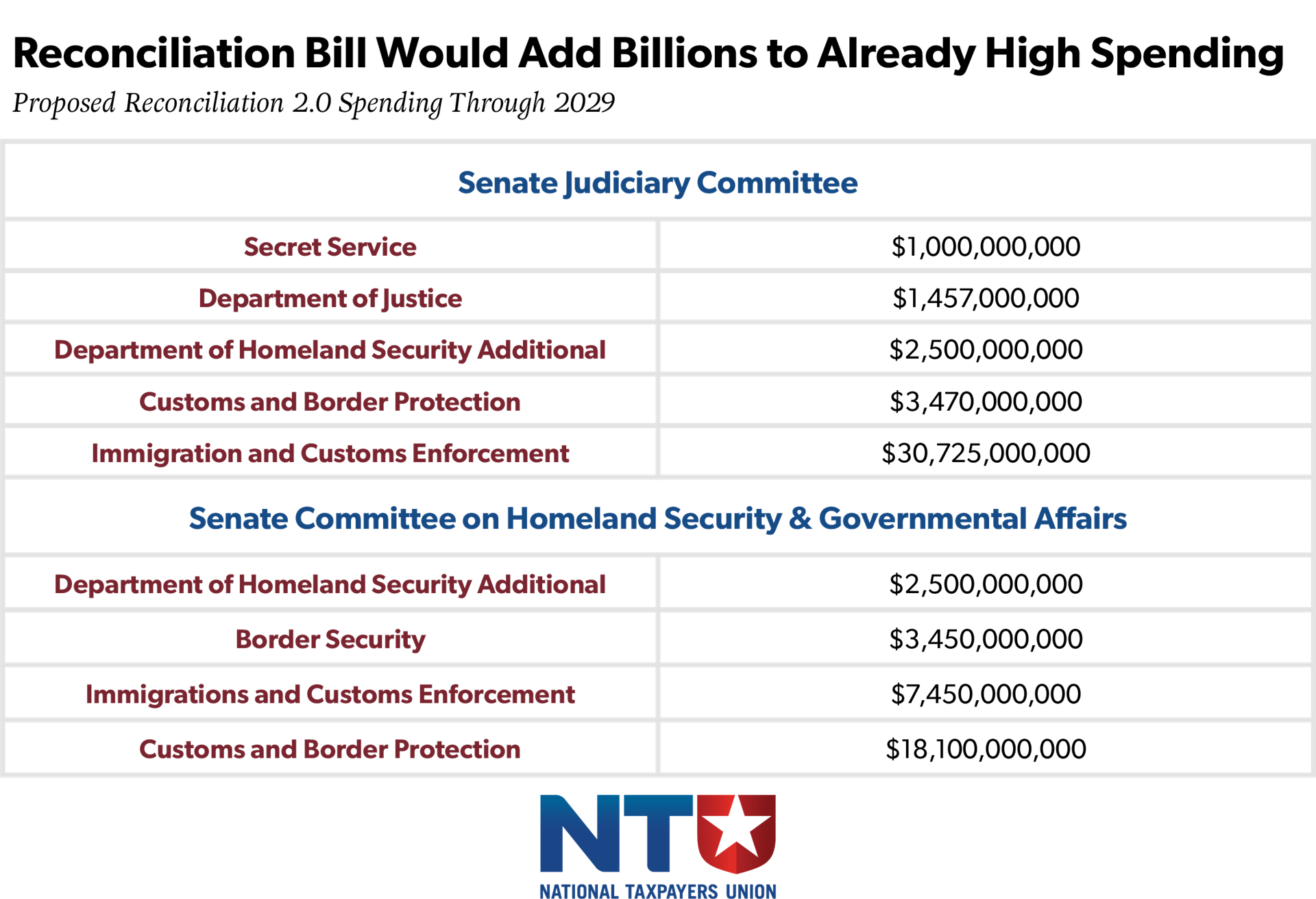
Some of the proposed spending contains limited pro-taxpayer restrictions. This includes prohibiting federal funding for construction of the East Wing of the White House for non-security purposes and a prohibition on funds for unproven surveillance technologies.
Most concerning, however, is how this proposed increase in mandatory spending—meant to deal with intransigence from a minority party in Congress unwilling to fund interior immigration enforcement—will affect future congressional appropriations. DHS was well funded going into this unprecedented standoff over immigration enforcement, with an enacted fiscal year 2025 base discretionary level of $65.03 billion, over $200 million above its assigned 302(b) allocated spending target, and $2 billion above the President’s budget request of $62.2 billion. Before negotiations fell apart in the Senate in January over immigration enforcement, the Senate came close to agreement on a proposed DHS funding level of $64.4 billion, which included a significant cut of $1.3 billion in CBP spending and flat funding for ICE.
Over the last five fiscal years, CBP received an approximate average spending level of around $18 billion, while ICE received around $10 billion per year.
Let’s not forget that the President’s One Big Beautiful Bill already included extremely generous supplemental plus ups for both ICE and CPB totaling $170 billion. That funding, plus this additional funding and regular appropriations will drive higher deficits when our debt levels are already on an unsustainable fiscal path.
Already, the portion of the federal budget on “autopilot” has grown significantly, thus undermining proper congressional review and oversight of spending. In FY2025, 73% of federal outlays consisted of either mandatory spending or payments on the national debt. That means discretionary spending comprised only approximately 27% of the total federal budget—a significant drop from 15 years ago when discretionary funding was more than 36% of spending. Federal debt also recently grew to be larger than the American economy, a milestone not seen since World War II.
Rather than use the reconciliation process for more spending, Congress should use this opportunity to fix some of the structural drivers of our fiscal situation. Further reforms to entitlements, subsidies, and government efficiencies will help put the federal budget on a more sustainable path by slowing the growth of mandatory spending, targeting benefits to those who need them most, and reducing wasteful or duplicative programs.
By focusing reconciliation on policies that bend the cost curve rather than add to it, lawmakers can demonstrate a commitment to fiscal responsibility while preserving economic growth and protecting taxpayers from an ever-expanding debt burden.