


Key Facts
- Tangible personal property (TPP) describes physical assets that belong to a business and generate productivity. They are even more important to the ongoing success of a business than land or structures.
- Taxes on tangible personal property are often out of touch with the modern realities of tech investment through cumbersome depreciation schedules and complex definitions of what’s taxable, contributing to a significant administrative burden for businesses.
- The U.S. is one of the few industrialized countries where uncompetitive tangible personal property taxes exist. Because businesses make investment decisions based on burdens that include TPP taxes, they are a liability to the technological race the US must win.
- The burdens of TPP taxes directly increase the costs of the goods and services on small businesses and consumers. Governments should avoid imposing new TPP taxes, while existing TPP taxes should be repealed or reformed to avoid complex depreciation schemes or other rules that overstate the taxable value of quickly obsolete technology such as computer servers.
Foreword
“What is a tangible personal property tax anyway?” This is a question we often hear at National Taxpayers Union (NTU), not just from individual taxpayers, but also from more than a few policymakers. And for good reason: state and local taxes on tangible personal property (TPP), once fairly common in America’s pre-income tax history, have become an obscure, complex, and economically inefficient area of tax law that is often misunderstood.
Everyday Americans who happen to live in states with “car taxes” may recognize, often with consternation, a form of TPP tax levied annually on the vehicles they drive. Yet, an even more insidious TPP tax is a misnomer of sorts, because it falls upon what is paradoxically called “business personal property” right on Main Street USA. In our modern information- and innovation-centered economy, TPP taxation is increasingly becoming a liability to our common prosperity at home and our competitiveness abroad. TPP taxes can exert a disproportionate drag on local economic development, in many cases leading to heavy reductions in employment growth, investment, and the rate of business starts.
In this second of a three-part series on tax policy toward data centers, our Senior Fellow Jared Walczak expertly demonstrates why this anachronistic tax is ill-suited to the dynamic demands of the Information Age. And, while data centers comprise one sector of this economy where TPP taxes often fall hardest, it is often not the only sector. Health care, national security, energy development, and other facilities whose purpose is to blaze new trails for products and services that will revolutionize our lives can also suffer. Essentially, any business pursuit that is particularly dependent on the rapid deployment of investment capital in cutting-edge technologies can be victimized by TPP taxes, to shocking effect.
Yet, there are instances where TPP taxes specifically discriminate against data centers, by denying these facilities “by-right” exemptions that factories and other business locations can often count on for relief. By-right or not, TPP taxes and their associated relief provisions can be terribly complex. Some are not even defined as outright taxes on tangible personal property, instead hiding furtively behind definitions of traditional real estate taxes that “happen” to include items like equipment and moveable fixtures. It is no wonder, then, that these taxes are so difficult for taxpayers to identify, much less pinpoint for their economic harm.
Jared also describes the problem of outdated depreciation schedules for valuing certain tech-related business property that more rapidly obsolesces than, say, a printing press or a desk. NTU has, itself, directly encountered the vagaries of TPP taxes with the District of Columbia government. Despite offering a generous exemption that protects many firms (including nonprofit organizations) from paying the tax, NTU is among the thousands who must file a detailed, painstakingly calculated inventory of tangible personal property with the local government to prove it qualifies for the exemption. One standout: a computer purchased in 2008 for this author’s use, which still carries a taxable value of 25% of the original purchase price. Considering that the software no longer exists to run this equipment in a modern office setting, most would consider such a computer to be no better than a doorstop. To the local government, however, it is apparently still a potential revenue-raising asset.
As Jared concludes, the most important lesson for policymakers in this paper is to avoid levying new TPP taxes. However, there are other “dos and don’ts” which NTU can suggest:
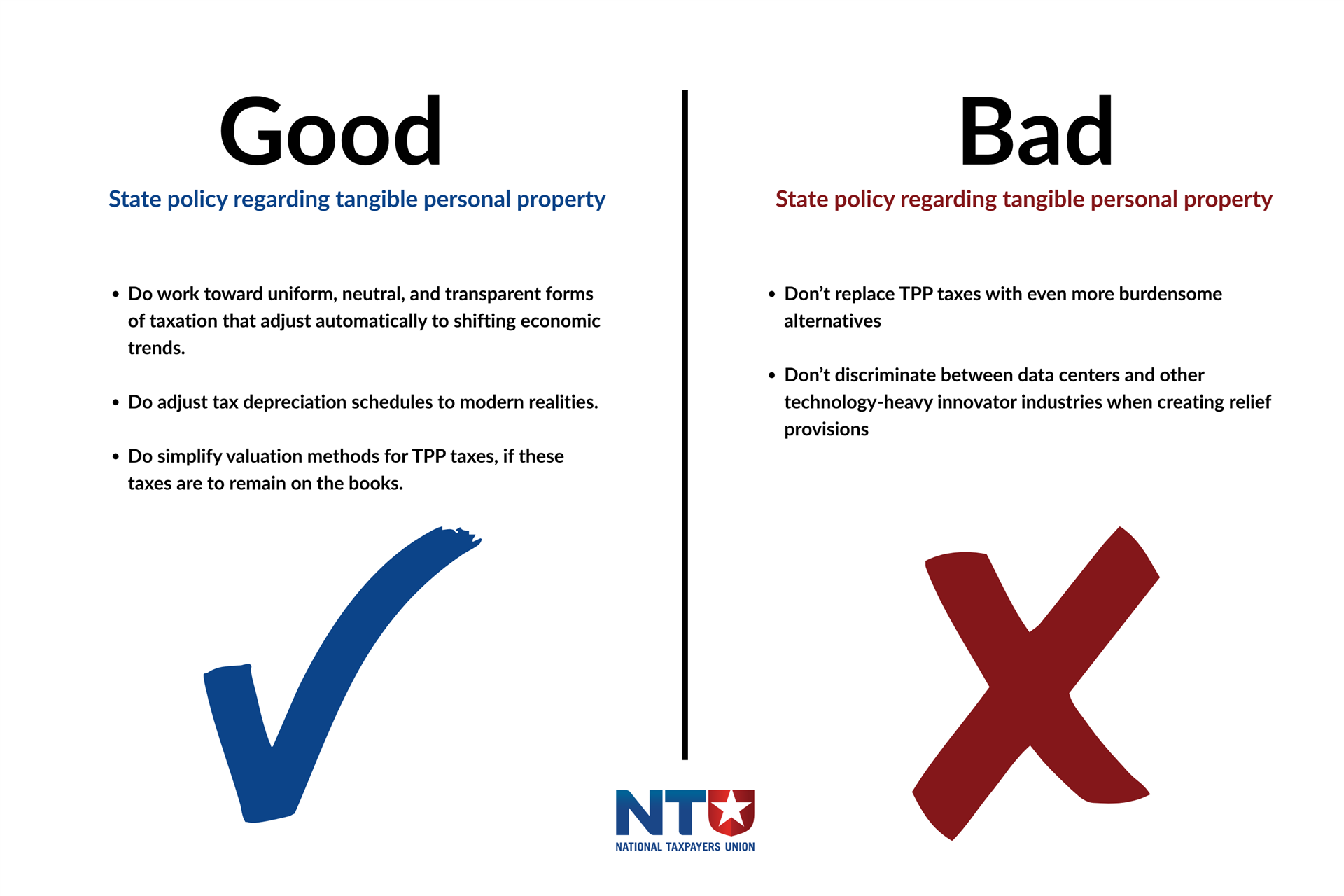
1) Don’t discriminate between data centers and other technology-heavy innovator industries when creating relief provisions. Punishing data center infrastructure by requiring investors and developers to do without exemptions that others receive, or to be subject to “discretionary” relief programs, will have ripple effects far beyond data centers themselves. Trust in the policy environment to be fair toward all businesses will erode, and with it opportunities that could greatly benefit local communities.
2) Don’t replace TPP taxes with even more burdensome alternatives, such as higher corporate income or sales taxes (which, as our first paper explained in detail, often treat data centers worse than other businesses anyway).
3) Do simplify valuation methods for TPP taxes, if these taxes are to remain on the books. The original acquisition cost is the simplest way of carrying TPP on a business’s books, followed by replacement cost. Forcing businesses and tax authorities to haggle over “reproduction cost”—which creates a theoretical value subject to endless disputes—ought to be more properly labeled as “unproductive cost to the taxpayer.”
4) Do adjust tax depreciation schedules to modern realities. Whether sitting in a data center, or in a medical research facility, or in a traditional office, the useful lives of computers and servers are measured in a handful of years. As the example above indicates, however, many state and local tax laws have not updated depreciation policies for decades.
5) Do work toward uniform, neutral, and transparent forms of taxation that adjust automatically to shifting economic trends. The 2025 federal tax law known as the One Big Beautiful Bill Act provides a “gold standard” in this regard with full and immediate expensing of many types of physical business investment. States and localities can do the same, with the benefit of more stable revenues in the long run.
Tax laws that can evolve with changing economic conditions need not entail constant tinkering on the part of public officials. Instead, embracing the principles outlined above—uniformity, neutrality, transparency, simplicity, stability, and growth—can be all that is necessary for pro-taxpayer policy to take root, flourish, and nurture the communities in which they are cultivated. This paper should provide the seeds for doing so.
Pete Sepp
President
National Taxpayers Union
Introduction
For a modern data center, servers alone can easily be worth billions of dollars. In many states, those servers—along with the data center’s other networking equipment, electrical build-out, backup generators, chillers, and more—are subject to property tax, frequently at valuations that overstate the true market value of those assets.
Property taxes can be imposed on both real property (land, improvements, and often fixtures) and on tangible personal property (TPP), which is a catch-all classification for machinery, equipment, and virtually every other form of business tangible property that is not real property. State taxation of tangible personal property is particularly harmful to capital-intensive businesses like data centers, and certain characteristics of data centers result in uniquely aggressive TPP tax burdens compared to other industries.
Personal property declines in value over time, and governments recognize this with depreciation schedules that vary based on property subclasses. But standard depreciation schedules, even those designed for computers or network equipment, struggle to keep up with the rapid pace of technological advancement in server technology, where cutting-edge microchips are virtually obsolete a few years later. These taxes can easily value aging servers at levels well above their true economic worth.
Tangible personal property taxes are economically inefficient and difficult to justify. The compelling rationales for taxing real property do not extend to the taxation of personal property, which is why some states are moving away from taxing personal property, and many states that still tax it provide generous abatements for new and expanding businesses. Even so, such abatements are more likely to be extended to traditional manufacturing facilities than to data centers and to other industries at the cutting edge of technology, science, and health innovation, which often bear the brunt of these harmful taxes.
This paper, the second in a three-part series on tax policy toward data centers,1 examines the economic implications of TPP taxation, details states’ varying approaches to TPP valuation and depreciation, and explores how these taxes apply to data center property in the 20 states with the most data center investment. Policymakers should pursue a level playing field, ideally moving away from the outdated notion of taxing personal property, but at minimum avoiding policies that (often inadvertently) impose particularly heavy taxation on specific industries, like data centers.
The Economics of TPP Taxes: A Poor Fit for Modern Times
As a highly capital-intensive industry, data centers are sensitive to local taxes on business tangible personal property, like servers, networking equipment, electrical build-out, cooling systems, backup generators, and related equipment. Because this equipment can be worth billions of dollars, levying property tax on it substantially increases the cost of operating in a jurisdiction and can discourage reinvestment (like refreshing older servers) since new property has a higher taxable value than depreciated property.
None of this is unique to data centers. Tangible personal property taxation falls on businesses of all types, disincentivizing investment and harming economic growth. These taxes are a nuisance even for businesses with very little tangible property, imposing high compliance costs. For more capital-intensive businesses, they are particularly harmful.
Tangible personal property taxes are a local tax on capital investment. Policymakers at all levels of government are increasingly exploring additional taxes on data center capital investment, overlaying these TPP taxes. States are increasingly threatening to withdraw sales tax exemptions for data center equipment purchases, which adds to the cost of acquiring capital.2 Existing TPP taxes represent an ongoing local tax cost of deploying that capital. At the federal level, meanwhile, lawmakers have floated proposals to delay cost recovery for data center investment, meaning that data center operators could not immediately deduct the full cost of their investment in their calculations of taxable net income.3 Data center capital investment risks facing aggressive, non-neutral taxation at all levels. With personal property taxes, that treatment is already in place.
A Drag on Investment
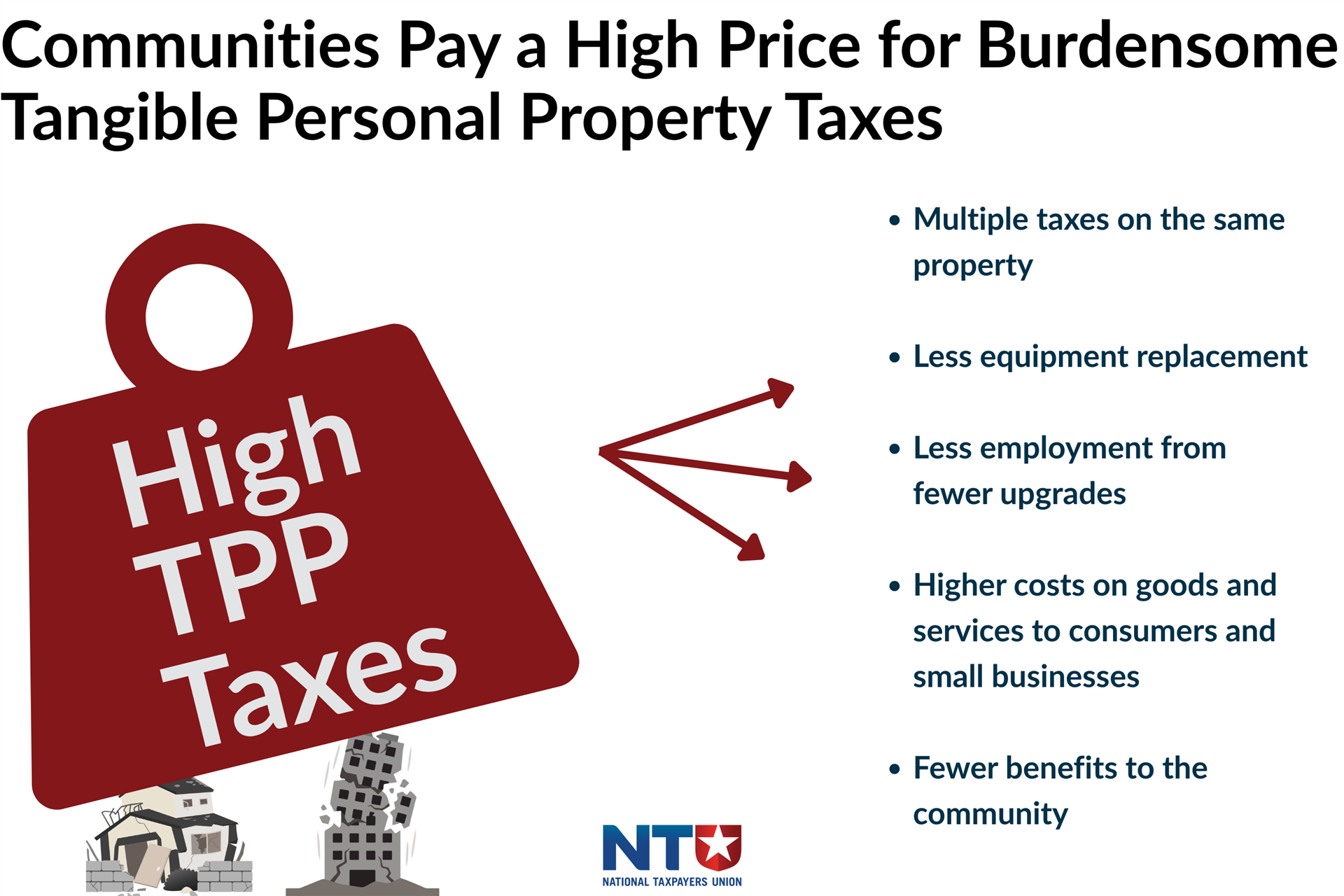
The result of high taxes on capital investment is lower capital investment, deployed more slowly. Tangible personal property taxes already have that effect, and poorly designed TPP taxes can be particularly significant. Taxing capital yields slower replacement cycles for data center servers and other equipment, to the detriment of local employment. Businesses across the country are worse off if the digital, automated services they rely on are more costly and run on less advanced systems. Additional federal, state, and local taxes on that same capital would compound the harm already generated by existing TPP taxes.
Taxation of tangible personal property, colloquially defined as property that can be touched and moved, but often more broadly defined as anything other than real property (land and structures) that can be perceived by the senses, varies widely across states: some exempt it entirely, some include it in local property tax bases under a statewide framework, and others grant discretion to local tax authorities. In some states, abatements may be offered at the state or local level, or both. Tangible personal property tax burdens on machinery, equipment, and other business assets depend on:
- Local property tax rates;
- Definitional boundaries between real and personal property;
- Assessment ratios or rate differentials for personal property;
- Personal property valuation methods;
- Asset classification and depreciation schedules; and
- Abatements or exemptions for certain personal property.
Historically, property tax regimes in the United States did not make a sharp distinction between real and tangible personal property. Under older “general property taxes” levied by both state and local governments, land, buildings, machinery, and household goods were all taxed. In time, household tangible property (household furniture, artwork, home goods, and other goods subject to personal ownership) was virtually eliminated from the tax base, though vehicles remain in the personal property tax base in some states. The exclusion of business tangible property, however, is less complete. In many states, machinery, equipment, computers, office furniture, and tools are still subject to local property taxes.
Although this practice is an old one, it lacks economic justification. The traditional arguments in favor of real property taxation do not apply to tangible personal property. Real property taxes are often conceptualized as a benefit tax, in which taxpayers owe in rough proportion to the benefits they receive from local government, and in which the services funded by the tax enhance the value of their property.
As public finance scholar John Mikesell noted decades ago, “Although local governments may contribute to the value of a parcel — land and structure — at a particular location, causing a value-driven property tax payment to be in the nature of a charge for local service, personal property is movable and not location-bound. Its value would be more independent of site and local service of that site. Thus such property is not logically taxable in the same system as real property.”4
Local spending on roads, schools, law enforcement, emergency services, and recreation not only improves local quality of life but also enhances the value of property. This is true even when an individual or business does not gain directly from a local service: businesses do not have children (nor do all households), but land in communities with better schools increases in value. The same cannot be said for more mobile classes of property, like machinery and equipment. Land is worth more in more desirable communities; a lathe is not. A home’s value increases when the schools are better; hardware’s value does not.
Real property values, moreover, are a serviceable proxy for the relative cost of providing local services to that property, which is not true of tangible property.5 The value of machinery or equipment inside a facility has a negligible effect on local government expenditures.
Finally, while all property taxes fall on capital (whether land, structures, or tangible property), land itself is an immovable asset. New land cannot be created, nor can land be moved.6 Structures on that land are not quite so permanent, and there are, of course, choices as to how to develop individual parcels, but they are also relatively fixed, and their value runs with the land upon which they are situated. None of this is true of mobile property like machinery and equipment. A tax levied on these production assets is purely a tax on capital investment, discouraging and penalizing it.
Complex Tax, Complex Choices
The taxation of TPP is complex. Unlike real property taxes, where assessed values are entirely determined by a local assessor, tangible personal property taxes are considered “taxpayer active,” meaning that the taxpayer is obligated to actively participate in the valuation of their property: itemizing it, recording the original cost and acquisition date, adjusting for trended cost indices where applicable, and applying depreciation schedules to determine the current value of their property and calculate their liability.
Personal property value is typically based on the initial acquisition price and the age of the asset, depreciated according to schedules published by each state (or, sometimes, locality) levying the tax. Depreciation is a reduction of the value of an asset based upon how far into its “useful life” it is, with the taxable value declining over time. Useful lives and the slope of the curves of their depreciation schedules vary by property subclass. Frequently, an asset maintains an established residual value even after the end of its useful life under depreciation schedules.
Asset lives are often set in broad categories and thus fail to reflect the actual useful life of specific assets. Servers used by cutting-edge hyperscale data centers, for instance, need to be replaced every few years, but they are typically included in broader asset classes—often computer equipment, and other times equipment more broadly—with much longer depreciation schedules.
In addition to differing depreciation schedules, either TPP as a whole or specific classes of TPP may be subject to different rates or assessment ratios than real property, and exemptions are sometimes available for “production-related” TPP, such as manufacturing machinery and equipment and other process inputs. Data center servers and other equipment, though also used in productive processes, do not receive these exemptions.
Economically, TPP taxes are an annual surcharge on the user cost of capital. They lower the after-tax rate of return on new investment and introduce a bias against capital-intensive production techniques. The tax is levied on a company’s physical capital regardless of business profitability.
Capital taxes distort capital allocation and accumulation. They influence location choices and investment timing decisions, and decrease investment, raise costs, and reduce output.
A Heavier Burden on Innovation
Tangible personal property taxes fall on a wide range of businesses, but they impose heavier burdens on businesses with high capital costs, even when these businesses are no more profitable than other businesses with low rates of capital expenditure, and notwithstanding any localized costs created by business activity. This makes the tax highly nonneutral and inefficient.
One study, which examined the Washington, DC, metropolitan area over 25 years, concluded that real property tax rates had little impact on businesses, but a one percentage point higher personal property tax rate reduced annual employment growth by 2.4 percentage points, which the authors highlighted as an “economically large negative effect.”7 A Japanese study of depreciation-asset taxation likewise found that higher effective property tax rates on depreciable assets reduce capital investment, thereby lowering output.8 A Massachusetts study found that shifting property taxes onto businesses, including through personal property tax levies, reduces the number of business establishments and jobs.9
An Alberta, Canada, study of business property taxation more broadly found that, for every one mill ($1 per $1,000 of taxable value) increase in non-residential property taxation (real and personal), the total value of annual building permits declined by $39.37 per capita, resulting in what the authors described as a boomerang effect, with declines in investment reducing the stock of capital and thus reducing property and income tax bases.10 And U.S. analyses of capital taxation more broadly likewise find that taxing capital reduces investment.11
Intriguingly, non-taxation of tangible personal property is associated with higher, not lower, property tax collections. Removing the TPP class, which particularly harms investment and growth, reduces the competitive disadvantage of remaining property taxes, which may decrease business opposition to property tax rates and reduce taxpayer responses to those rates.12
A National Conference of State Legislatures (NCSL) task force identified TPP taxes as particularly burdensome, and state-level reform commissions have drawn similar conclusions.13 The task force recommended reducing or eliminating business personal property taxes, highlighting concerns about economic distortions, compliance costs, and competition for mobile capital.
U.S. TPP Taxation—Increasingly, an Anti-Competitive Outlier
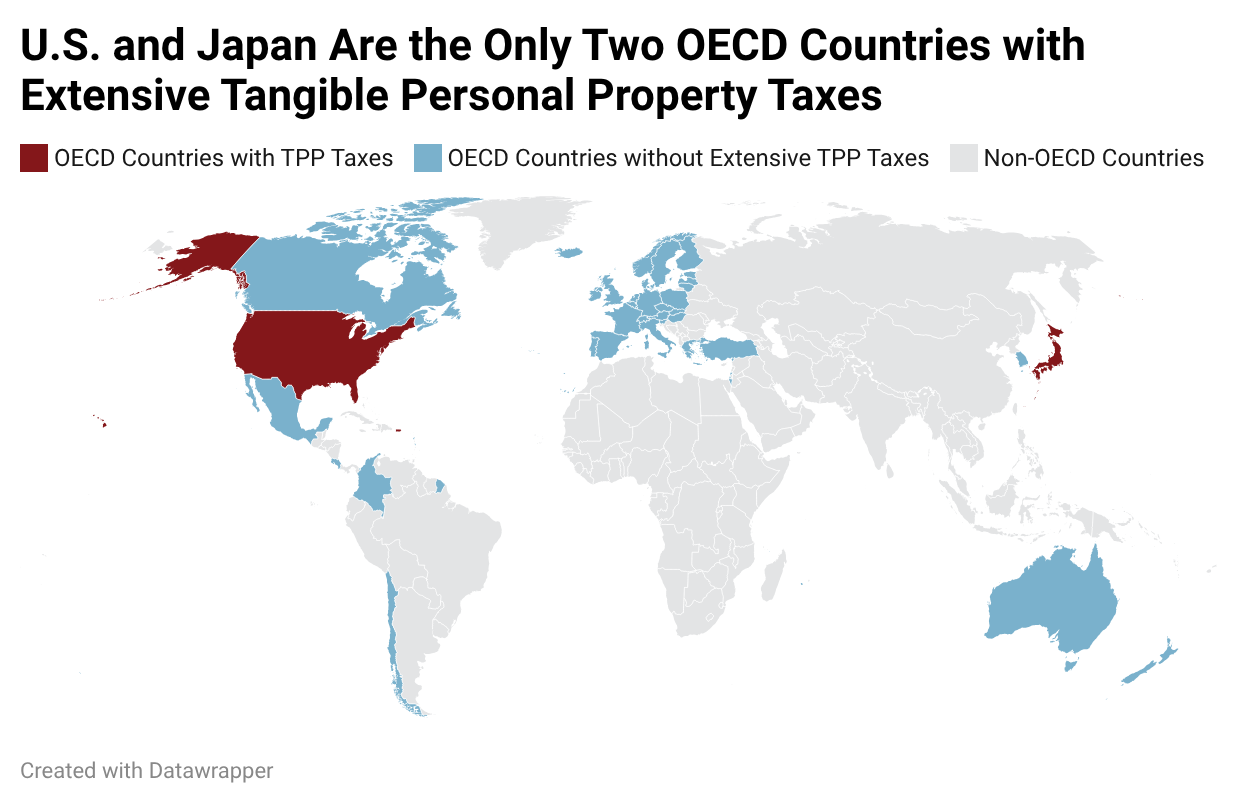
Most countries have moved away from taxing tangible property. Among the 38 countries in the Organisation for Economic Co-operation and Development (OECD),14 the United States is one of only seven with taxes on personal property, and most other regimes are not as extensive as that in the U.S., leading the tax on personal property to be called “the most American of property tax institutions” as early as 1966 in recognition of the rarity of taxing TPP elsewhere.15 Japan is the only other major economy to have widespread taxation of tangible personal property, following the repeal of similar taxes in France and Russia. U.S. taxation of personal property has declined over time, from constituting more than 30% of property taxation in the 1860s to about 17% in 1956 and down to about 10% in more recent decades.16
Heavy TPP taxation slows the rate of new investment, making it more expensive for data centers to refresh servers. This not only undercuts their competitiveness but also impairs a key channel by which data centers benefit the local economy: the outside jobs associated with supporting these facilities’ constant technological churn. And when businesses, including small Main Street businesses that seem far removed from debates around cutting-edge technology, use cloud services in the course of their operations, they bear some of the burden of those higher taxes on cloud servers.
Defining Tangible Personal Property: Why Details Matter for Everyday Americans
The definition of tangible personal property is downstream of real property. Most states define it as all property that is neither real nor intangible, rather than classifying TPP by specific characteristics. Texas defines personal property as “property that is not real property” and tangible personal property as “personal property that can be seen, weighed, measured, felt, or otherwise perceived by the senses.”17 North Carolina specifies that tangible personal property consists of “all personal property that is not intangible and that is not permanently affixed to real property.”18 Appraisers typically stress that personal property is movable, which represents a key distinction between real and personal property.19 What constitutes tangible personal property, therefore, depends on what counts as real property, which can vary from state to state.
Definitions matter because the distinction between real and tangible property governs assets’ taxability (in states that do not tax TPP) and tax treatment (in states that tax both real and tangible property). Personal property, to the extent that it is taxed, is depreciated, while real property is not.
Land and structures are unambiguously real property, and “fixtures” are usually considered real property as well. Illinois, which does not tax tangible personal property, is typical in this regard, defining real property as “all buildings, structures and improvements, and other permanent fixtures.”20 A great deal turns on what counts as a fixture.
Under the traditional fixture test, appraisers consider (1) annexation to real estate, (2) adaptation to the use of real estate, and (3) intent of the annexing party. By way of shorthand, anything that is permanently installed, and which is functionally immovable without destroying it or the other real property to which it is affixed, counts as real property.21 Conventionally, definitions often turn on whether an asset is truly affixed or “bolted down.” However, many pieces of equipment are affixed to real property but can still be transferred between facilities or repurposed to suit the needs of the operation, not the real property itself, complicating the analysis.22 States often regard assets as permanently affixed, even when, in practice, they can be and sometimes are relocated or repurposed without damage.
TPP Definitions and Data Centers—Often Confusing Translations
For a data center, a conventional approach to fixtures would mean that a generator or chiller installed as part of the broader facility may be taxed as real rather than personal property, whereas a modular unit is tangible property. A generator may be classified as “permanently” affixed under state law, even if that permanence is contestable.
Some states, however, either enumerate what constitutes tangible personal property or, conversely, begin with a very broad definition and list the exclusions. New York, for instance, counts “mains, pipes, and tanks” for conducting steam, heat, water, and electricity, and “boilers, ventilating apparatus, elevators, plumbing, heating, lighting and power generating apparatus . . . and equipment for the distribution of heat, light, power, gases and liquids” as real property, a list that encompasses server room air conditioners, switchgear, transformers, and other data center equipment.23
Virginia’s definition of fixtures includes generators, fuel storage tanks, electrical substations, batteries, chillers, HVAC systems, cooling towers, radiators, exhaust fans, water storage and pumping, monitoring systems, transmission and distribution equipment, and surveillance and security systems—practically all of a data center’s mechanical and electrical equipment, excluding the servers themselves. Notably, these are not general definitions for real property. These types of property are classed as real property in Virginia specifically when they are “used in a data center.”24
States like Ohio, by contrast, begin with an expansive definition of real property that, without exclusions, would encompass a large swath of tangible property, but then carve out specific classes of property, including machinery, equipment, and distribution systems. In Ohio, even if tangible property is permanently affixed, it is considered TPP if it “primarily benefits the business” rather than the real estate.25
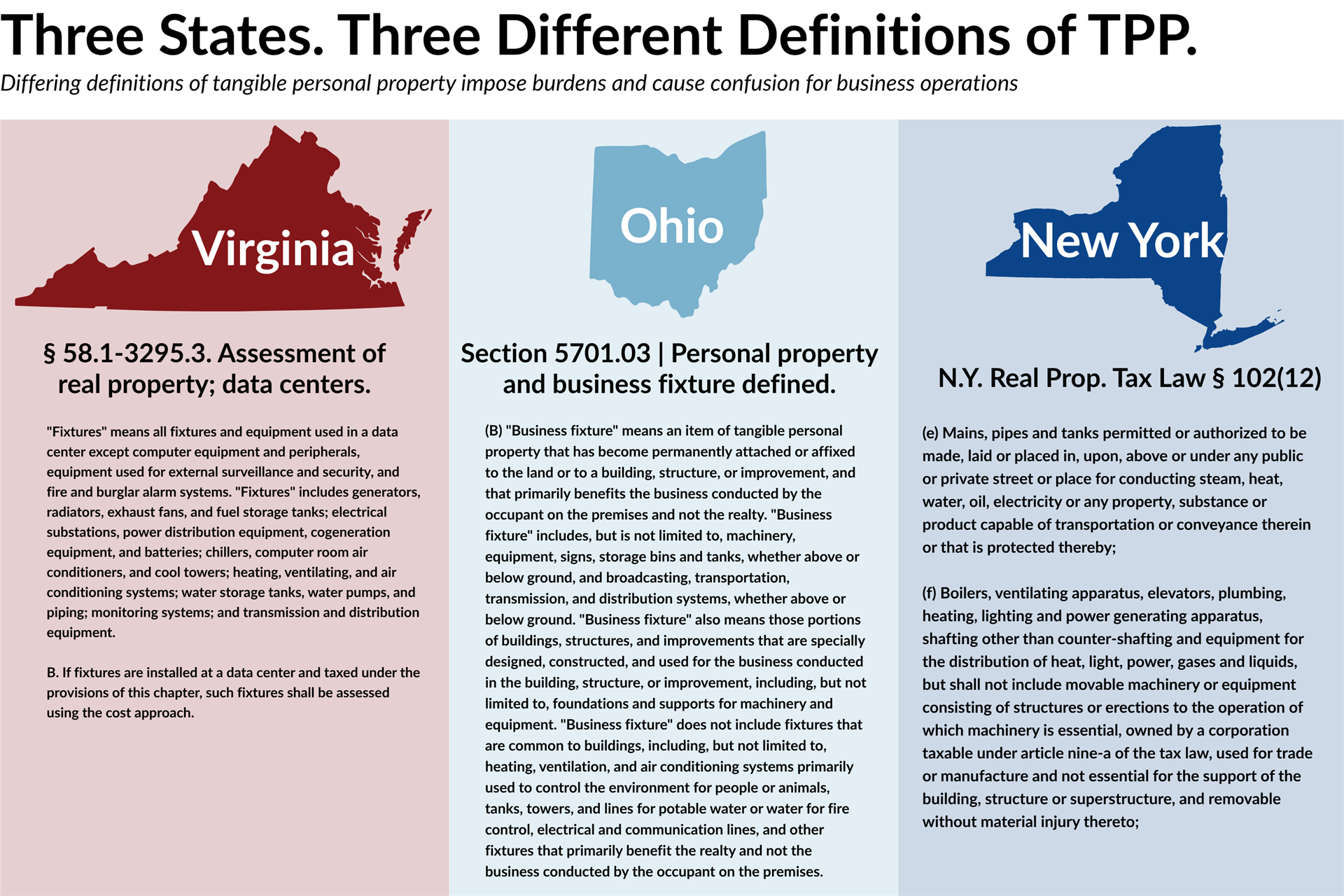
In Virginia and other states that tax both real and tangible personal property, the definitions matter because real and tangible personal property tax regimes differ. In a state like Ohio, which does not tax TPP, the definitions are important because they determine whether certain property ordinarily considered TPP elsewhere can be taxed under the real property tax.
Tangible personal property is typically revalued annually under depreciation schedules, while fixtures are valued by the appraisal of the real property. When rapidly depreciating assets are classed as real property, this can lead to overvaluation. Different effective rates on real and tangible property can also have significant tax implications.
Valuing and Depreciating Tangible Personal Property: Especially Harmful to Technology
States vary in how they value and depreciate personal property. These differences are of particular importance to data centers, which have capital-intensive investment in assets that become rapidly obsolete and must be replaced regularly. Depreciation schedules and valuation standards are often poorly calibrated for assets that lose value so quickly, overstating their residual value for tax purposes. Tangible personal property taxation is inherently more burdensome on capital-intensive industries, but it becomes a particularly aggressive tax for businesses at the cutting edge of technological innovation—a category that includes data centers, as well as many other technological, medical, and scientific research and development facilities, and advanced manufacturers.
Personal property is assessed according to its current value, which is some depreciated fraction of its original, replacement, or reproduction value. It can be valued based on sales comparison, income capitalization, or cost, though, in practice, most TPP is valued on a cost basis, which is simpler and more administrable.26 The other approaches primarily arise in tax disputes, where taxpayers may use them to rebut cost-basis presumptions.
Businesses are required to report acquisition costs of all tangible personal property, and this original cost is the most common baseline for valuing TPP. Some states, however, instead specify “reproduction cost new” or “replacement cost new” as the basis for valuing TPP.27
Under a “percentage of original cost” framework, depreciation schedules are applied against the original acquisition cost to determine current taxable value. “Reproduction cost new” is typically achieved by using a trended cost less depreciation, with the state applying a classification-specific cost index to estimate the cost of newly reproducing property of the same quality. For a three-year-old server, then, this would be an estimate of the contemporary cost of reproducing a new server with three-year-old technology and specifications. By contrast, “replacement cost new” attempts to estimate the cost of reproducing the benefit of the existing property. This might represent the cost of a new, higher-tech server, prorated for the portion of it necessary to yield the computational power of the existing server.
The “reproduction cost new” approach is uniquely likely to overstate value for any asset class involving rapid innovation. No one is reproducing servers with three-year-old specifications. Trending the acquisition cost yields valuations that have very little to do with actual market value. Unfortunately, many states that purport in statute to use “replacement cost new” actually use trended values that are better described as a reproduction-cost approach.
Technology’s Unique Challenge—Rapid Obsolescence
Whatever method the taxing authority uses to determine the initial valuation, that value must then be depreciated to reflect how far along the property is in its usable life. This can be uniquely challenging with technology, particularly fast-changing technology like data center equipment.
For many classes of property, degradation is slow, and utility is close to binary. An older HVAC system is worth less than a brand-new one because it may fail and need replacement sooner, but as long as it is working, it performs almost the same function as a newer system. The same goes for a typical piece of manufacturing machinery. Eventually it may break down, but its productivity in year ten may be identical to its productivity in year one.
This is not true for computer equipment, particularly cutting-edge servers, as newer servers rapidly eclipse them in quality. Physically speaking, a three-year-old server may still be in good condition, but it has already lost substantial value compared to newer servers, and it may be rapidly approaching obsolescence. An older piece of machinery is less valuable because it is nearer to the end of its useful life, but not because it has already lost significant productivity. A server, by contrast, may still “work” for several more years but already be functionally worthless.
Depreciation schedules define an asset’s useful life, set the curve by which value declines across that useful life, and typically establish a residual floor at which depreciation stops while the property remains in use. States tend not to have specific classifications for data center equipment, usually classifying servers under a broader category of “computer equipment.” These schedules typically feature relatively short asset lives and low floors, but even relatively fast depreciation schedules can dramatically overstate the remaining value of older servers and other data center equipment. (When the District of Columbia undertook a comprehensive tax review, the inadequacy of TPP depreciation schedules for computer equipment was called out particularly.28) Worse, such equipment sometimes shares a schedule with much longer-lived equipment associated with traditional manufacturing.
States usually allow companies to seek reductions in appraised value by claiming obsolescence, but that relief can be difficult to obtain even where theoretically permitted under state law. It often requires litigation, rather than being incorporated into the ordinary appraisal process.
Abating Tangible Personal Property Taxes
Cognizant of the burden of TPP taxes on capital-intensive businesses, many states offer relief to some or all businesses. Broadly speaking, this relief comes in three forms:
- Definitional exclusion of some subclasses of tangible property from the tax base
- Lower effective tax rates on select TPP subclasses
- Abatement of tax burdens for qualifying projects
Some states provide by-right exemptions for certain classes of property, like manufacturing machinery and equipment. Data centers are rarely eligible for these exemptions, which usually apply to specific industry classifications, whereas the exemptions can take the machinery and equipment of traditional manufacturers off the books entirely. Other states create a range of TPP subclasses, or permit localities to do so, with different tax rates or assessment ratios for distinct types of property. These, too, tend to benefit traditional manufacturing over data centers.
Finally, state and local governments are sometimes authorized to provide direct abatements of TPP tax liability through incentive packages for certain projects. Some of these abatements are automatically conferred subject to meeting eligibility thresholds, but many are discretionary. Data centers are eligible for such incentives in some, but not all, states with abatement programs. Oregon, for instance, offers abatements for qualified investments in new property in rural enterprise zones, an incentive not specific to data centers but one some data centers have harnessed.29 Florida, which offers economic development incentives to manufacturers, has a special abatement for data centers that requires local referendum authorization.30
Notably, while manufacturing equipment is often exempt by right, any relief for data center equipment is almost invariably structured as an incentive and is often discretionary. Sound tax policy is neutral, not discriminating against select industries or using the tax code to reward or penalize specific kinds of investments.
Tax Treatment by State
This paper provides state-level detail on the tax treatment of data center and manufacturing equipment in the top 20 states for data center investment. These states were identified using the Data Center Map database,31 which primarily tracks colocation and cloud service providers but also includes hyperscale operators, mapping 4,287 data centers across the U.S. This analysis is based on facility count, not expenditures or capacity.
These data were cross-checked with two analyses based on investment rather than facility count, PwC’s “Economic Contributions of Data Centers in the United States” report (produced for the Data Center Coalition),32 and the Colliers 2026 “Data Center Marketplace Report,” which reports on 19 key data center markets across 14 states.33 These three datasets, which use different measures, yield substantial, though not complete, overlap. Sixteen states make the top twenty ranking on both the PwC and Data Center Map lists, and only one state (Utah) ranks outside the top twenty under one of those lists but appears on the Colliers list as an emerging data center market.
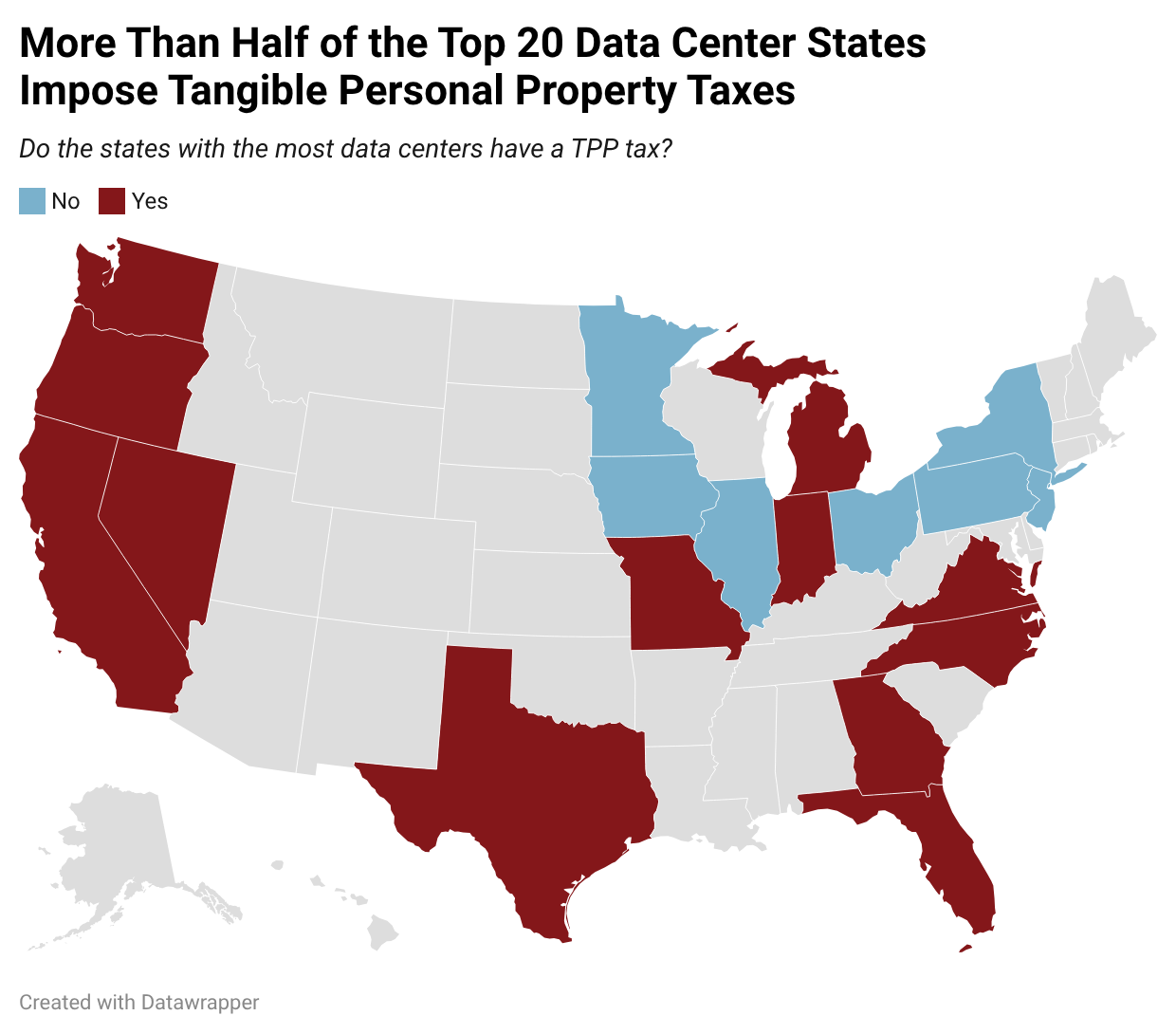
Of these top twenty states, thirteen tax tangible personal property, while seven exempt TPP from property taxation. Definitional boundaries of real and personal property are important everywhere, as the two classes of property are assessed differently. However, the distinction is particularly important in states without a TPP tax, as the definition of real property determines whether data center equipment other than servers and computer equipment is subject to property taxation.
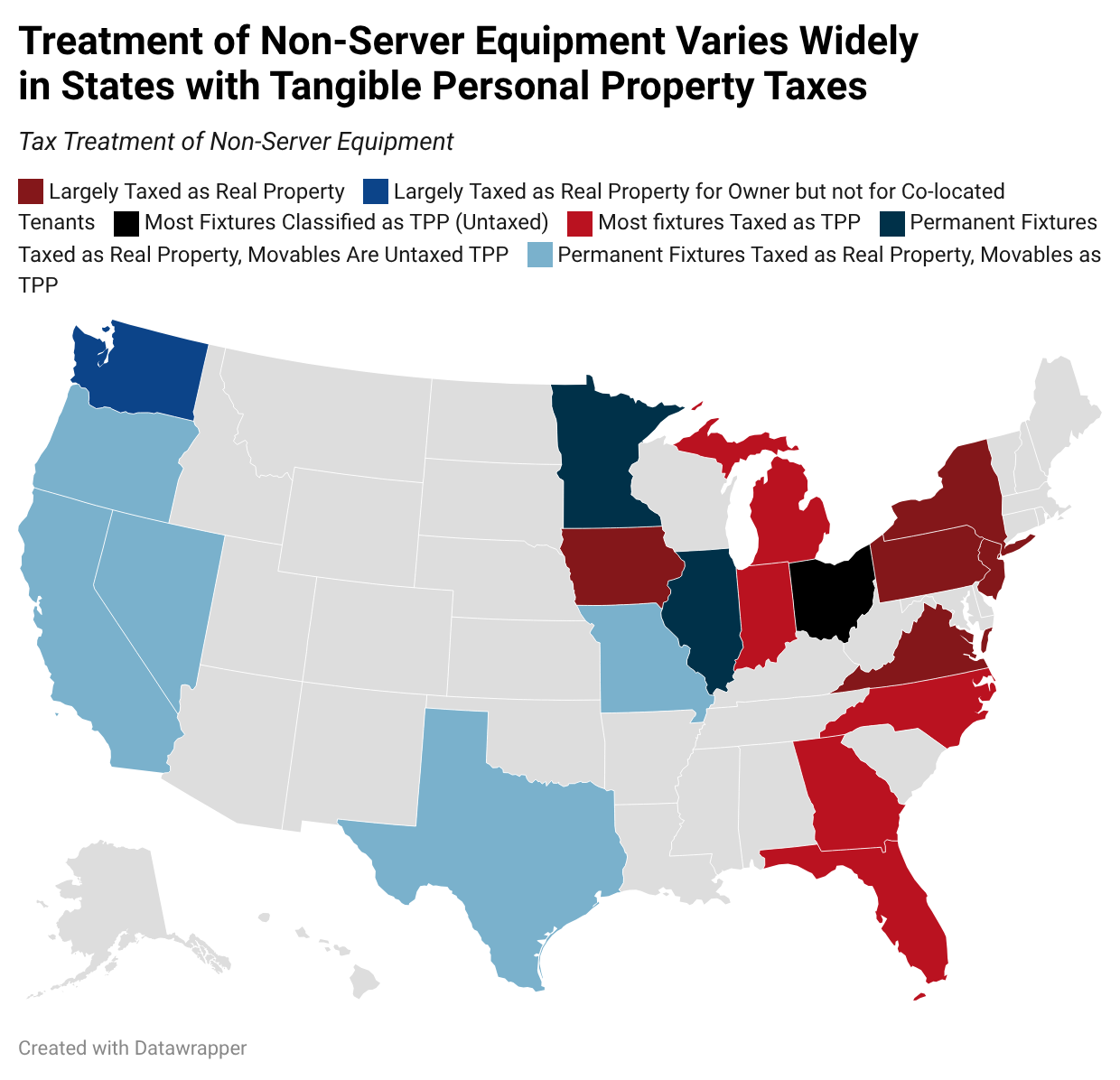
State Taxation of Data Center Tangible Personal Property
State | TPP Tax | Treatment of Non-Server Equipment |
Arizona | Yes | Fixtures taxed as real property, movables as TPP |
California | Yes | Permanent fixtures taxed as real property, movables as TPP |
Florida | Yes | Most fixtures taxed as TPP |
Georgia | Yes | Most fixtures taxed as TPP |
Illinois | No | Permanent fixtures taxed as real property, movables are untaxed TPP |
Indiana | Yes | Most fixtures taxed as TPP |
Iowa | No | Largely taxed as real property |
Michigan | Yes | Most fixtures taxed as TPP |
Minnesota | No | Permanent fixtures taxed as real property, movables are untaxed TPP |
Missouri | Yes | Permanent fixtures taxed as real property, movables as TPP |
Nevada | Yes | Permanent fixtures taxed as real property, movables as TPP |
New Jersey | No | Largely taxed as real property |
New York | No | Largely taxed as real property |
North Carolina | Yes | Most fixtures taxed as TPP |
Ohio | No | Most fixtures classified as TPP (untaxed) |
Oregon | Yes | Permanent fixtures taxed as real property, movables as TPP |
Pennsylvania | No | Largely taxed as real property |
Texas | Yes | Permanent fixtures taxed as real property, movables as TPP |
Virginia | Yes | Largely taxed as real property |
Washington | Yes | Largely taxed as real property for owner but not for colocated tenants |
Sources: state statutes and regulations; author’s research.
Depreciation schedules for data center TPP vary widely, and servers are typically included under different schedules than other, less rapidly depreciating equipment. In Arizona, the state values most newly acquired business personal property at 2.5% of original cost, with no further depreciation, whereas other TPP-taxing states with a significant data center presence have depreciation schedules running four to eleven years for servers.
The following table shows the relevant depreciation curve for servers in each of these TPP-taxing states, along with the valuation method used. In most states, depreciation schedules are the same statewide, but local governments can set their own schedules in Florida, Texas, and Virginia. In an extreme case of in-state variation, Loudoun County, Virginia’s tax rate on data center personal property is $4.15 per $100, while Wise County’s is $0.24, and Wise County also has a more favorable depreciation schedule. Across five years, Loudoun’s cumulative tax burden is 23 times Wise’s.
For purposes of the below table, a default representative depreciation schedule is used for Florida and Texas, though local governments can diverge from it, and, in Virginia, Loudoun County’s depreciation schedule is used.
Depreciation Schedules for Data Center Servers
Year | AZ | CA | FL | GA | IN | MI | MO | NV | NC | OR | TX | VA | WA |
1 | 2.5% | 73% | 87% | 76% | 40% | 60% | 85% | 60% | 80% | 76% | 78% | 60% | 75% |
2 | 2.5% | 47% | 71% | 51% | 56% | 44% | 59.5% | 36% | 62% | 60% | 56% | 45% | 56.7% |
3 | 2.5% | 30% | 56% | 30% | 42% | 32% | 41.7% | 22% | 42% | 43% | 35% | 30% | 45.1% |
4 | 2.5% | 19% | 43% | 10% | 32% | 24% | 25.0% | 13% | 21% | 32% | 13% | 15% | 34% |
5 | 2.5% | 12% | 32% | 10% | 24% | 19% | 10% | 5% | 5% | 23% | 10% | 10% | 24.8% |
6 | 2.5% | 8% | 24% | 10% | 18% | 15% | 10% | 5% | 5% | 14% | 10% | 5% | 17.9% |
7 | 2.5% | 5% | 20% | 10% | 15% | 8% | 10% | 5% | 5% | 10% | 10% | 5% | 13.3% |
8 | 2.5% | 3% | 20% | 10% | 15% | 8% | 10% | 5% | 5% | 10% | 10% | 5% | 9.8% |
9 | 2.5% | 2% | 20% | 10% | 15% | 8% | 10% | 5% | 5% | 10% | 10% | 5% | 7.1% |
10 | 2.5% | 2% | 20% | 10% | 15% | 8% | 10% | 5% | 5% | 10% | 10% | 5% | 5.1% |
11 | 2.5% | 2% | 20% | 10% | 15% | 8% | 10% | 5% | 5% | 10% | 10% | 5% | 5% |
Floor | 2.5% | 2% | 20% | 10% | 15% | 8% | 10% | 5% | 5% | 10% | 10% | 5% | 5% |
Method | Orig. | Mkt. | Repr. | Repr. | Orig. | Orig. | Orig. | Repr. | Repr. | Orig. | Repr. | Orig. | Repr. |
Note: Valuation methods are simplified into four classes: Original Cost (Orig.), Market Valuation (Mkt.), Reproduction Cost (Repr.), and Replacement Cost (Repl.). Statutes in Florida, Texas, Nevada, and North Carolina use “replacement cost” terminology but use index-trended factors that mechanically yield reproduction rather than replacement costs. This table classifies them by their functional result rather than by the verbiage employed by these states. Typical depreciation schedules are used for Florida and Texas, but local governments may diverge from these. Virginia’s depreciation schedules are set by cities and counties; here, Loudoun County’s is used as representative.
Sources: state regulations and guidance; author’s research.
In a server’s third year of operation, when it would likely be due for replacement in a high-tech AI-oriented data center, Florida still values the server at 56% of its original cost. Among states considered, Indiana, Missouri, North Carolina, Oregon, and Washington also treat the server as at least 40% “good,” even though the server is approaching obsolescence.34
In two of the top twenty states for data center investment, personal property is taxed at a different rate or assessment ratio than commercial real property.35 Missouri has a small ratio differential, 33.3% for personal property and 32% for commercial real property. In Virginia, where localities establish separate tangible personal property taxes, rate differentials can be meaningful and are broken up by subclasses. The general TPP rate is typically several multiples of the real property rate, though certain equipment, including data center computer equipment, tends to be taxed at a rate between the two extremes.
Beyond this, however, real property sometimes enjoys other advantages unavailable to personal property. In states like California, Florida, Michigan, and Oregon, for instance, assessment limits constrain the annual valuation growth of real property, a protection unavailable to tangible personal property.
Many of the states considered provide discretionary abatements, often tied to operating in economically disadvantaged areas. These discretionary incentives tend to favor traditional manufacturers over data centers, though historically some data centers have obtained them as well—more in some states than others. Michigan stands out in exempting the TPP of traditional manufacturers by right but not offering similar treatment to data centers.
TPP Tax Treatment in the Big Seven
Seven states currently dominate the data center landscape. Virginia and Texas are the undisputed top two, with California, Illinois, Georgia, Ohio, and Arizona also hosting a significant share of data center facilities. California, however, despite its historic strength due to Silicon Valley, is rapidly losing ground. According to a Pew Research analysis of proprietary data, California has 11.7% of the Big Seven’s current data centers, but accounts for only 3.7% of the planned future data centers across those states.36 In fact, California and Indiana (a state well outside the top seven) currently have the same number of planned future data centers, with Pennsylvania just behind, indicating California’s slide.
Virginia
Virginia’s personal property tax rates are set by local tax authorities, but the structure invariably imposes higher burdens on data centers than on most other business types, particularly traditional manufacturers. This is a byproduct not only of rates but of tax base definitions.
Virginia’s tax on tangible personal property is unusual, as it has three subdivisions: a standard business personal property tax, a machinery and tools (M&T) tax for manufacturing machinery and equipment, and a merchant’s capital tax for business inventory. Counties and independent cities are free to set not only their own rates, but also their own classifications and depreciation schedules for business personal property taxes.37 Manufacturing equipment subject to the M&T tax receives preferential rates compared to other classes of taxable tangible property.
Loudoun County, Virginia, the Commonwealth’s “Data Center Alley,” has a personal property class for “computer equipment in a data center,” with a rate of $4.15 per $100 in value (the county’s ordinary rate for TPP). Loudoun uses a six-year depreciation schedule, valuing servers and other data center computer equipment at 60% of initial purchase price in the first year, declining to 45, 30, 15, 10, and finally 5%, where it remains as long as it is in service.38 Virginia statutorily defines the mechanical and electrical build-out as real, not tangible, property.39
Real property does not depreciate and is assessed at full market value, but the real property tax rate is $0.805 per $100, meaning that, in the first year, data center computer equipment is taxed at more than three times the effective rate on real property. Under Loudoun’s depreciation schedules, servers kept in place for three years would face an average effective rate that is 2.3 times that of real property. Loudoun’s M&T tax is levied at $2.75 per $100, though with a slower depreciation schedule.
Virginia also statutorily defines tangible personal property used in manufacturing, other than machinery and equipment, as intangible (notwithstanding it being “tangible in fact”), and thus exempt from tangible personal property taxation.40 This applies to the furniture, fixtures, and even computer equipment of manufacturers, whereas data centers enjoy no such exemption, with all such equipment—even electrical and cooling equipment that could be identical to systems used in a manufacturing facility—classified as either real or tangible property, and taxed accordingly.
Virginia’s system can vary greatly from county to county. It frequently results in uncommonly high tax burdens on the share of data center property classified as personal property, but data centers benefit from the fact that many assets that would be classified as personal property in other states are treated as real property in Virginia, where real property rates are much lower than personal property tax rates.
Texas
In Texas, each appraisal district develops its own depreciation schedules, and each taxing district sets its own property tax rate. Schedules vary, but the rate is the same (and applied to the full market value) for all property. Large-scale new capital investments frequently receive Chapter 312 property tax abatements, which can abate property taxes owed to cities, counties, and special districts (but not school districts) for up to ten years.41 These abatements are discretionary and negotiated but are at least potentially available to all commercial and industrial new development, expansion, or modification.42
Approval requires a public hearing, and the abatement’s criteria and terms are negotiated and must be approved by a majority vote of the governing body of each taxing unit. Because Texas has high property tax costs, these abatements are often relied upon by many industries to reduce the upfront cost of new investment.
But, while Chapter 312 abatements can be significant, school districts are responsible for the majority of the property tax burden in Texas, and abatements of school property taxes on TPP are channeled through the Jobs, Energy, Technology, and Innovation (JETI) Act of 2023. These abatements are available to traditional manufacturers but, notably, not to data centers.43 Because Texas has high property tax rates, real and especially personal property tax burdens drive above-average total effective rates on data centers.
California
In California, both real and personal property are taxed at the same rate in each jurisdiction. Abatements are prohibited by the uniformity clause. The only meaningful distinctions are based on classification of assets as real or personal property, because real property is subject to assessment limits under Proposition 13, whereas personal property is always appraised at full cash value.
California’s treatment of data center servers and networking equipment is more sophisticated than most, using reproduction cost reduced by both depreciation and obsolescence, with a depreciation curve derived from market studies, which has been characterized as a “market cost” approach. Whereas California stands out negatively for its unusually aggressive sales taxation of the acquisition of data center TPP, the state’s property tax treatment of that equipment, once purchased, is better than average, with a valuation framework that acknowledges the rapid obsolescence of data center servers.44
Illinois
Tangible personal property has not been taxable in Illinois since 1979. Its taxation is prohibited by the state constitution,45 with the local revenue loss offset by surtaxes on the corporate income tax and on pass-through income taxed under the individual income tax, called “personal property replacement taxes.” Servers and networking equipment are therefore exempt, though permanently installed fixtures such as generators, switchgear, and chillers can fall under real property tax classifications.
Georgia
In Georgia, real and tangible personal property are taxed at the same ratio of fair market value, and trade fixtures are taxed as personal, not real, property. This means that not just servers, but also electrical systems, generators, and other equipment are taxed as personal property, and subject to depreciation. Georgia law stipulates that fair market value for machinery, equipment, and fixtures should take obsolescence into account,46 and the state’s Appraisal Procedures Manual specifies that this includes loss of value from the “appearance in the market of a more innovative design,”47 which is particularly pertinent to data centers’ server equipment.
Because the state constitution mandates uniformity, local governments cannot provide abatements directly, though TPP relief is sometimes provided indirectly through a system by which a development authority takes title to a property (which then becomes tax-exempt) and leases it back to the company alongside a negotiated payment in lieu of taxes (PILOT) designed to represent a discount compared to full taxation.48 These abatements are theoretically available to all industries, but as they are discretionary, in practice their issuance is likely to embed political preferences.
Ohio
Ohio fully phased out its tax on business tangible personal property in 2009 and statutorily defines most industrial build-out as personal property.49 Affixed property that “primarily benefits the business conducted by the occupant” is TPP and thus untaxed.50 This makes Ohio’s property tax regime one of the more favorable for capital-intensive industries, including (though certainly not limited to) data centers. Elimination of TPP taxes was part of a broader tax package that also saw the introduction of a gross receipts tax, the Ohio Commercial Activity Tax (CAT), which applies to gross revenue without regard to profitability.51
Arizona
In Arizona, most new business personal property does not depreciate. It is valued at 2.5% of acquisition cost indefinitely, across most business asset types,52 the result of reforms adopted in 2022 that dramatically reduced the taxation of tangible personal property.53 The reforms collapsed existing depreciation schedules, which varied by class, into a new, low valuation. This resulting value is multiplied by the commercial and industrial assessment ratio (15.5% in 2026), effectively meaning that rates are imposed on about 0.4% of the original cost. Arizona uses low assessment ratios for other classes of property as well, including residential real property, so rates are higher to reflect these valuation rules. This still leaves only very modest tangible personal property tax liability, whether for data centers, traditional manufacturers, or any other businesses.
TPP Tax Treatment in Other Competitive States
Tangible personal property is exempt from tax in five of the other thirteen states in the top twenty data center markets: Iowa, Minnesota, New Jersey, New York, and Pennsylvania. Each of these states, however, defines taxable real property broadly—at least for data centers.
Minnesota and New York classify most fixtures as real property regardless of business type, subjecting these assets to the property tax despite not taxing TPP. In Pennsylvania, fixtures of “industrial establishments” are classed as tangible property (and thus untaxed), while commercial fixtures are taxed as real property, so the taxation of data center TPP depends upon whether a property is treated as commercial or industrial.54 In Iowa, attached machinery, equipment, and improvements are exempt for manufacturing establishments but taxable for other industries, including data centers.55 And, in New Jersey, most attached fixtures are real property, but whether generators, chillers, and certain other equipment are taxable real property or exempt personal property hinges on whether the business activity is a “production process,” a determination that favors traditional manufacturers.56
Of the eight remaining states in the top twenty that tax personal property, four (Indiana, Michigan, Missouri, and Oregon) value TPP by percent of original cost and four use reproduction cost (Florida, North Carolina, Nevada, and Washington), notwithstanding statutory language that sometimes references replacement cost. Most take obsolescence into account, but Indiana only accounts for “abnormal obsolescence”57 and Michigan’s standards for demonstrating obsolescence are particularly high. In all cases, the burden of proof tends to be with taxpayers, and obsolescence is rarely factored in by assessors on their own.
Discretionary abatements of some or all TPP liability are available in Florida, Indiana, Michigan, Nevada, North Carolina, and Oregon, often primarily or exclusively in economically distressed areas or designated enterprise zones.58 Indiana and Nevada have specific provisions regarding data centers, while, in the other states, data centers are theoretically on a level playing field with other industries, though the discretionary nature of these abatements can lead to preferential treatment of some industries—likely not data centers—over others. Notably, Michigan exempts manufacturers’ TPP by right,59 but does not do the same for data center TPP.
Conclusion
Tangible personal property taxes discourage capital investment. That is true for all industries, but is particularly significant for capital-intensive businesses, and especially for those employing cutting-edge technology, where technological advancement outpaces traditional depreciation schedules. This is not just a data center issue; it is a technology, science, and health innovation problem. It is an issue for any company investing heavily in technology or engaging in substantial research and development, particularly if that business does not qualify as a manufacturer.
Since 2005, Kansas, Maine, Ohio, and Wisconsin have repealed TPP taxes, while Michigan has eliminated them on manufacturing but not on other personal property, including data center equipment. Ideally, more states should wean themselves off these outmoded taxes. But, even where that is not presently a viable option, lawmakers should work to ensure that rates, valuation methods, depreciation schedules, and obsolescence standards do not penalize technological investment, whether in data centers or other innovative firms. Depreciation schedules for servers and other frequently replaced assets should be short, obsolescence should not be unduly difficult for taxpayers to demonstrate, and TPP systems should avoid “reproduction cost” methods that overstate the value of older technology.
Unduly harsh TPP taxation reduces capital expenditures, undermines economic growth, and pushes productive activity across state borders. Capital investment is good for communities. Smart tax policies treat it that way.
1 For the first paper, on sales taxation of data center equipment, see Jared Walczak, “Sound Policies, Not Subsidies: Data Center Equipment Tax Exemptions,” National Taxpayers Union, July 22, 2026, https://www.ntu.org/publications/detail/sound-policies-not-subsidies-data-center-equipment-tax-exemptions.
2 Id.
3 U.S. Senate Committee on Finance, “Proposal for the Taxation of Data Centers,” Senate Finance Committee Democratic Staff White Paper, Aug. 6, 2026, https://www.finance.senate.gov/imo/media/doc/080626_wyden_data_center_tax_white_paper.pdf; Data Center Tax Accountability and Disclosure Act of 2026, S. 5054, 119th Cong. (2026).
4 John L. Mikesell, “Patterns of Exclusion of Personal Property from American Property Tax Systems,” Public Finance Quarterly 20:4 (October 1992): 537.
5 Even this real property proxy can break down to the degree that structures and fixtures dominate a parcel’s real property value. Data centers’ real property consists of land, costly structures, and expensive fixtures, with values that are vastly disproportionate to the services the property and its employees receive, generating a large fiscal surplus.
6 Technically, land can be restored or reclaimed in ways that render it habitable when it previously was not—in extreme cases, even by infill that allows construction on what was previously water, but these are edge cases, and it remains true that the geographic area is fixed, and what is at issue here is the investment in productive capacity. Indeed, the willingness to expend resources reclaiming otherwise unusable property testifies to the fixedness of land: the effort made to infill tidal flats to build Boston’s Logan International Airport was only justifiable because of the value of land in Boston.
7 Stephen T. Mark, Therese J. McGuire, and Leslie E. Papke, “The Influence of Taxes on Employment and Population Growth: Evidence From the Washington, D.C. Metropolitan Area,” National Tax Journal 53:1 (2000): 119.
8 Yohei Kobayashi, Motohiro Sato, and Masaaki Suzuki, “Empirical Studies on Effect of Property Tax on Capital Investment,” RIETI Discussion Paper No. 18-J-031 (Nov. 2018).
9 Yonghong Wu, “Property Tax Exportation and Its Effects on Local Business Establishments: The Case of Massachusetts Municipalities,” Economic Development Quarterly 24:1 (2010): 3-12.
10 Bev Dahlby, Ergete Ferede, and Mukesh Khanal, “The Impact of Property Taxation on Business Investment in Alberta,” The School of Public Policy Publications 14:8 (March 2021), 2, https://ssrn.com/abstract=3834589.
11 Eric Ohrn, “The Effect of Tax Incentives on U.S. Manufacturing: Evidence from State Accelerated Depreciation Policies,” Journal of Public Economics 180 (2019).
12 Mikesell, 539.
13 National Conference of State Legislatures, “Principles for the Taxation of Business Personal Property,” Executive Committee Task Force on State and Local Taxation, Jan. 9, 2016, https://documents.ncsl.org/wwwncsl/Task-Forces/SALT/PPTax_StatementofPrinciples.pdf.
14 Andrey V. Korytin and Tatiana A. Malinina, “Международный опыт налогообложения движимого имущества организаций” [“International Experience in Taxation of Business Personal Property”], inansovyj žhurnal — Financial Journal, No. 2, 2019, 22-36, https://econpapers.repec.org/article/frufinjrn/190202_3ap_3a22-36.htm.
15 Mikesell, 529, quoting Netzer (1966).
16 Id., 532.
17 Tex. Tax Code Ann. § 1.04(4)-(5).
18 N.C. Gen. Stat. § 105-273(14).
19 International Association of Assessing Officers, “Standard on Valuation of Personal Property: A Criterion for Measuring Fairness, Quality, Equity and Accuracy,” Nov. 2018, https://www.iaao.org/wp-content/uploads/StandardValuationPersonalProperty.pdf.
20 35 ILCS 200/1-130.
21 International Association of Assessing Officers, 2.
22 Nicholas W. Carter, “Where’s the Real Estate? Redundancies, Servers, Edge Sites, and the Search for Real Property’s Role in the Modern Data Center,” The Appraisal Journal 1-2 (2024), 33-34, https://www.appraisalinstitute.org/getmedia/2b86828c-5131-407d-8cc2-1aab2fca7a9c/taj_issue_1-2-2024_feat2-datacenters.
23 N.Y. Real Prop. Tax Law § 102(12)(e)–(f).
24 Va. Code § 58.1-3295.3.
25 Ohio Rev. Code § 5701.03(B).
26 As noted in one analysis, “Current market-value information on tangible personal property is generally not available, as active markets in used machinery and equipment often do not exist. Moreover, the sales that do occur often are liquidation sales, which would not meet the standard usually imposed for valuing real property — i.e., an arm’s-length transaction between a willing buyer and a willing seller, with neither party under pressure to make the transaction.” John H. Bowman, “Tangible Personal Property Taxation,” in Taxing Simply, Taxing Fairly: Full Report of the District of Columbia Tax Revision Commission (Washington, DC: District of Columbia Tax Revision Commission, 1998), 210, https://cfo.dc.gov/sites/default/files/dc/sites/ocfo/publication/attachments/ocfo_chptf_bowman2.pdf.
27 International Association of Assessing Officers.
28 Bowman, 211.
29 ORS 285C.175 et seq.
30 Fla. Stat. § 196.1995.
31 “USA Data Centers,” Data Center Map, https://www.datacentermap.com/usa/, count as of June 2026.
32 PwC, “Economic Contributions of Data Centers in the United States, 2023-2024,” May 2026, https://www.centerofyourdigitalworld.org/2026-impact-study.
33 Raul Saavedra and Steig Seaward, “2026 Data Center Marketplace Report,” Colliers, March 25, 2026, https://www.colliers.com/en/research/nrep-usdc-data-center-marketplace-2026.
34 In some cases, these older servers may still be used for less exacting data processing tasks, but their value for these secondary uses is low, potentially well below the valuations ascribed by depreciation schedules.
35 At least one other state, Michigan, also yields disparate treatment by exempting some classes of property from certain mill levies. Commercial and manufacturing real property receive partial exemptions in Michigan that real property does not, a case of treating TPP better than real property. However, these exemptions are not available to data centers.
36 Skyler Seets and Kaitlyn Radde, “Most New Data Centers in the U.S. Are Coming to Rural Areas,” Pew Research Center, April 13, 2026, https://www.pewresearch.org/short-reads/2026/04/13/most-new-data-centers-in-the-us-are-coming-to-rural-areas/.
37 In Virginia, independent cities exist outside of counties. The City of Alexandria, for instance, is not in a county, and neighboring Fairfax County has many towns, but no cities.
38 Loudoun County, “Business Personal Property Tax Assessment Schedules,” https://www.loudoun.gov/6301/Business-Personal-Property-Tax-Assessment.
39 Va. Code § 58.1-3295.3.
40 Va. Code § 58.1-1101(A)(2).
41 Tex. Tax Code ch. 312.
42 Texas Taxpayers and Research Association, “Chapter 312: Local Property Tax Abatements,” Feb. 2019, https://ttara.org/wp-content/uploads/2019/02/Chapter312_Revised_2_14_19.pdf.
43 Tex. Gov’t Code §§ 403.601–403.623.
44 California State Board of Equalization, “Assessors’ Handbook, Section 581: Equipment and Fixtures Index, Percent Good and Valuation Factors,” https://www.boe.ca.gov/proptaxes/pdf/ah58123.pdf; Id., Property Tax Rule 6, https://www.boe.ca.gov/proptaxes/pdf/rules/Rule6.pdf.
45 Ill. Const. 1970, art. IX, § 5(c).
46 O.C.G.A. § 48-5-2(3).
47 Ga. Comp. R. & Regs. r. 560-11-10-.02.
48 O.C.G.A. § 36-62-1 et seq.
49 Public utility tangible personal property remains taxable.
50 Ohio Rev. Code § 5701.03(B).
51 Jared Walczak, “Ohio’s Commercial Activity Tax: A Reappraisal,” Tax Foundation, Sept. 26, 2017, https://taxfoundation.org/research/all/state/ohio-commercial-activity-tax-2017/.
52 A.R.S. § 42-13054.
53 H.B. 2822, 55th Leg., 2d Reg. Sess. (Ariz. 2022).
54 53 Pa. Cons. Stat. § 8811(b)(1).
55 Iowa Code § 427A.1(1)(d)–(e).
56 N.J. Stat. Ann. § 54:4-1(a)–(b).
57 50 IAC 4.2-4-8.
58 In North Carolina, these can only take the form of cash grants. Like Georgia, the state uses a workaround due to uniformity requirements within the property tax itself.
59 Mich. Comp. Laws §§ 211.9m–n.