


Congress will soon be asked to increase the $41.1 trillion debt limit. As of October 30, 2026, debt subject to the limit totaled $40.33 trillion, leaving $777 billion in remaining borrowing authority.
National Taxpayers Union’s (NTU) updated projection shows that the debt limit will likely be reached in February 2027. However, contact with the statutory limit does not immediately mean that the federal government will be unable to pay its bills on time. The Treasury can make payments for a limited period of time using incoming receipts, existing cash on hand, and extraordinary measures that can allow additional headroom.
The X-Date, when the Treasury would no longer have sufficient fiscal resources to make all required payments on time, will likely occur by the beginning of December 2027. At debt limit contact in February 2027, we project that the Treasury would have under $1.5 trillion in remaining fiscal resources, which would be exhausted by December 2027.
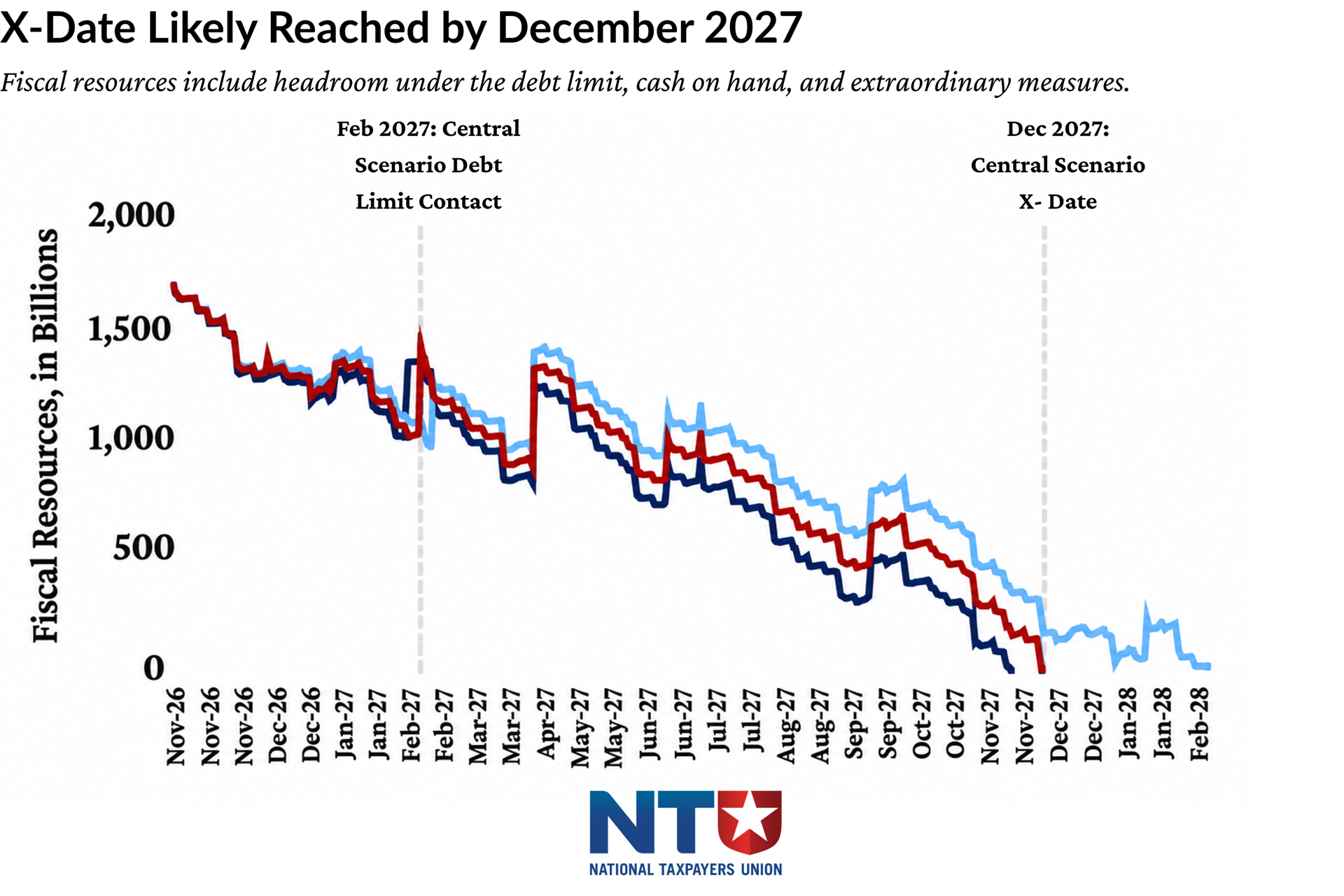
In addition to the central estimate, scenarios with receipts 3% below and above the baseline projection illustrate the effects of larger and smaller deficits. The lower receipts scenario has a debt limit contact of February 2027 and a November 2027 X-Date. The higher receipts scenario has a March 2027 debt limit contact and a February 2028 X-Date. These estimates are subject to considerable uncertainty and will change as additional information becomes available. (A companion report, “What Affects Contact with the Debt Limit and the X-Date?” provides additional detail on the factors affecting the estimates.)
Congress Should Pair the Debt Limit Increase with Responsible Spending Restraint
Policymakers should not wait until the deadline to address the debt limit or the unsustainable budget.
Congress should responsibly enact a debt limit increase in the lame duck session, along with real spending cuts and policy reforms that address the underlying fiscal problem. The budget reconciliation process should be used to increase the debt limit, paired with policy changes to restrain spending. Outside of the reconciliation process, Congress could also pair a debt limit increase with a fiscal commission and spending caps.
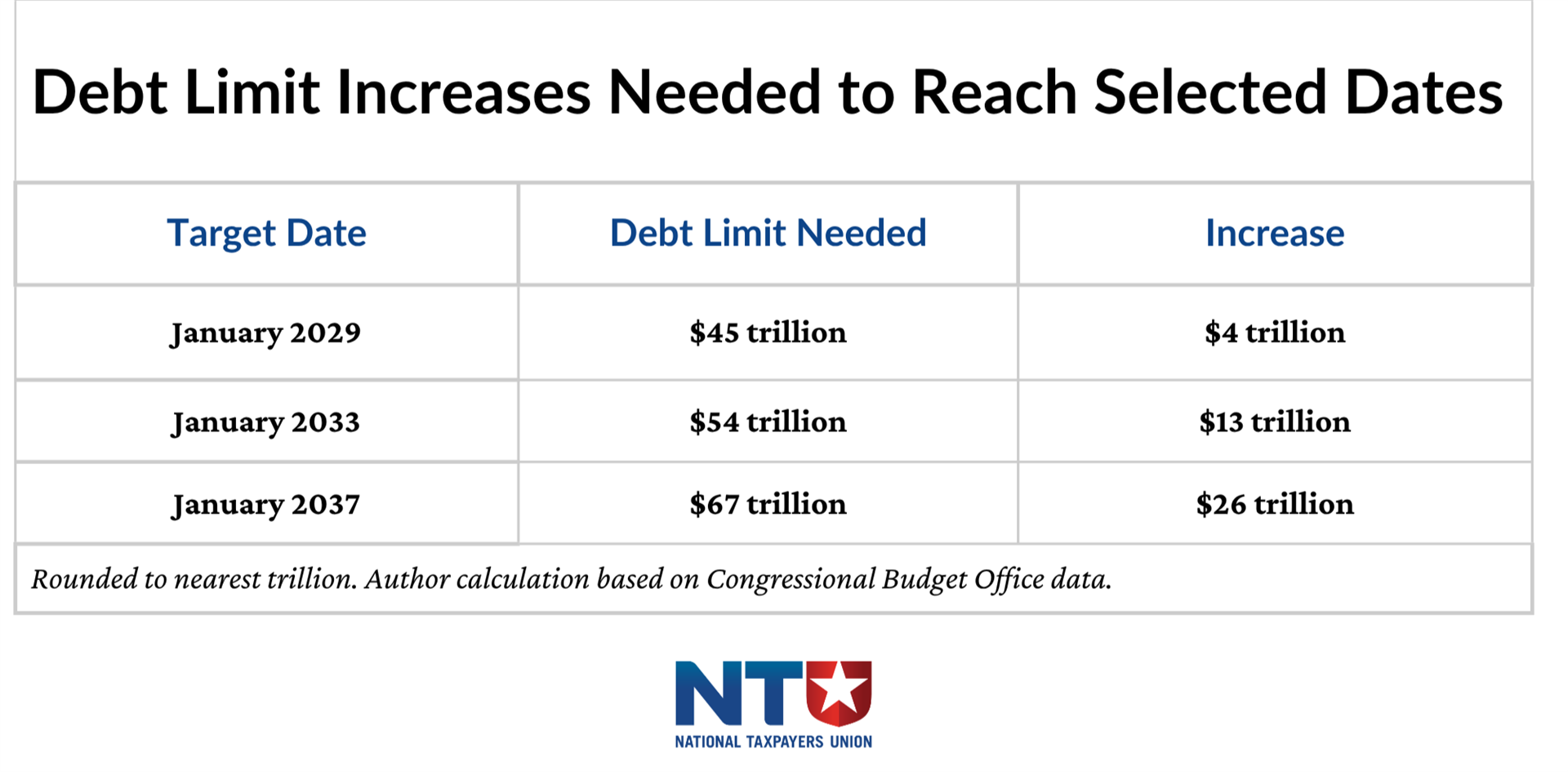
Because the budget deficit is so large, the debt limit increase needed will be substantial. To reach January 2029, the debt limit will need to be raised to about $45 trillion, an increase of about $4 trillion.
Updates to Previous Projections
This report updates NTU’s previous debt limit estimates that were first published in August 2026. In the August projection, the central scenario projected debt limit contact in May 2027 and a February 2028 X-Date. The current central estimate is now similar to the early scenario described in the August projections, which showed a February 2027 debt limit contact and a December 2027 X-Date.
Two factors had meaningful effects on the updated projections:
1. The Treasury’s November 2, 2026, Marketable Borrowing Estimates assume cash balances of $850 billion at the end of December 2026 and $1 trillion at the end of March 2027. Treasury’s new end of March cash balance assumption is similar to the level assumed in the August early scenario and nearly $250 billion above the August central scenario. Treasury’s updated cash balance assumptions are now incorporated into all three scenarios.
2. The model also incorporates updated estimates of available extraordinary measures and inflation adjustments for Treasury Inflation-Protected Securities (TIPS).