


Congress will soon be asked to increase the $41.1 trillion debt limit. As of October 30, 2026, debt subject to the limit totaled $40.33 trillion, leaving $777 billion in remaining borrowing authority. However, reaching the statutory limit does not immediately mean that the federal government will be unable to pay its bills on time.
The first step in projecting the debt limit deadlines is estimating when the debt subject to the statutory limit will come into contact with that limit. The important factors that determine the debt limit contact date are the growth of the federal deficit that necessitates additional borrowing, changes in the Treasury’s cash on hand balances, and changes in intragovernmental debt that counts towards the limit.
It is worth noting that the level of debt subject to the limit does not track the budget deficit exactly. The Treasury may take actions during its normal course of business to grow the debt either faster or slower than the deficit. For example, the Treasury may build up its cash on hand balances by issuing additional debt (or conversely spend down cash balances and issue less debt).
Once the debt reaches the limit, the Treasury Secretary may declare a “debt issuance suspension period,” which provides access to certain financial management authorities. During the debt limit impasse, the Treasury may not increase debt subject to the statutory limit, although maturing debt can usually be rolled over.
The Treasury is still able to make timely payments to meet the government’s obligations for a limited time using a mix of incoming receipts, existing cash on hand, and “extraordinary measures” that temporarily reduce certain types of intragovernmental debt and allow additional cash to be raised. The Treasury’s cash on hand and the additional borrowing authority made available through extraordinary measures will likely provide more than $1 trillion of available financial resources at the time the debt limit is reached.
The X-Date is the point at which the Treasury will no longer have sufficient cash and borrowing authority to meet all of the federal government’s legal obligations in full and on time. The Treasury would require additional borrowing authority to be able to pay its bills.
The X-Date is likely to be reached by December 2027, when projected cash on hand and available extraordinary measures would be exhausted. This estimate is subject to considerable uncertainty and will change as additional information becomes available. Three factors will be particularly important in determining when the Treasury exhausts its available financial resources: the Treasury's cash on hand balances, the availability of extraordinary measures, and the timing of federal revenues and spending obligations.
Cash on Hand
One of the biggest sources of uncertainty about projecting the debt limit contact date and X-Date is the Treasury’s cash on hand balances. The Treasury holds its operating cash balances at the Federal Reserve in an account known as the Treasury General Account (TGA). As of October 30, 2026, the Treasury held about $952 billion in the TGA.
TGA balances have grown significantly in the last decade. The median daily TGA balance increased from about $51 billion in 2008–2014 to $255 billion in 2015–2019 and $700 billion since 2022.
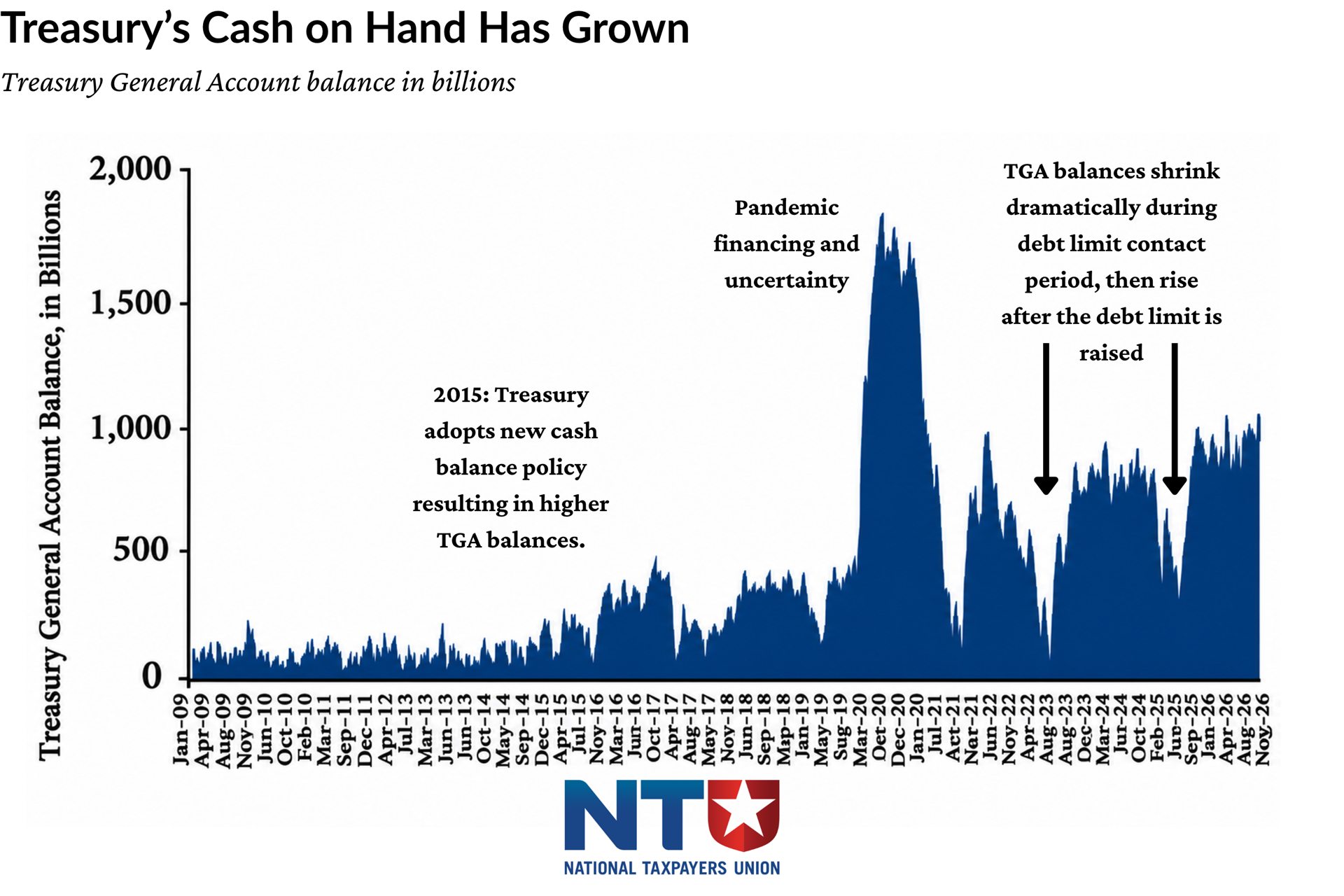
The Treasury’s policy is to maintain a cash on hand balance sufficient to cover at least one week of projected cash needs, “defined as net fiscal outflows plus the gross volume of maturing marketable debt.” The Treasury believes that “in the current environment, $400 to $500 billion is the absolute bare minimum that Treasury needs to be compliant with its cash balance policy on any given day.”
In its latest marketable borrowing announcement, the Treasury projects a cash balance of $850 billion at the end of December 2026 and $1 trillion at the end of March 2027. If those projected balances are achieved, Treasury would enter the next debt-limit episode with substantially more cash than in prior episodes. However, it remains possible that the debt limit is reached prior to the point at which the $1 trillion cash level is met.
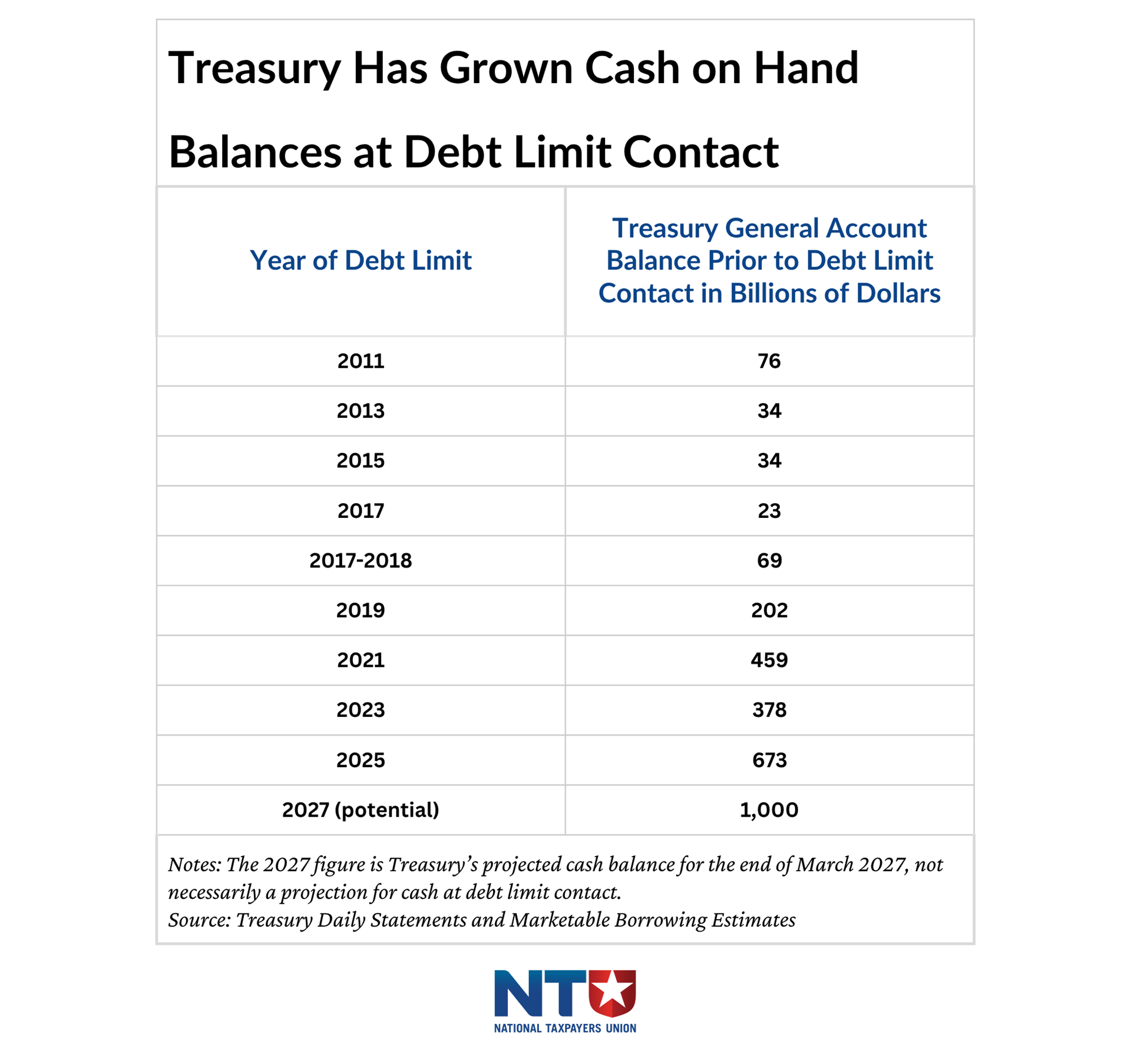
During a debt limit impasse, the Treasury will typically spend down the TGA, often to levels much lower than the Treasury’s desired levels. Once the debt limit is raised or suspended, Treasury has rapidly restored its cash on hand reserve, often exceeding the prior TGA balance. These large inflows and outflows from the TGA have important implications for bank reserves and the Federal Reserve’s balance sheet and can impair the Fed's operational independence.
Extraordinary Measures
During a debt limit impasse, the Treasury Secretary may use extraordinary measures to create additional borrowing authority. Declaring a debt issuance suspension period specifically allows the Treasury to suspend certain investments and redeem certain securities held by federal retirement funds.
There are three main extraordinary measures used by the Treasury:
1. Government Securities Investment Fund (G Fund). The G Fund is the Government Securities Investment Fund of the Thrift Savings Plan (TSP) for federal retirees. Assets in the fund are invested in special-issue Treasury securities that count against the debt limit. When the debt limit is reached, the Treasury Secretary has the authority to suspend the daily reinvestment of assets in the fund. When the debt limit is raised, the fund is made whole, and TSP participants are not affected.
2. Exchange Stabilization Fund (ESF). The ESF is used to purchase and sell foreign currencies. Some assets of the fund are invested in special-issue Treasury securities that count against the debt limit. When the debt limit is reached, the Treasury Secretary has the authority to suspend the reinvestment of assets in the fund. There is no requirement or authority that the interest foregone for the ESF be restored when the debt limit is raised.
3. Civil Service Retirement and Disability Fund (CSRDF) and Postal Service Retiree Health Benefits Fund (PSRHBF). The CSRDF provides retirement and disability benefits to eligible federal employees, while the PSRHBF finances health benefit premiums for Postal Service retirees. The funds are invested in special-issue Treasury securities that count against the debt limit. During a debt issuance suspension period, the Treasury Secretary has the authority to suspend new investments in the funds and take early redemption of some investments. When the debt limit is raised, the funds are made whole, and retiree benefits are not affected.
Two other extraordinary measures also create a limited amount of additional space. The Treasury can enter into an exchange with the Federal Financing Bank. The Treasury can also suspend issuance of State and Local Government Series securities.
Additional one-time use extraordinary measures can also become available throughout the year. At the end of June, September, and December, certain investments and reinvestments are scheduled for the CSRDF and the PSRHBF. During a debt issuance suspension period, these investments may be suspended. Reaching these dates during the debt limit can allow for significant additional headroom and extend the duration of extraordinary measures.
Access to the one-time extraordinary measure available only on June 30 will provide a strong incentive for the Treasury Secretary to declare the debt issuance suspension period before the end of June 2027.
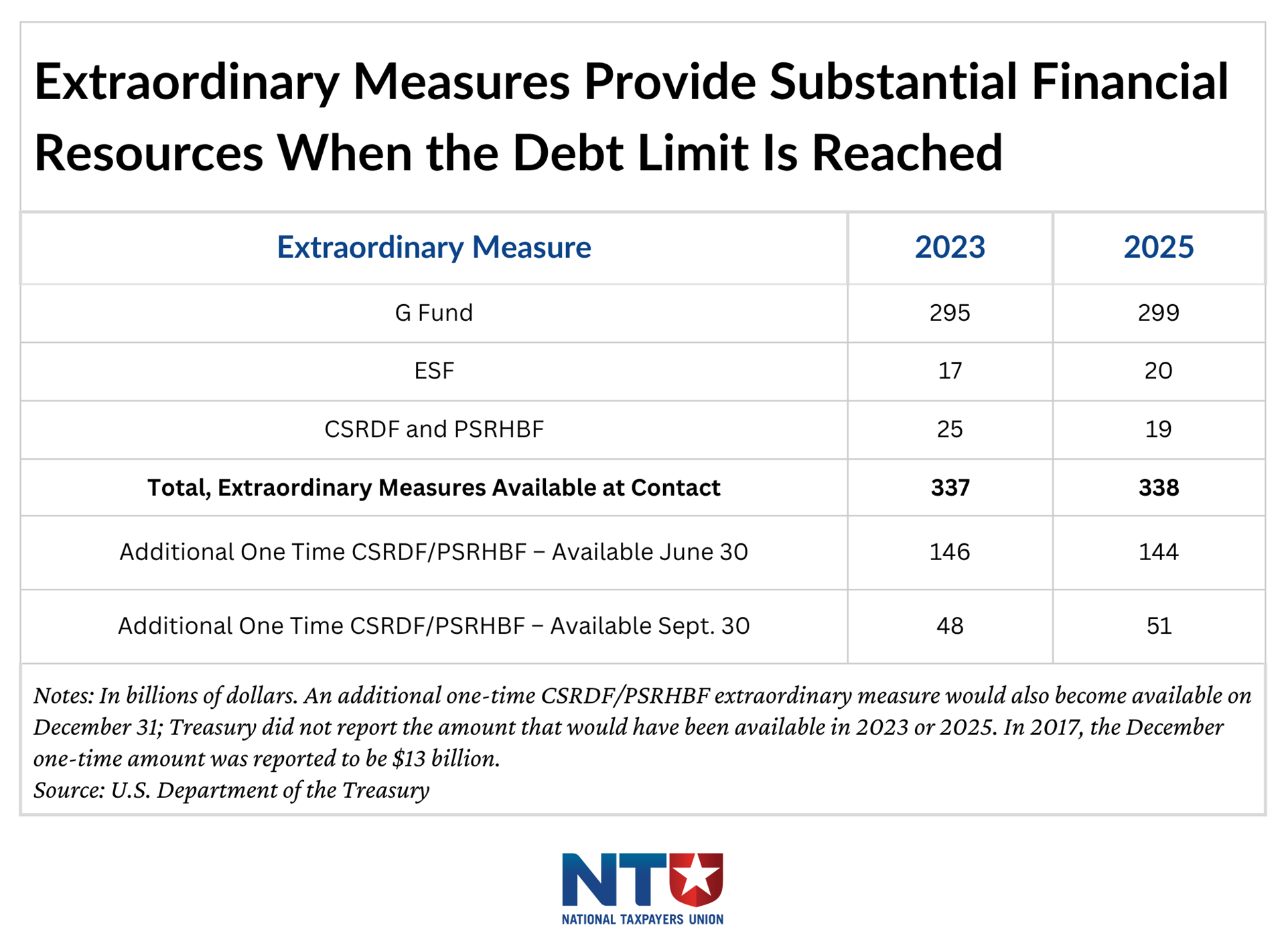
The exact amount of available extraordinary measures can fluctuate from day to day. At the end of the debt issuance suspension period in 2025, the Treasury had utilized $399 billion of the $512 billion available extraordinary measures, including the one-time June 30 measure.
Monthly Deficits Throughout the Fiscal Year
The ebb and flow of revenues, outlays, and the deficit are the most important variables for determining when the debt limit must be raised.
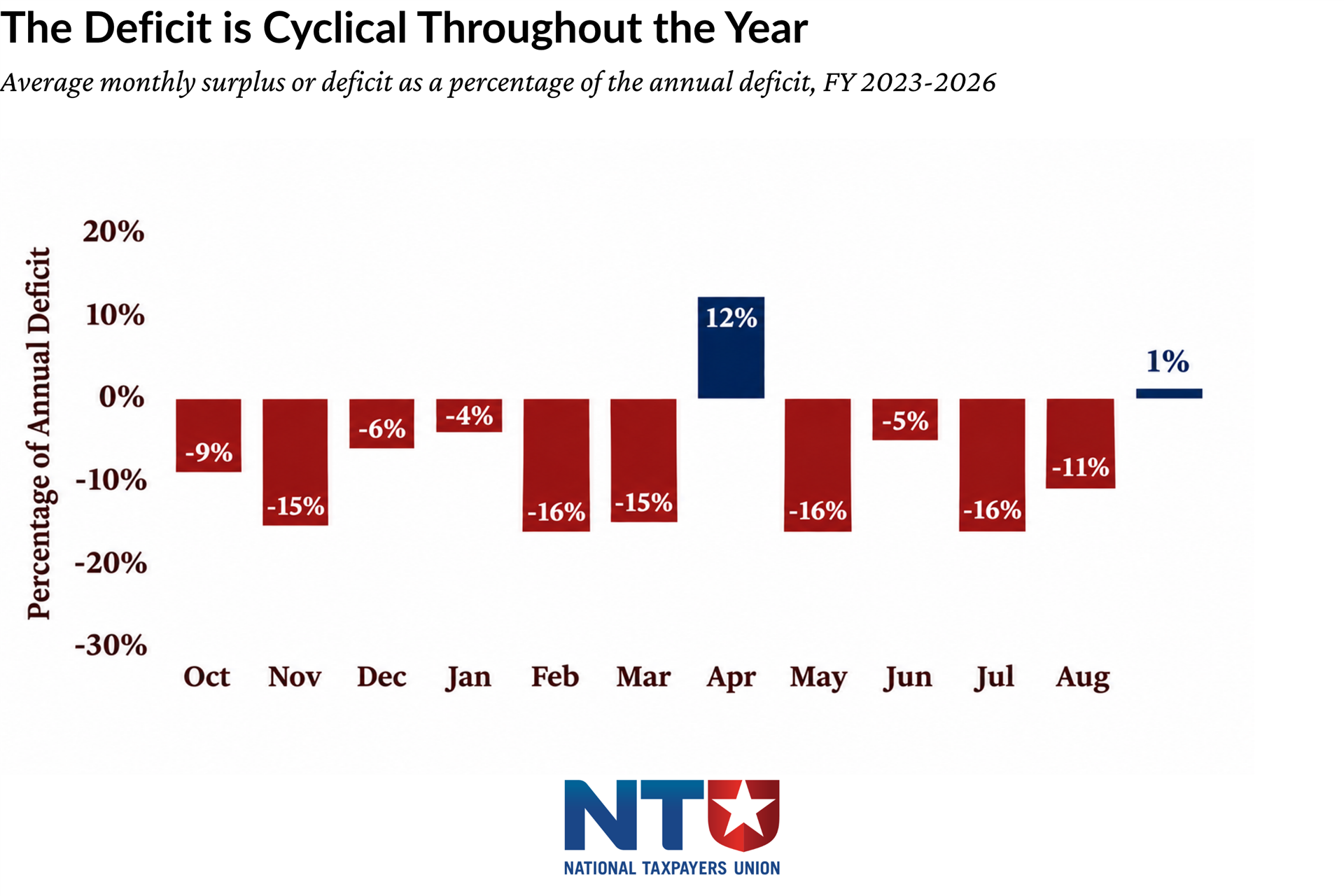
Certain months tend to have high deficits, while others have large surpluses as revenues exceed spending. For example, April usually has large surpluses as individuals pay income taxes due from the prior year and corporations pay quarterly taxes. September often runs a small surplus due to quarterly estimated income tax payments by corporations and individuals. In contrast, the federal government typically has large budget deficits in October, November, February, March, May, July, and August.
Similarly, Treasury payments and receipts are not distributed uniformly within each month. The first day of each month is a high outlay day, with Medicare payments that can range from $50 billion to $90 billion, $17.5 billion of veterans’ benefits, and $13.5 billion of federal civilian and military retiree benefit payments due each month. If the first of the month falls on a weekend, these payments can be shifted to fall on the last business day of the preceding month. One-fourth of Social Security payments are made on the third of each month, with most remaining payments made on the second, third, and fourth Wednesdays, when payments total more than $30 billion on each of these days.
Incoming receipts can be difficult to predict, as changes in the economy can have a significant impact on tax revenues. While most revenues from individual tax withholdings are collected regularly throughout the year, large receipts are collected on April 15, as well as on quarterly estimated tax payment dates. For calendar-year taxpayers, individual estimated payments are generally due in January, April, June, and September, while corporate payments are generally due in April, June, September, and December.
The Treasury is also consistently rolling over hundreds of billions of dollars of debt, with $200 to $250 billion of short-term securities typically maturing on each Tuesday and Thursday, or $400 to $500 billion per week. Longer-term debt also matures at mid- and end-of-month, typically adding another $100 billion to $150 billion per maturity date, although the amounts can exceed $200 billion. When debt matures, the Treasury typically issues new debt to replace it without adding to the total debt subject to the limit. However, if the new debt is sold at a higher interest rate than the older maturing debt, higher interest costs could increase the deficit and necessitate additional borrowing to fill the gap. Regular interest outlays are typically made in the middle and end of the month.
Conclusion
The timing of when the debt limit must be increased so that the Treasury can pay all of its bills depends on several different factors. The Treasury General Account balance is at historically high levels and the Treasury’s goal is to have $1 trillion of cash on hand at the end of March 2027. Extraordinary measures provide several hundreds of billions of additional borrowing authority under the statutory debt limit. The normal fluctuations in federal revenues and outlays will also impact contact with the debt limit and the X-Date.
The current X-Date projection is that fiscal resources will be depleted by December 2027. However, this estimate is subject to considerable uncertainty. The projected timing will change as the Treasury's financial resources, federal borrowing needs, and economic conditions evolve.