

Last week, the U.S. House of Representatives passed its fiscal year 2027 budget resolution by a vote of 216-214.
In addition to the recommended budgetary levels for the FY2027–2036 budget window, the resolution includes reconciliation instructions to four committees in the House. To find these instructions, look at the language included in Title II, section 201(b) of the text:
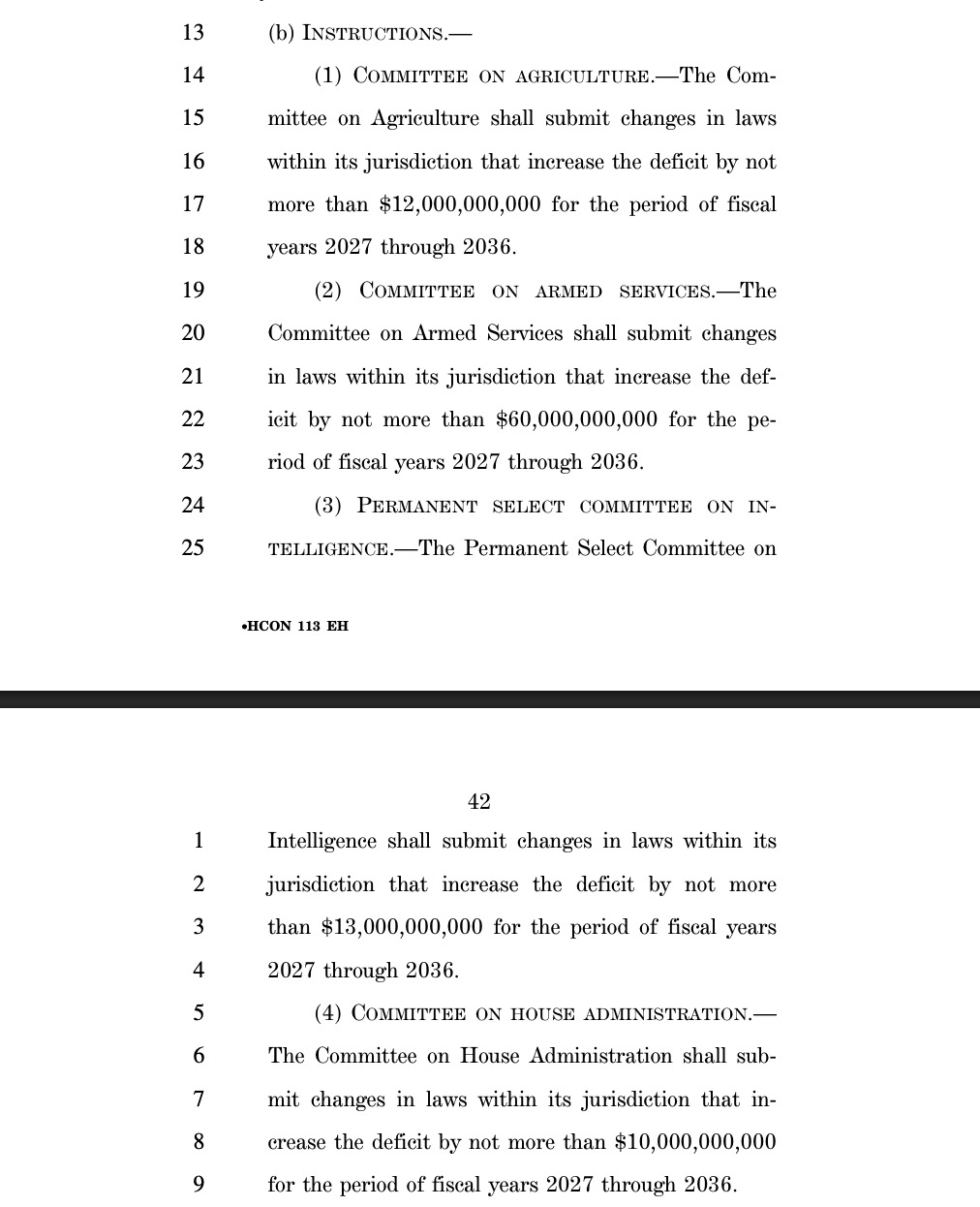
Reconciliation instructions can apply to three categories: outlays, revenues, or the debt limit. In the FY2027 budget resolution, all four instructions are in the outlays (or spending) category.
Additionally, each reconciliation instruction requires four key elements to be complete:
(1) An instructed committee;
(2) A direction (increase/decrease);
(3) An amount; and
(4) A period of time.
This blog will review each instruction and break down what it means in terms of the four key elements.
Of critical importance is that reconciliation instructions only include these elements of legislative design; they do not prescribe specific policy details. Instructed committees must meet the instructions but have flexibility within those instructions to decide which policies to recommend under the parameters of reconciliation (and the Byrd Rule) in meeting their instruction. In other words, the budget resolution’s reconciliation instructions do not include specific policies, just the basic elements described. They should be thought of as guardrails.
Section 201(b)(1).
This paragraph includes an outlay instruction with all four elements provided.
✅ Instructed Committee: House Committee on Agriculture
✅ Direction: Deficit Increase
✅ Amount: $12,000,000,000
✅ Period: FY2027–2036
What’s the goal?1 The expected intent of this instruction is to provide not more than $12 billion in spending for agricultural support, potentially in the form of farm subsidies, as a response to inflation and trade disruptions (likely including tariff relief).
Section 201(b)(2).
This paragraph includes an outlay instruction with all four elements provided.
✅ Instructed Committee: House Committee on Armed Services
✅ Direction: Deficit Increase
✅ Amount: $60,000,000,000
✅ Period: FY2027–2036
What’s the goal? The expected intent of this instruction is to provide not more than $60 billion in spending to support the war in Iran, including backfilling our arsenal defense needs as munitions and other capabilities are expended.
Section 201(b)(3).
This paragraph includes an outlay instruction with all four elements provided.
✅ Instructed Committee: House Permanent Select Committee on Intelligence
✅ Direction: Deficit Increase
✅ Amount: $13,000,000,000
✅ Period: FY2027–2036
What’s the goal? The expected intent of this instruction is to provide not more than $13 billion in spending for intelligence efforts related to national security. These plans are likely related to the war in Iran, but will be largely classified.
Section 201(b)(4).
This paragraph includes an outlay instruction with all four elements provided.
✅ Instructed Committee: Committee on House Administration
✅ Direction: Deficit Increase
✅ Amount: $10,000,000,000
✅ Period: FY2027–2036
What’s the goal? The expected intent of this instruction is to provide not more than $10 billion in spending to advance the SAVE America Act and support election integrity. In many ways, this is considered the politically critical piece of the package, as it faces significant headwinds in the Senate under a 60-vote threshold. Of note: while this may be the lynchpin of the entire reconciliation 3.0 effort, the Byrd Rule will likely result in an election security policy set that is substantially different from the existing SAVE America Act.
In total, the House-passed reconciliation instructions would provide targets to four committees that sum up to $95 billion in outlays over the next decade. Accounting for the interest cost added to that deficit spending brings the true total up to $135 billion.
So what do the reconciliation 3.0 instructions really mean?
Under the House’s parameters, if ultimately adopted, the deficit will increase by up to $135 billion (including interest impact) and some version of policy will be enacted by the four instructed committees related to areas under their jurisdiction.
That’s it.
We have an idea of what those policy decisions may look like, but it is ultimately up to the committees of jurisdiction to make those recommendations, negotiate with their Senate counterparts to meet the yet-unseen Senate instructions, and find a way to move them through the most technical stage of the reconciliation process—the notorious Byrd bath.
Of note, the Byrd Rule applies in the Senate, not in the House. Under the Byrd Rule, the reconciliation package must carefully follow the instructions given to Senate committees of jurisdiction. Given that the House version lacks instructions for its Senate counterparts, any budget resolution that is ultimately adopted with the purpose of unlocking the reconciliation process will require instructions specifically to Senate committees to be added.
1 Remember, the policy goal is not actually part of the instruction; this is simply a collection of stated goals the author has compiled explaining the likely direction of negotiations.