

Colorado is a state at the crossroads. For decades, Colorado has stood out for providing its taxpayers with the most robust set of protections against overtaxation in the country, thanks to the trailblazing Taxpayer Bill of Rights (TABOR) enshrined in the state constitution by voters in 1992. TABOR requires a vote of the public to increase any tax, mandates a flat income tax rate, and mandates that revenue surpluses above a certain level be refunded to taxpayers.
Of course, tax-and-spend politicians appreciate neither limits on how they can tax nor how they can spend, so TABOR has long been a target of pro-tax groups. Over the years, its protections have been eroded, most significantly in 2000 by Amendment 23, which exempted education funding from TABOR limitations and required that it grow every year regardless of incoming tax revenue, and in 2005 by Amendment C, which temporarily suspended TABOR limits on government spending.
But many more efforts to bypass or end TABOR have failed. All of the following measures have been put before voters since 2005, and all have been rejected by Colorado voters:
- Amendment D (2005): Would have allowed Colorado to borrow up to $2 billion outside of the TABOR cap.
- Proposition 103 (2011): Would have temporarily raised the state income tax from 4.63% to 5% and the state sales tax from 2.9% to 3%, and exempted the increased revenue from the TABOR cap.
- Proposition CC (2019): Would have permanently ended the requirement for the state to refund excess revenues.
- Proposition 120 (2021): Asked voters to trade an increase to the TABOR cap for minor reductions in property tax rates.
- Proposition HH (2023): Again asked voters to allow the state to retain TABOR refunds in return for a property tax cut.
In addition to these ballot efforts, a major lawsuit brought by state representatives, county officials, and school boards aimed to get TABOR declared unconstitutional. The somewhat whimsical legal theory underlying this argument was that, by restricting the state’s ability to raise taxes, it violated a provision in the U.S. Constitution guaranteeing every state a representative form of government. The case bounced around in multiple federal courts before disappearing into the dustbin of history in 2022.
But, while Colorado voters must be tired of being asked to vote their TABOR protections away, that is the position they will once again be in this November. Two ballot measures would erode TABOR protections, while a third would aim to solidify them by capping the state’s income tax at its current 4.4% rate.
Initiative 195
In 1987, Colorado became the first state in the nation to transition from a graduated income tax to a flat tax. It predated the next state to do so, Utah, by three decades, though eight have done so in the last four years alone.
Initiative 195 would undo that progress. Instead of a uniform 4.4% personal income tax rate, Initiative 195 would move Colorado to a graduated income tax system, with the following brackets:
Federal Taxable Income | Rate |
≤ $25,000 | 3.7% |
$25,001 - $100,000 | 4.2% |
$100,001 - $500,000 | 4.4% |
$500,001 - $750,000 | 7.4% |
$750,001 - $1,000,000 | 7.9% |
$1,000,001+ | 8.4% |
While the lowest two brackets of taxpayers would receive a small tax cut, taxpayers making over $500,000 would receive a significant tax increase. That threatens to reverse one positive trend that Colorado has long benefited from thanks to its flat tax—in the latest IRS interstate migration data, not only did Colorado rank #15 overall in terms of gaining new net residents, it also ranked #11 in terms of gaining filers earning over $200,000 in income.
Not only are these high-income arrivals often bringing businesses and jobs with them, they also pay a substantial amount of tax. In 2026 alone, NTUF estimates that Colorado in-migration will generate nearly $203 million in additional tax revenue for Colorado. The real benefits of tax competitiveness appear over time, however, as new higher-income individuals arrive and continue to pay income, property, sales, and other taxes year after year. And indeed, Colorado’s millionaire population nearly tripled over the decade between 2013 and 2022, growing notably faster than the nationwide millionaire population, helping to make the state’s tax base more sustainable in the long term.
Unfortunately, Initiative 195 would make Colorado a clear outlier in the region. High taxes have proven a substantial reason for higher-income taxpayers and businesses to leave states like New York even when most nearby states are similarly tax-happy, but they are even more devastating to a state’s competitiveness when a more attractive tax environment is accessible simply by moving across a border.
Top Income Tax Rate by State, Colorado and Its Neighbors
State | Top Income Tax Rate | Trend since 2020 |
Texas* | No state income tax | ↔ |
Wyoming | No state income tax | ↔ |
Arizona | 2.5% | ↓ |
Colorado (currently) | 4.4% | ↘ |
Oklahoma | 4.5% | ↓ |
Utah | 4.5% | ↓ |
Nebraska | 4.55% | ↓ |
Kansas | 5.58% | ↘ |
New Mexico | 5.9% | ↑ |
Colorado (under Initiative 195) | 8.4% | ↑ |
*Not a direct neighbor, but separated by just 34 miles via the Oklahoma panhandle.
Higher income tax rates would not only affect lawyers and business executives. They would also hit small business owners whose business income “passes through” to the individual income tax code. Colorado small business owners who rely on the sale of their business for retirement income would also be particularly hard-hit.
These graduated brackets would also apply to corporate filers. A graduated corporate income tax makes significantly less sense than a graduated personal income tax, as it creates a strong incentive for corporations to “split” into smaller entities to reduce their tax burden and invest time and resources into tax planning instead of productive investment. Just as importantly, graduated corporate income tax rates do little to promote fairness—a gigantic, multi-billion-dollar corporation can be owned by millions of shareholders who are each far less wealthy than a “small” corporation worth a few million dollars that is owned by a single individual.
All of these business owners would be left with less income to invest, hire, and expand their businesses. This means a less dynamic economy and fewer job opportunities for everyday Coloradans. The meager tax savings for the lower-income brackets under Initiative 195 would be little consolation to taxpayers who see their job opportunities limited by uncompetitive tax policies.
Colorado already struggles to keep young families from leaving once they are ready to settle down. In the latest IRS interstate migration data, Colorado ranked third in terms of gaining net residents under the age of 35. But digging deeper, that seemingly rosy number belies the fact that Colorado is losing residents of all other age groups to other states. No state gaining as many net young residents to interstate migration as Colorado loses residents in every other age bracket.
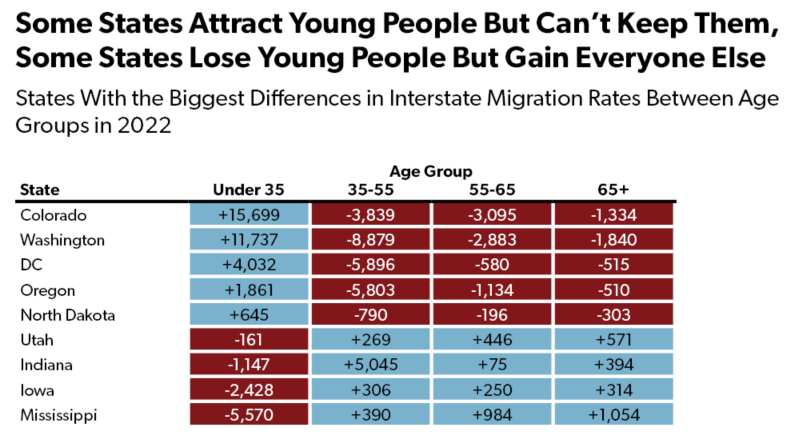
This reflects an unfortunate reality: Colorado can attract young people with its college towns and myriad opportunities for outdoor adventure, but when it comes time to make a career, buy a house, and start a family, a lot of those arrivals head elsewhere. Colorado has made efforts to address one of those problems with reforms intended to boost housing density, but the proliferation of “fees” (taxes by another name intended to avoid triggering TABOR’s voter-input mechanisms) has taken its toll.
Initiative 195 would compound this problem by creating a substantial marriage penalty. The above brackets would apply regardless of filing status, meaning that married filers would face a substantially higher tax burden than unmarried filers, particularly at higher income brackets. Starting a family would become a higher-tax activity in Colorado than in surrounding states.
Initiative 232
Directly in opposition to Initiative 195 is Initiative 232, a ballot initiative that would cap the state’s income tax at the existing 4.4% level. While Initiative 232 would not create any practical constraint on Colorado’s ability to place a graduated income tax before voters in the future, it creates some interesting interaction effects with Initiative 195.
Should both Initiative 195 and Initiative 232 receive a majority of “yes” votes, the measure with the higher number (not higher percentage) of “yes” votes would be enacted. Should Initiative 195 receive more “yes” votes, then it would override Initiative 232’s income tax cap entirely.
Curiously, however, should Initiative 232 receive more “yes” votes, but with Initiative 195 still achieving a majority, Colorado would still no longer have a flat tax—instead, the 3.7% and 4.2% tax brackets would become law, while the remaining brackets would be subject to Initiative 195’s 4.4% cap.
Proposition NN
The other measure, Proposition NN, was referred by the state legislature to the ballot. It would effectively end TABOR refunds by substantially increasing the amount of revenue that the state can retain instead of returning to taxpayers.
Under current law, state revenue above the TABOR cap is projected to be $329.9 million for the current fiscal year, and $521 million for the next fiscal year. Absent changes, these excess revenues would be returned to taxpayers in the form of TABOR refunds. However, the TABOR cap under Proposition NN would be $4.6 billion higher this fiscal year and $4.7 billion higher in the next fiscal year, easily wiping out those refunds.
This new cap would represent a 25.3% increase on the current cap, and would continue to be adjusted upwards in the future. This makes it unlikely that TABOR refunds would be issued at any point in the near future.
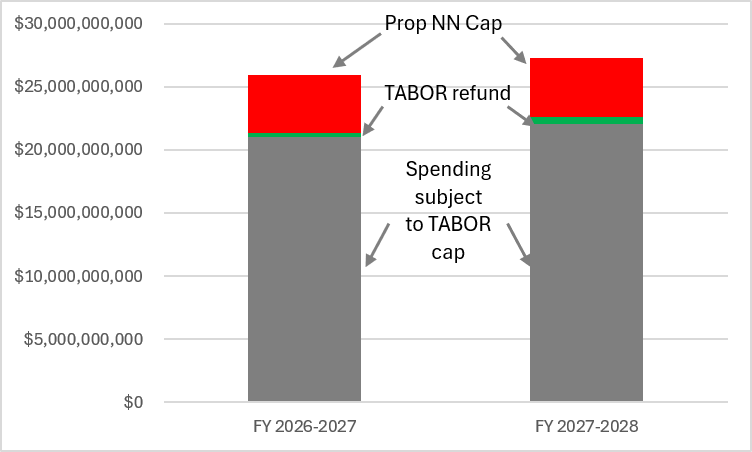
The official state Legislative Council fiscal note does not project beyond these years, but a separate analysis requested by state legislators estimated that the average Colorado taxpayer would lose $7,381 in TABOR refunds over the next decade should Proposition NN pass.
Conclusion
Despite some high-profile high-earner tax increases in 2026 in states like Washington and Hawaii, the vast majority of states continue to try to lower their income taxes as fast as possible to attract new residents, businesses, and investment. In that environment, where a state that isn’t cutting its income tax is becoming less competitive, Colorado risks standing out in a very bad way by contemplating nearly doubling its top income tax rate and attempting to further undermine TABOR.
Fundamentally, Colorado faces a spending problem, not a revenue problem. Even after adjusting for inflation, Colorado’s spending per capita has increased by 31% over the past two decades, a situation that inevitably leads to shortfalls. Attempting to plug these shortfalls on the revenue side is like trying to fix a leaky boat by draining the ocean.
Coloradans deserve fiscal discipline, not further taxes. Unfortunately, the latter is all that Initiative 195 and Proposition NN offer.