

The Honorable Todd Young
185 Dirksen Senate Office Building
United States Senate
Washington, DC 20510
The Honorable Brian Schatz
722 Hart Senate Office Building
United States Senate
Washington, DC 20510
The Honorable Mike Flood
343 Cannon House Office Building
United States House of Representatives
Washington, DC 20515
The Honorable Brittany Pettersen
348 Cannon House Office Building
United States House of Representatives
Washington, DC 20515
Dear Senators Young and Schatz and Representatives Flood and Pettersen,
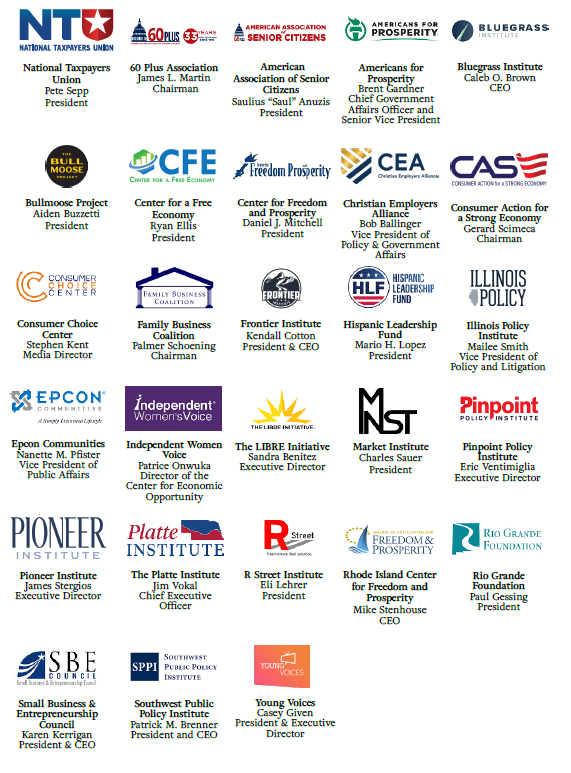
On behalf of the undersigned organizations, representing a wide array of taxpayer, free market, consumer, and limited government advocates, we write to express our strong support for S.2416, the Identifying Regulatory Barriers to Housing Supply (IRBHS) Act. This legislation takes a common sense approach to meaningfully address the nation’s affordable housing shortage by promoting transparency in local zoning and development policies.
America’s shortage of affordable housing is rooted in exclusionary zoning and restrictive land-use policies. Enacted at the local level, these regulations stifle new home building and have created a persistent gap between housing supply and demand, and ultimately put financial pressure on the wallets of working class Americans. A report by Up For Growth revealed a nationwide housing deficit of 3.85 million units in 2022, more than twice the level seen in 2012. Until these barriers are addressed, millions of families will continue to suffer from the country’s lack of affordable housing.
The IRBHS Act offers a practical approach to boosting the supply of affordable housing by shining a light on local policies that prevent the construction of new homes. Your legislation directs localities receiving Community Development Block Grant funding to report on their adoption of policies that affect housing supply. Instead of imposing specific reforms, the IRBHS Act leverages the power of transparency to give local communities the tools to confront the housing crisis proactively.
Importantly, this legislation encourages better use of existing taxpayer dollars instead of expending more federal resources to try to solve the problem.
By pinpointing burdensome practices that hamper the construction of new housing—such as onerous zoning restrictions, building fees, environmental laws, and excessive parking requirements—the IRBHS Act provides a structured framework for communities to increase the supply of housing in a manner that is consistent with their own local needs. Rather than just throwing more money at the problem, this legislation focuses on removing obstacles that prevent existing investments from achieving their full impact.
Families and communities nationwide depend on a housing market that is affordable, and this legislation is a practical and bipartisan step toward achieving that goal. We are proud to support your proposal and look forward to working with you to help it become law.
Sincerely,