

Last month, the national debt hit $40 trillion. For such a monumentally dubious achievement, it received relatively little attention. It’s not that hard to understand why—while it took us 192 years to accumulate our first $1 trillion in national debt, we now add that amount about every three months.
So, interest in that development was mostly confined to those alarmist taxpayer groups who believe that a space rock could ever disrupt our harmonious dinosaur society. Congress certainly didn’t seem to notice, with the House pushing to use $14 billion in rescissions to “fund” other spending. It’s a bit like deciding not to buy tickets to a concert, and using the “savings” to pay for a spa day.
You know, while you have $40 trillion in credit card debt.
But while the consequences of careening along on a streetcar named “Disaster” are self-evident for the federal government, states will feel the consequences just as much when Congress finally wakes up to the danger. At that point, it’s not a matter of whether states will lose federal funding, but how much.
Of course, the federal funds spigot is unlikely to just shut off entirely, especially not all at once. So we took a look at how long each state could absorb a 5% annual reduction in federal aid through their rainy day funds.
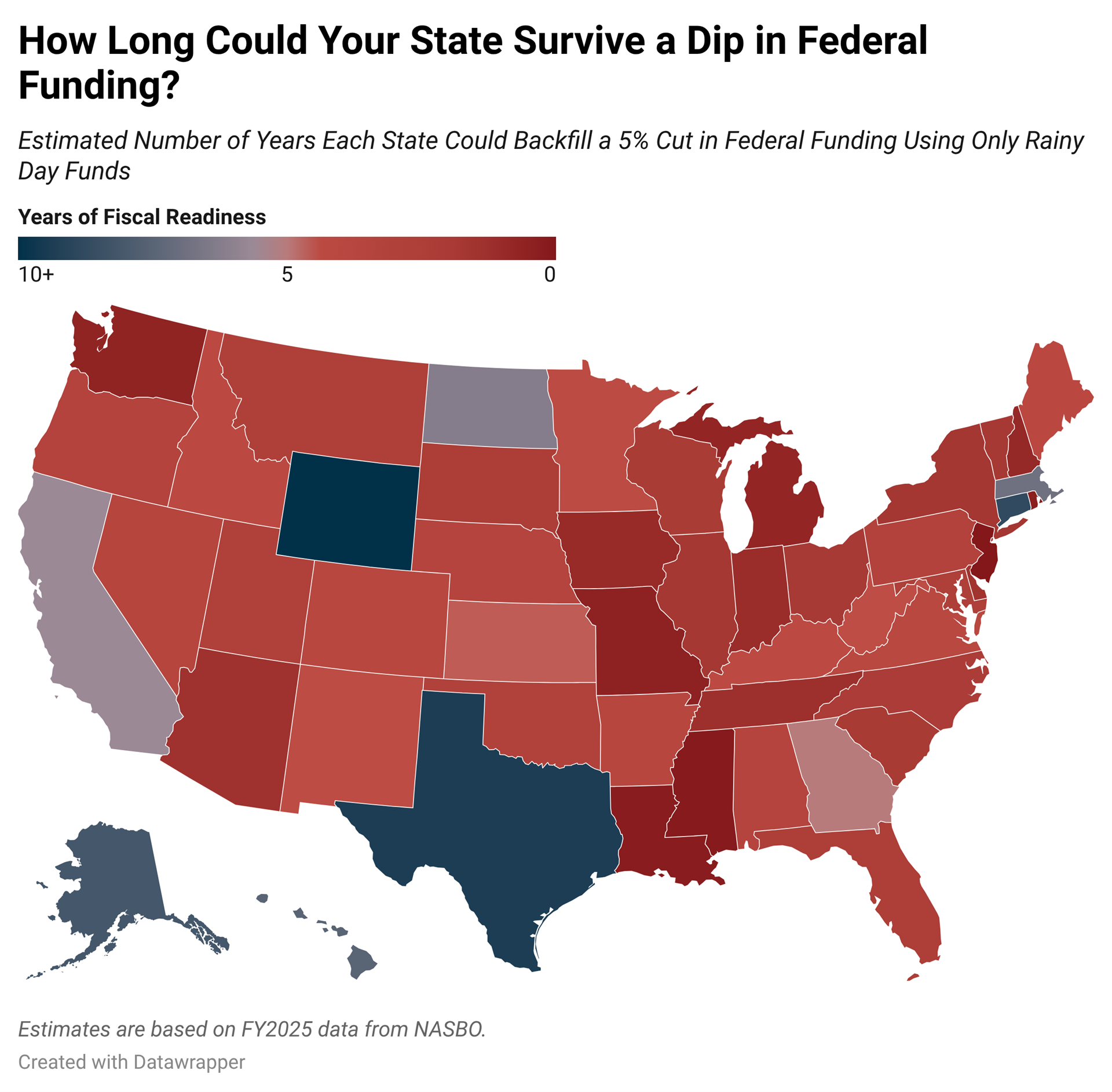
No state comes close to the rainy day fund of Wyoming, which could replace a 5% federal funding dip for over three decades through its rainy day fund. On the exact other end of the spectrum is New Jersey, which routinely operates with an empty rainy day fund, relying instead on general fund surpluses. In 41 states, the rainy day fund would not last half a decade.
This is far from a perfect proxy for fiscal readiness. If federal funding to the state shrank, it would likely shrink in other areas that indirectly affect incoming state revenues as well. And rainy day funds are not meant to head off any kind of long-term reduction in federal funding, even in the most careful states.
Nevertheless, it is hard to predict when precisely Congress will wake up to its fiscal peril and start taking action. The states better positioned in this area would have a longer ramp to make the kind of comprehensive, structural budget adjustments they would need to make.
State policymakers and policymakers should not make the mistake of thinking that the national debt is a problem for the suits in DC. An emergency plan to deal with what seems like an insurmountable crisis is always better than no plan at all.