

An Update on Major Tax Ballot Measures
Wealth Taxes: California and Oregon
California’s billionaire tax will be on the ballot in California this November, after Governor Gavin Newsom failed to convince the measure’s backers to withdraw it ahead of last month’s deadline.
The billionaire tax is an unprecedented, “one-time” 5% tax on the net worth of California billionaires, including assets located outside of California. The tax would apply retroactively to billionaires who were California residents as of January 1, 2026.
Recently I spoke with the California Taxpayers Association (CalTax) about the problems with the proposal:
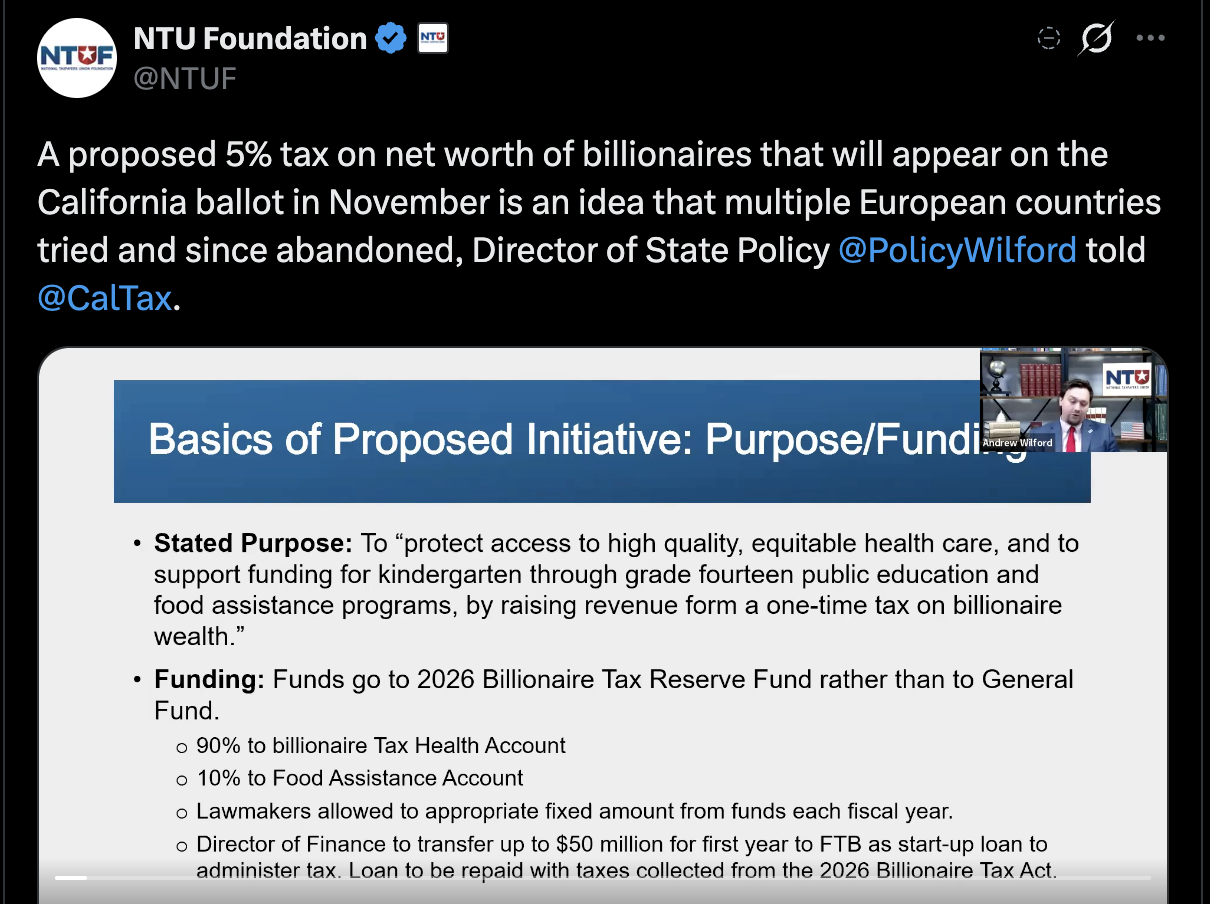
Proponents claim it would raise the state $100 billion to fund state health care programs, but these rosy predictions were based on the presumption that billionaires would be unable to avoid the tax. But Stanford’s Hoover Institution, accounting for confirmed/likely departures and lost revenue from other state taxes, estimates that the tax will actually end up losing California $24.7 billion.
Administrative issues and legal vulnerabilities abound, as NTUF covered in a report earlier this year. California may well end up with the worst-case scenario: building up the extensive administrative apparatus necessary to collect a one-time tax, only to end up having to refund everything collected after a series of costly legal battles.
Further north, a similar wealth tax ballot measure in Oregon failed to gather the necessary signatures to make the ballot. Other proposed tax ballot measures to end the state’s estate tax, sunset all Oregon state taxes unless they were enacted again, and require a supermajority to pass future tax increase ballot measures also failed to qualify for the ballot.
Income Taxes: Colorado, Missouri, and Massachusetts
Colorado voters will likely face competing measures this November. One ballot measure would replace the state’s flat 4.4% income tax with a graduated rate ranging from 3.71% to 8.41%, making Colorado easily the highest-tax state in the Mountain West. Conversely, a separate measure would cap the state’s income tax rate at the current 4.4% level.
In Missouri, voters are set to vote in August on a proposal that would enable the state to eliminate its state income tax and expand the state sales tax base to include some services. While Missouri has lowered its top income tax rate from 5.4% to 4.7% over the past few years, the state has fallen behind most of its neighbors.
Without Income Tax Fix, Missouri Is Falling Behind Its Neighbors
State | Top Rate | Trigger Floor | Migration (2022) | Top Rate (2022) |
Tennessee | 0% | 0% | Gains every 12m, 5s | 0% |
Iowa | 3.8%* | 3.8%* | Loses every 5hr, 58m | 8.53% |
Kentucky | 3.5%* | 0% | Gains every 1hr, 29 m | 5% |
Arkansas | 3.9% | 3.9% | Gains every 46m, 15s | 5.5% |
Oklahoma | 4.5% | 0% | Gains every 41m, 45s | 4.75% |
Nebraska | 4.55% | 3.99% | Loses every 4hr, 36m | 6.84% |
Missouri | 4.7% | 4.5% | Gains every 59m, 28s | 5.4% |
Illinois | 4.95%* | 4.95%* | Loses every 9m, 42s | 4.95%* |
Kansas | 5.58% | 4%* | Loses every 2hr, 9m | 5.7% |
*State has a flat individual income tax.

In Massachusetts, a proposal to cut the state’s income tax rate by 1% was removed from the ballot after the Massachusetts Supreme Court determined that the attorney general’s summary misleadingly described the impact on capital gains income taxes.
The measure would have gradually reduced the state’s 5% bracket down to 4%, while leaving the existing 4% millionaire surtax in place.
Property Taxes: Florida
The biggest property tax measure on the ballot this November will be in Florida, where voters will vote on a significant expansion of the state’s homestead property tax exemption. The measure would gradually expand the state’s $50,000 homestead exemption for local property taxes to $250,000 for existing residents. New residents would only receive the benefit after living in Florida for five years. Notably, school district property taxes would be excluded from the increased exemption.
While framed as property tax relief, the measure would further push the property tax burden onto renters, who are indirectly affected by commercial property taxes. Additionally, it would likely result in cash-starved counties maxing out millages and local option sales taxes.
NTUF’s Matthew Putnam has described a better path forward to provide relief to taxpayers frustrated with ever-increasing property tax bills: Truth in Taxation. Truth in Taxation focuses on making local officials accountable to taxpayers for how they spend their property taxes, ensuring that localities do not passively rake in housing market inflation in the form of higher tax revenue without giving voters a chance to weigh in.