

The Real World Cup Winner: Tax Officials
The World Cup will lead to 47 teams going home defeated, and just one team that achieves sports immortality. But while every other team may feel the weight of disappointment and crushed dreams, they can take comfort in remembering what is truly important.
What, sportsmanship, the honor of representing their nation, or the achievement of even participating in the most prestigious international sports tournament? No, of course not.
Taxes.
The month or so that World Cup athletes will spend in North America entails daunting tax obligations at every level of government, requiring visiting athletes to file tax returns in every city, state, country, or province that they play or practice in. Each of these separate jurisdictions will take a slice of each World Cup athlete’s salary, even if the salary is earned for a club on a completely different continent.
For example, Haitian athletes will play group stage matches in Foxborough, Massachusetts, Philadelphia, Pennsylvania, and Atlanta, Georgia. In addition, the team has set up a training “base camp” in Galloway Township, New Jersey. On top of the 35% federal tax rate on nonresidents, these athletes will owe income taxes to each of those four states based on the percentage of time spent in each. Philadelphia has a local income tax, which will also apply.
This all means that just as there are winners and losers in the matches, some visiting teams will face higher tax rates for their time in North America than others. Canadian players will pay the highest combined rate in the group stage by virtue of the fact that they play each of their matches at home in either British Columbia or Ontario, where the combined federal/provincial rate is higher than in any American or Mexican state.
But high Canadian taxes are nothing new to Canadians. Panama and New Zealand players will end up facing the next-highest World Cup tax rate, with Panama subjected to Canadian and New Jersey taxes, while New Zealand will spend its time in California and Vancouver.
On the other end of the spectrum is South Korea, which played exclusively in Mexico before being sent home. Mexico taxes nonresidents at a 25% rate, with no income taxes below the federal level. Colombia is next, playing in either Mexico or Florida (where there is no state income tax).
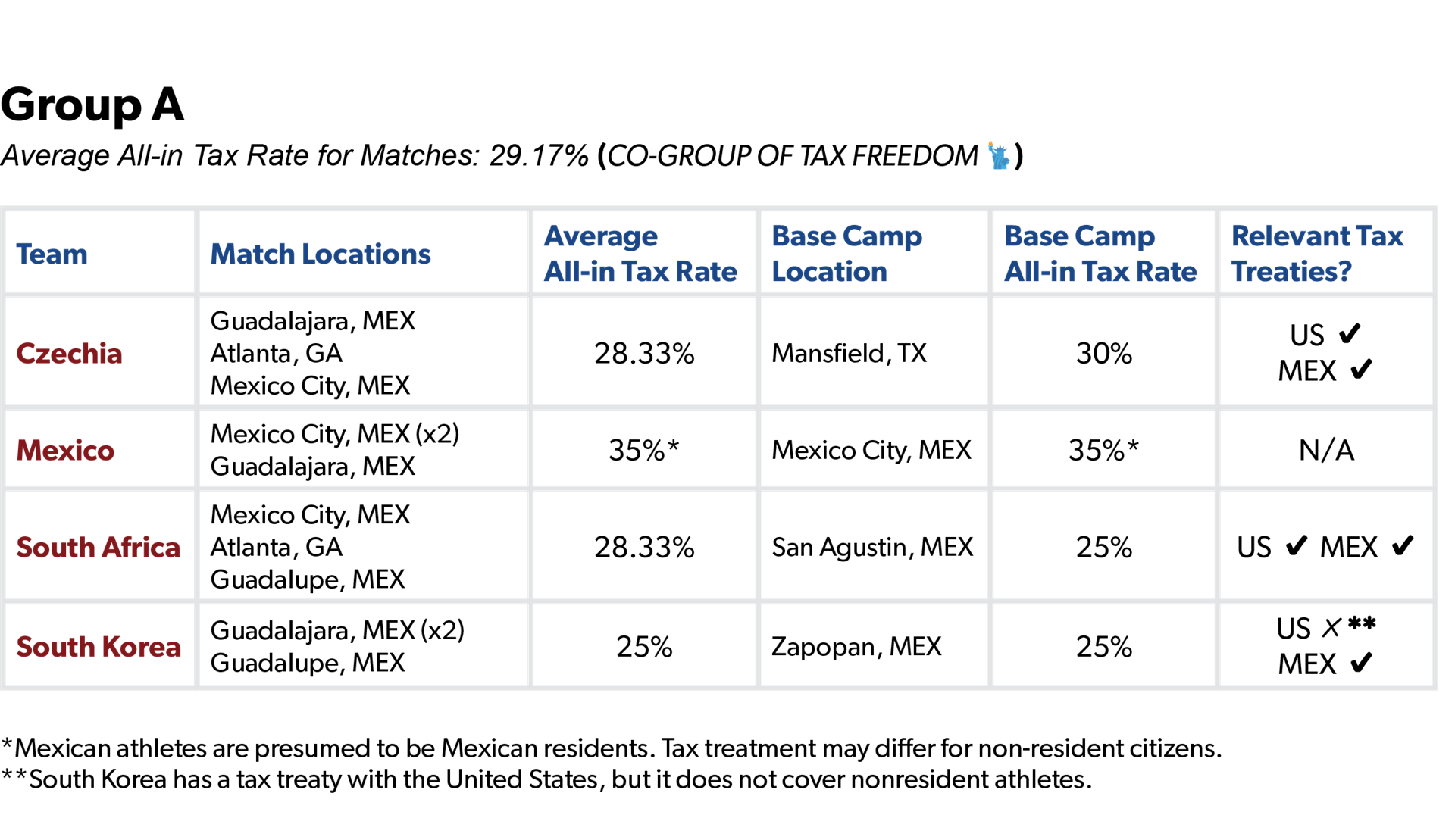
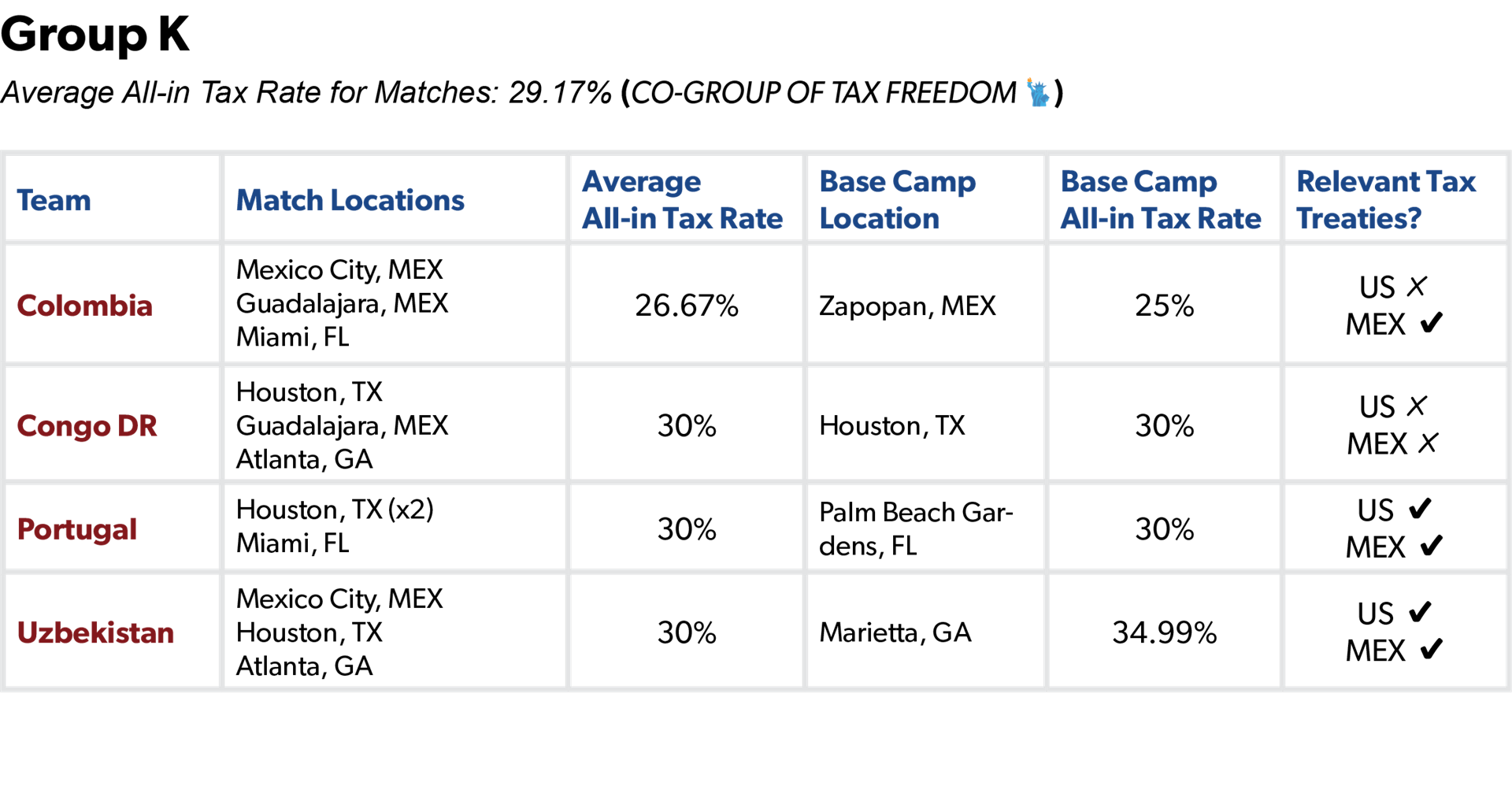
The groups that received the best draws (for tax purposes) were Group A and K, which played all their matches in either Mexico, Florida, Texas, or Georgia.
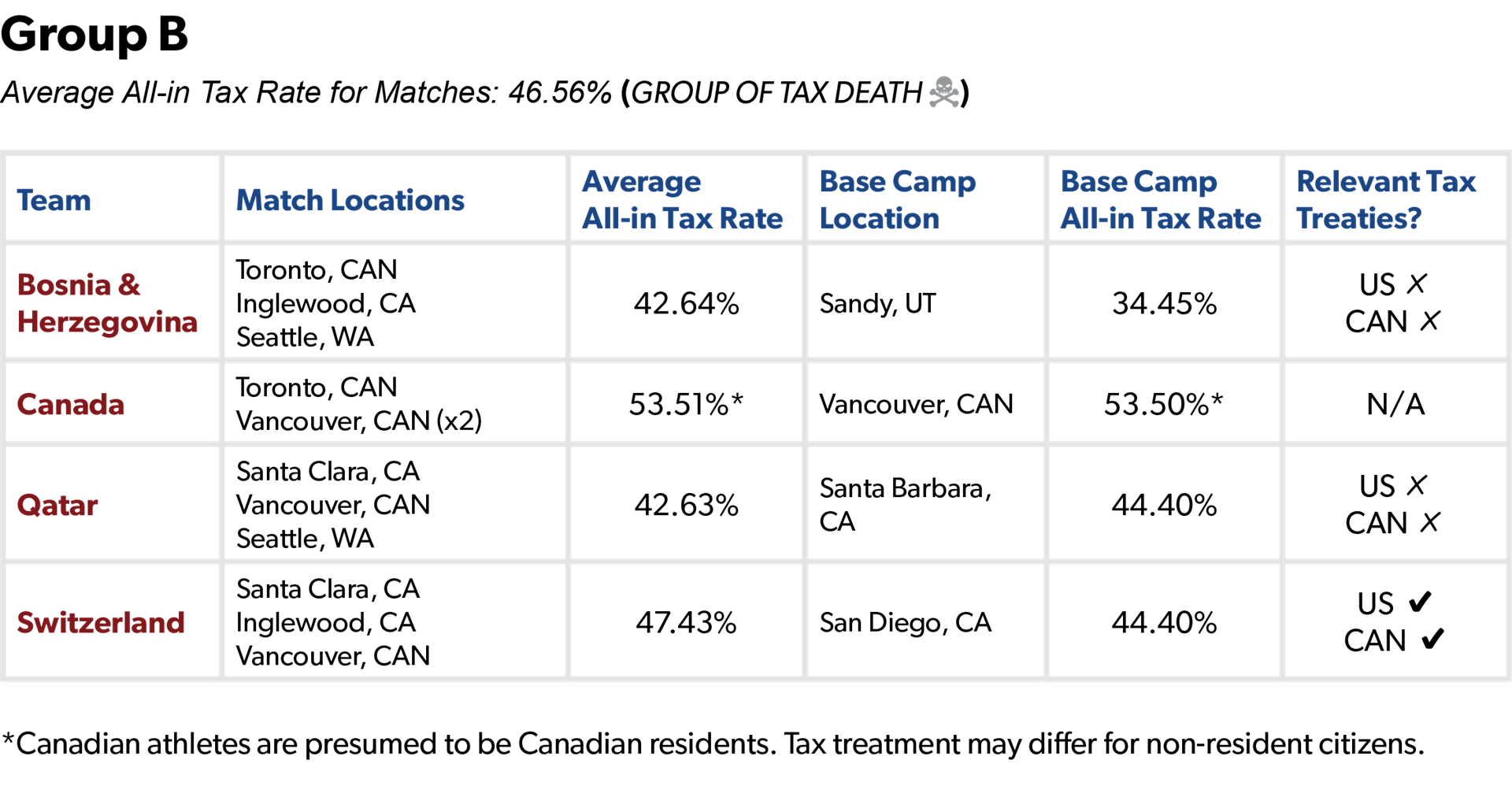
The so-called “Group of (Tax) Death” was Group B, where even a match in (for now) tax-free Seattle could not salvage the tax situation of teams stuck playing their other matches in Canada or California.
Non-Multimillionaire Athletes Will Pay More Than Taxes
While this is somewhat of a lighthearted exercise, there’s real pain underlying it for smaller-nation athletes who don’t play in the top leagues. The difficulty of navigating these types of jock taxes for an athlete playing (and paying) in multiple countries is enormous for even the most seasoned tax lawyer, and understandably well beyond the expertise of most athletes. Paying an expert to handle it for you is a virtual necessity.
But this kind of service isn’t cheap, easily running an individual athlete around $10,000. That amount may be what Cristiano Ronaldo loses between his couch cushions, but that can be extremely costly for World Cup athletes from smaller nations. It’s a shame that their most memorable souvenir will be a five-figure bill from an accountant.
Click here to read the full study, which gets into more detail about how tax compliance works for these international athletes and ranks the World Cup tax burden of each of the 48 teams.