

New York Shows the Cost of Millionaires Leaving
It’s a common response when tax increases on the wealthy are proposed at the state level: “But this state increased taxes on the rich, and they have more millionaires than ever!”
It’s technically true, and I can say that without specifying a state because the number of millionaires is always increasing over time, in every state. Inflation, economic growth, and population growth all mean that a state having more millionaires than it did in the past is a given.
That’s why, instead, NTUF looked at the share of the nationwide millionaire population in New York, where millionaire migration remains a hotly debated topic. In the decade leading up to the latest IRS data in 2022, New York’s share of the millionaire population dropped from 12% to 8.7%.
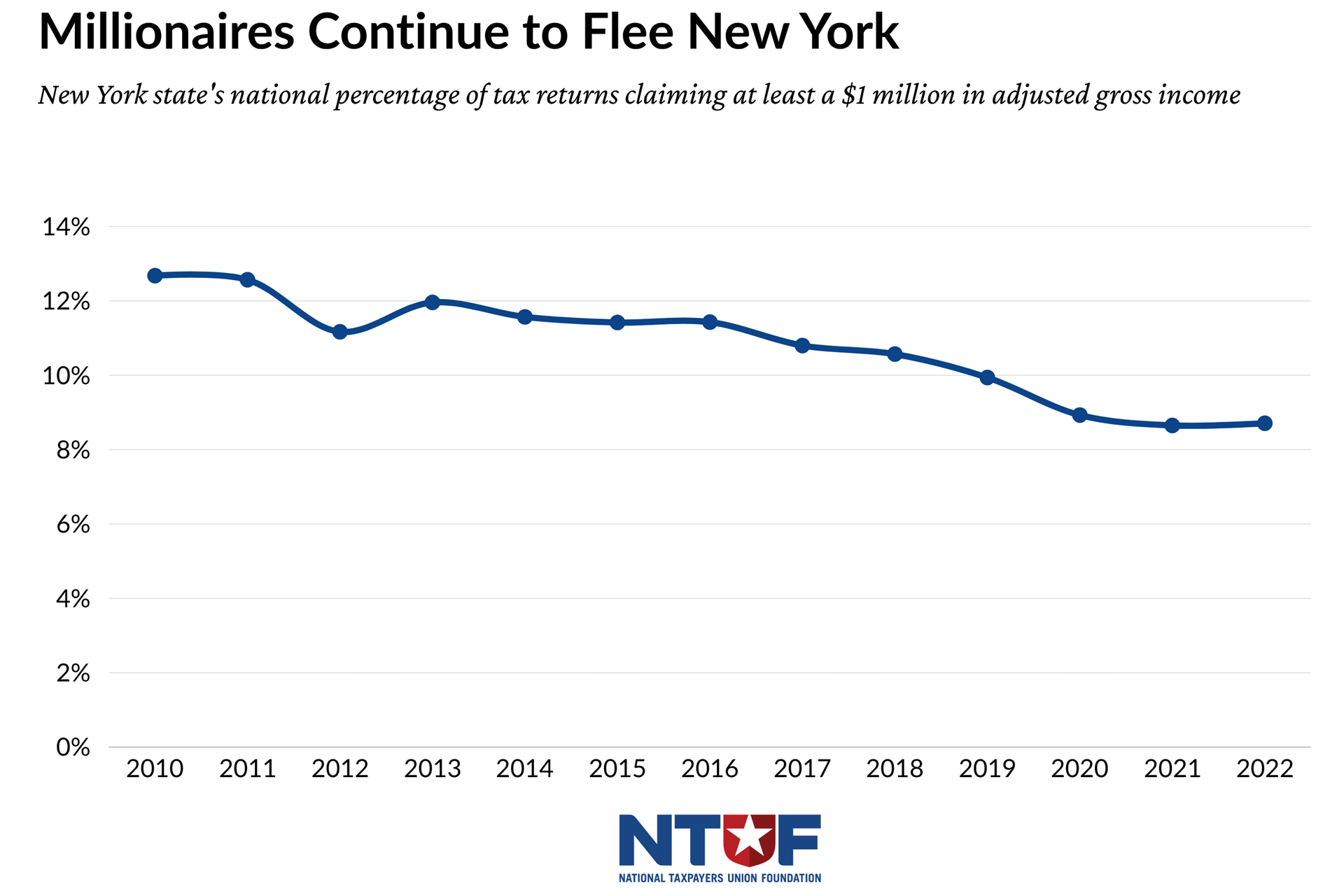
That has real consequences. New York’s millionaire population over that period of time increased from 41,520 to 69,780, but it would have been 95,812 if the state had maintained a 12% share of the nationwide millionaire population.
The upshot is that New York would have raised $12.2 billion more in revenue in 2022 if it had maintained a 12% share of the nationwide millionaire population. And, considering that each New York millionaire pays the same amount of tax as 39 average New Yorkers, that means a greater burden is placed on everyone else to make up the difference.
States considering funding new spending initiatives through high-earner taxes need to be aware that these types of targeted tax increases can drastically erode a state’s tax base over time. Even if you have more millionaires than last year.
Get Rid of Your State Lottery
There’s a predatory institution that probably operates in your state. It costs your poorest residents four times as much money as your wealthiest residents, disproportionately impacts less-educated people, and made $30 billion in profit off of $105 billion in revenue in 2024 across each of its state-level subsidiaries. It also routinely advertises deceptively and is exempt from federal regulation.
It’s your state’s lottery, and if you have one, you should get rid of it.
You may say that it funds important programs, and is earmarked for specific, nice-sounding initiatives like education or parks. But, if you wouldn’t fund those programs with a fee that charges your poorest residents four times as much as your wealthiest residents, why would you fund them with a lottery?
What’s more, the idea that lottery revenue can be “earmarked” for specific projects is a mirage. A new source of funding for education means that existing funding can be moved elsewhere. It’s not funding education; it’s funding the niche new initiative that would never have fit into the budget otherwise.
Nor would scrapping state-run lotteries restrict access to gambling for those who enjoy it for entertainment purposes. Plenty of alternatives exist without being advertised by the states themselves.
So, unless you’re in Alabama, Alaska, Hawaii, Nevada, or Utah, your state has a lottery. The question to ask yourself is: why?