

Data centers are the issue of the year. If you’ve worked in state politics this year, and not while using quill and ink inside a Faraday cage, you’ve both used and heard about data centers. Yet for all the ubiquitousness of the topic, states just can’t stop doing it wrong.
Last week, New York became the first state to impose a statewide, year-long moratorium on new data center construction after Governor Kathy Hochul signed an executive order to that effect. Numerous counties and local governments across the country have already done the same.
As with other moratoriums, New York appears unlikely to use this moratorium period for any proactive purpose, such as streamlining the state permitting process for bringing new energy sources online to match increased power demands. Instead, New York will study environmental impacts and form working groups. There’s a reason that New York already has fewer data center facilities than smaller states like Georgia, Arizona, and Ohio.
Even Virginia isn’t safe from these shenanigans. Virginia is the state with the most data centers in the country, receiving billions of dollars in property tax revenue from data centers each year. But last month, Virginia enacted an unprecedented new tax on electricity consumption by data centers.
Why? Well, the legislature was sharply divided over proposals to repeal the state’s sales tax exemptions for data center sales. As in many other states, these have been termed “data center tax breaks,” with the implication that they are special handouts to data centers. The reality is far less exciting: data center sales are a business input.
Whenever tax wonks try to explain why taxing business inputs, or business-to-business (B2B) sales, is a bad idea, they tend to become professorial and esoteric.
“You see, taxing B2B leads to tax pyramiding, and ideally, sales tax should fall upon the final consumer. Taxing B2B taxes each step along the supply chain, and results in people paying sales tax on the taxes paid on intermediate sales.” It’s all true, but it sounds more like we’re pointing out a grammar error than a real problem for real people. I know because I’ve said versions of those exact words myself.
So allow me to put it more bluntly: taxing data center sales makes everything else your state’s residents buy more expensive. It appears to be taxing data centers, but your residents are the ones who pay.
To visualize this, let’s imagine a simplified example where an online fitness company has to advertise online to gain customers. We’re going to pretend, for the sake of this example, that each step along the way would add $25 pre-tax to the final cost of the product, and that there are no other inputs.
Customers Pay the Price for B2B Sales Tax
Cost of a Fitness Subscription with or without Sales Tax on Business Transactions
| Scenario 1: 6% Tax on All Sales | Scenario 2: 6% Tax Only on Final Sale | ||
Transaction | Added Cost Before Sales Tax | Added Cost After Sales Tax | Added Cost Before Sales Tax | Added Cost After Sales Tax |
Data center leases servers to cloud infrastructure provider | $25 + 6% | $26.50 | $25 | $25 |
Cloud hosting provider sells cloud hosting services to online newspaper | $51.50 + 6% | $54.59 | $50 | $50 |
Online newspaper sells advertising services to online fitness company | $79.59 + 6% | $84.37 | $75 | $75 |
Online fitness company sells annual subscription to final customer | $109.37 + 6% | $115.93 | $100 + 6% | $106 |
15.93% Effective Tax Rate | 6% Effective Tax Rate | |||

So, data center sales tax exemptions shouldn’t be thought of as “incentives” or “giveaways” to data centers. They exist to prevent tax increases on everyone else, just the same as any other business input tax exemption.
And for what it’s worth, electricity usage is a business input as well. So Virginia simply traded one business input tax for another.
An Update to the Update on Major Tax Ballot Measures
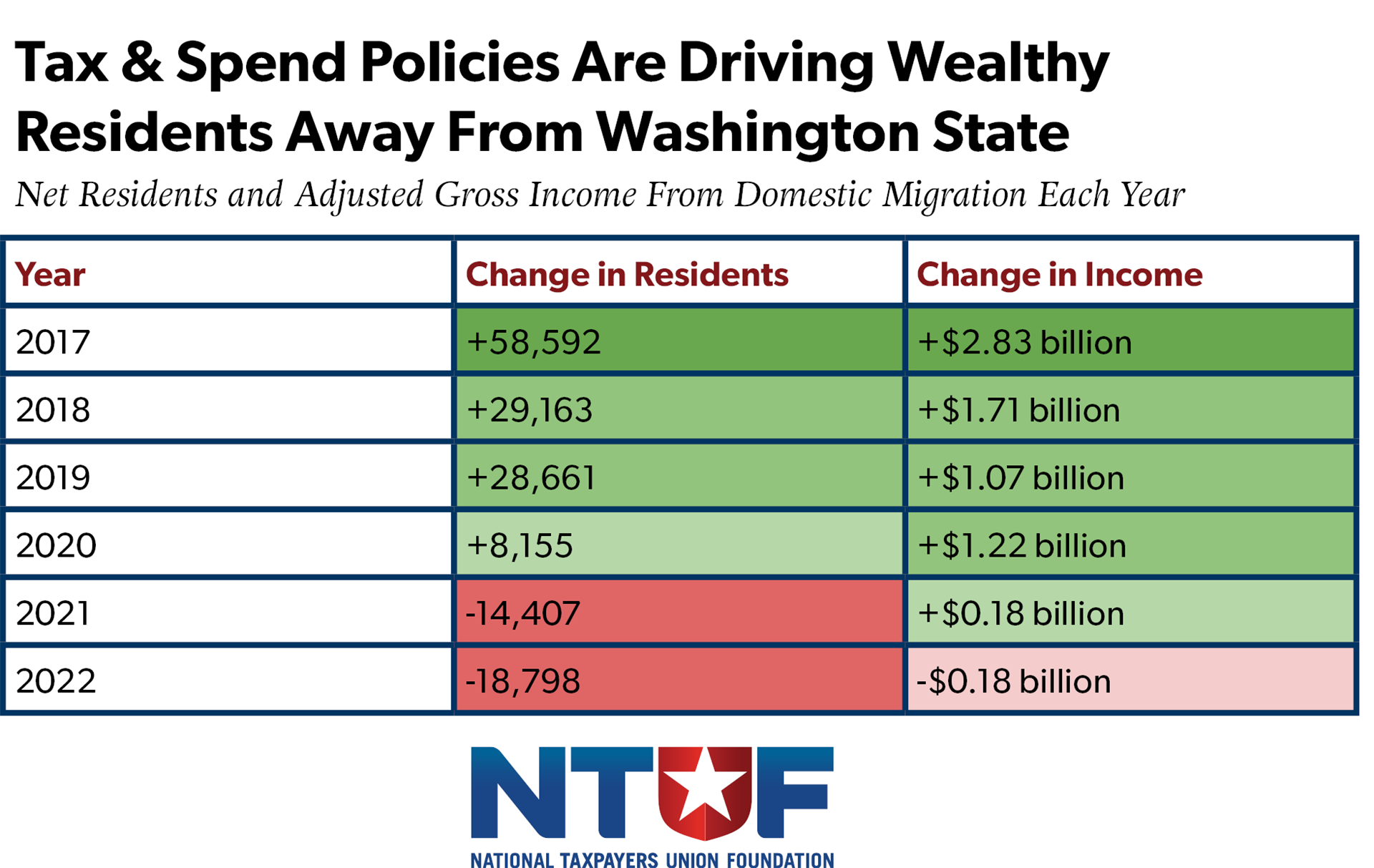
Between last week’s email and now, two more important tax ballot measures have taken major steps towards appearing on the ballot in November. In Washington, organizers of a petition to repeal the state’s new 9.9% income tax submitted far more than the required 300,000 signatures to appear on the ballot. The new income tax was passed this year but is not set to go into effect until 2028. The Washington Secretary of State’s office has confirmed that the measure will be on the ballot in November.
In Colorado, voters will likely be presented with dueling ballot measures after organizers submitted signatures on a measure to cap Colorado’s income tax rate at its current 4.4%. A separate ballot measure would replace the current flat rate with a graduated income tax system ranging from 3.71% to 8.41%.
We’ll keep you posted on the biggest ballot measures as we move closer to the elections in November.
Happy Conference Season
And last but not least: if you’ll be at ALEC, SPN, NCSL, or any of the other gatherings taking place this summer, please let us know—our team would love to chat!