


Key Facts:
- In the latest release of IRS data on interstate moves by taxpayers in 2022, a taxpayer moves to Florida and Texas every four and a half minutes, while one leaves California every two and a half minutes.
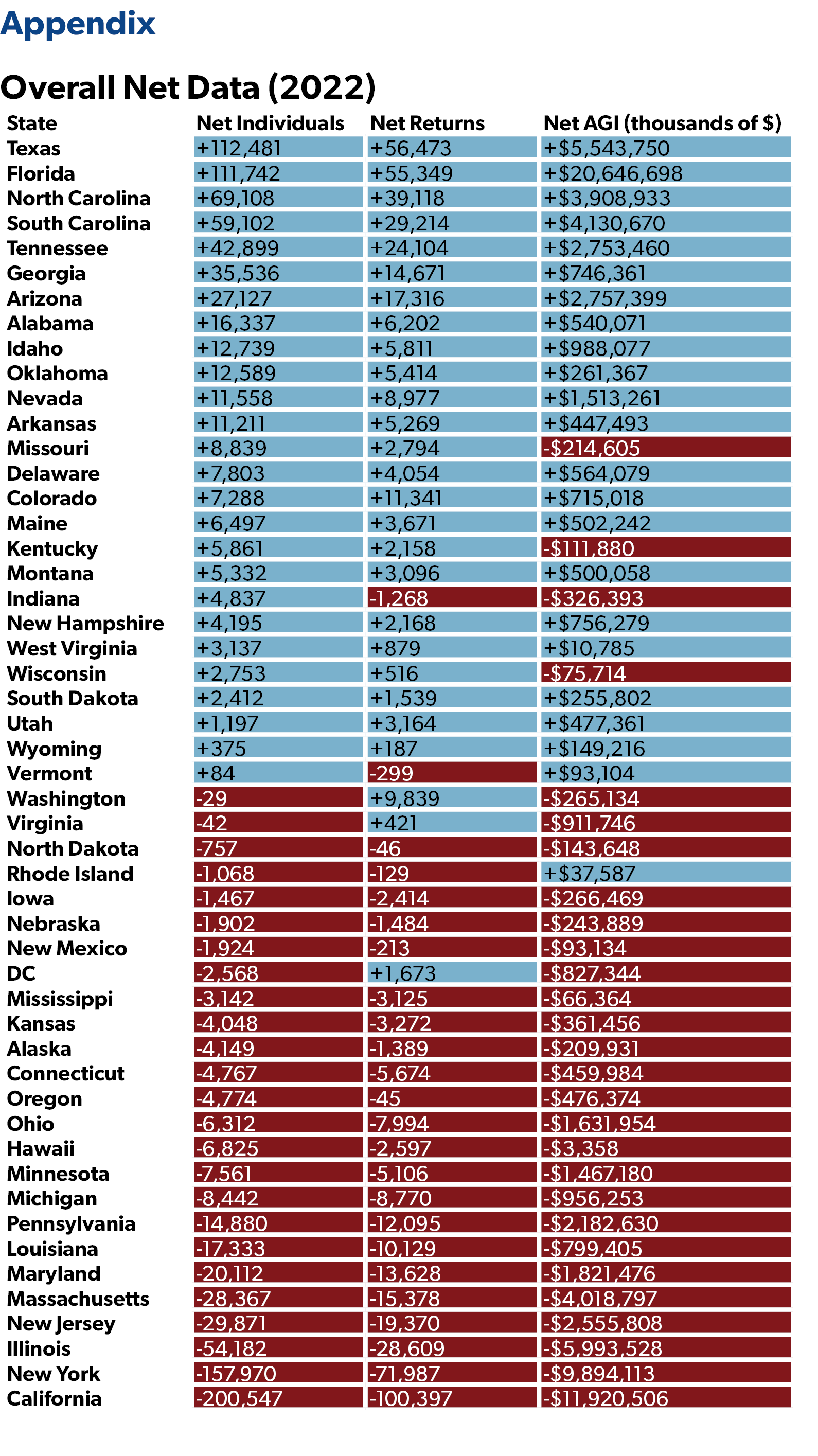
- Texas, Florida, North Carolina, South Carolina, and Tennessee were the biggest net winners from interstate migration, while California, New York, Illinois, New Jersey, and Massachusetts were the biggest net losers.
- Florida gained more than three times more new high-income residents than any other state, while Texas gained the most new young residents. California, New York, and Illinois were at the bottom of both categories.
Recently, the IRS released its 2022 update to its data series on interstate migration by taxpayers. In it, we see a continuation of the trends that we have seen for years: taxpayers are fleeing high-tax states and heading to low-tax ones. In 2022, Florida and Texas remained the biggest beneficiaries of interstate migration, while California and New York continued to see their tax bases erode at an alarming rate.
As states continue to diverge on tax policy, our “laboratories of democracy” are increasingly running noticeably different experiments. IRS migration data, therefore, is one of the most direct and honest forms of feedback available from taxpayers on what kind of state they want to live in. Polls may miss the mark, elections can swing on the personality and character of the candidates, but taxpayers voting with their feet are usually making a financial decision.
There are many reasons why Americans choose to move to a different state. Housing, employment opportunities, weather, proximity to family and friends—these factors and more can contribute to or even govern an individual taxpayer’s decision on what state to live in. But, at the macro level, the single best predictor of which states will gain new residents from interstate migration and which states will lose them is tax policy.
This round of interstate migration data describes taxpayers who listed a different state of residence when they filed their taxes in 2023 than the state they claimed residence in when they filed in 2022. In effect, it covers interstate moves that Americans made during calendar year 2022.
Migration in Minutes: Every Five Minutes, a Taxpayer Moves to Texas and Florida, and Two Leave California
Movements of tens of thousands of Americans in and out of a state can be difficult to conceptualize. Our Migration in Minutes metric translates migration flows into how often a taxpayer leaves or enters a state. All frequency data is based on net migration.
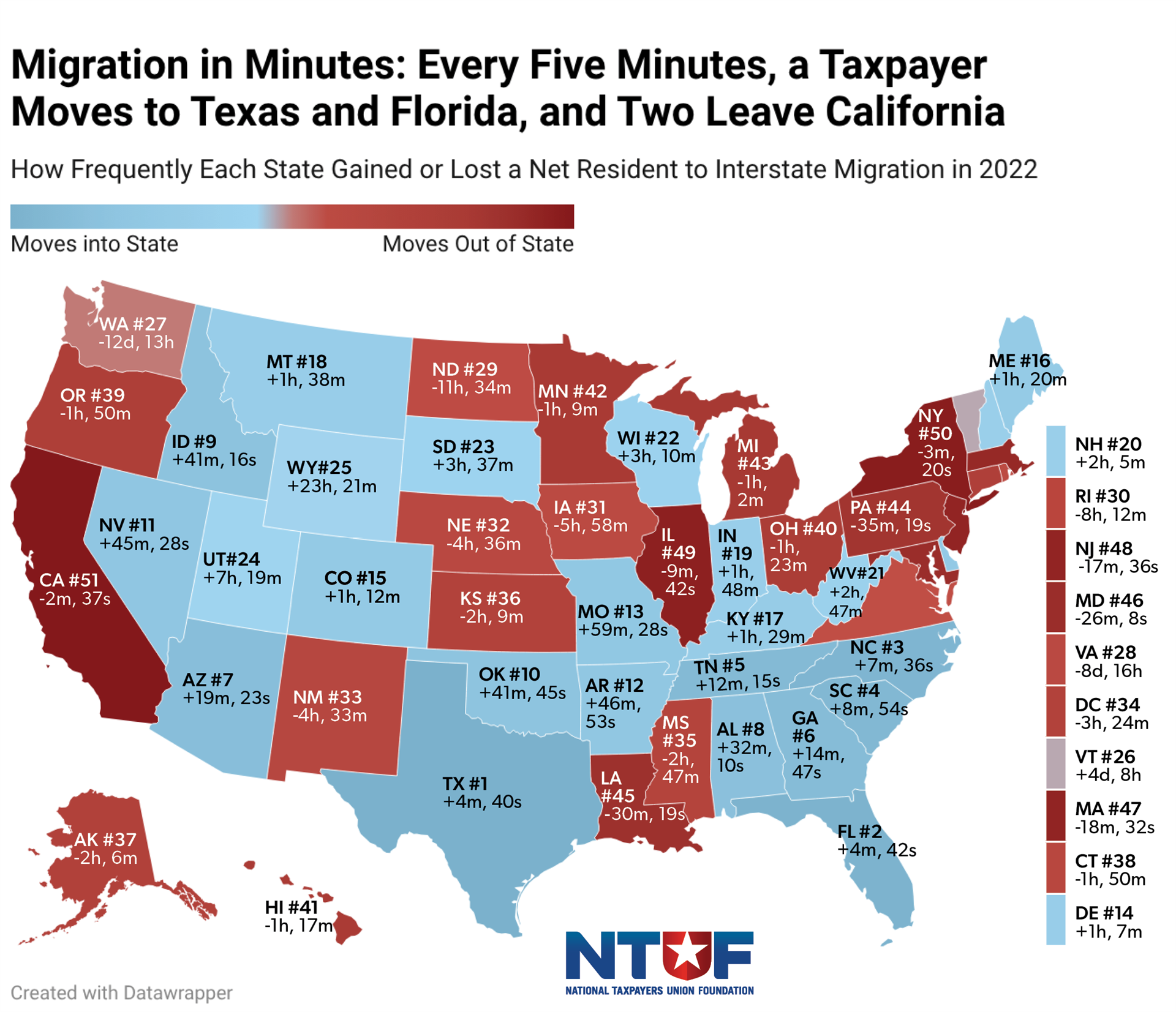
The five states losing a resident most frequently are the same as last year: California (every 2 minutes, 37 seconds), New York (3 minutes, 20 seconds), Illinois (9 minutes, 42 seconds), New Jersey (17 minutes, 36 seconds), and Massachusetts (18 minutes, 32 seconds). The top five states also remained the same: Texas (gaining a new resident every 4 minutes and 40 seconds), Florida (4 minutes, 42 seconds), North Carolina (7 minutes, 36 seconds), South Carolina (8 minutes, 54 seconds), and Tennessee (12 minutes, 15 seconds). Texas managed to surpass Florida for the first time since 2013.
Migration Trends Are Even More Pronounced among Higher-Income Taxpayers
While Texas gained more net residents from migration than Florida in 2022, Florida remained the top destination for higher-income individuals. Florida gained a net of 50,485 new residents with incomes above $200,000 (the highest-income group reported by the IRS). All told, more than 45% of Florida’s net gain in residents in 2022 was composed of individuals earning $200,000 or more. The next closest was Texas, gaining a net of 15,470 individuals making $200,000 (but just 13.7% of the state’s total net gain).
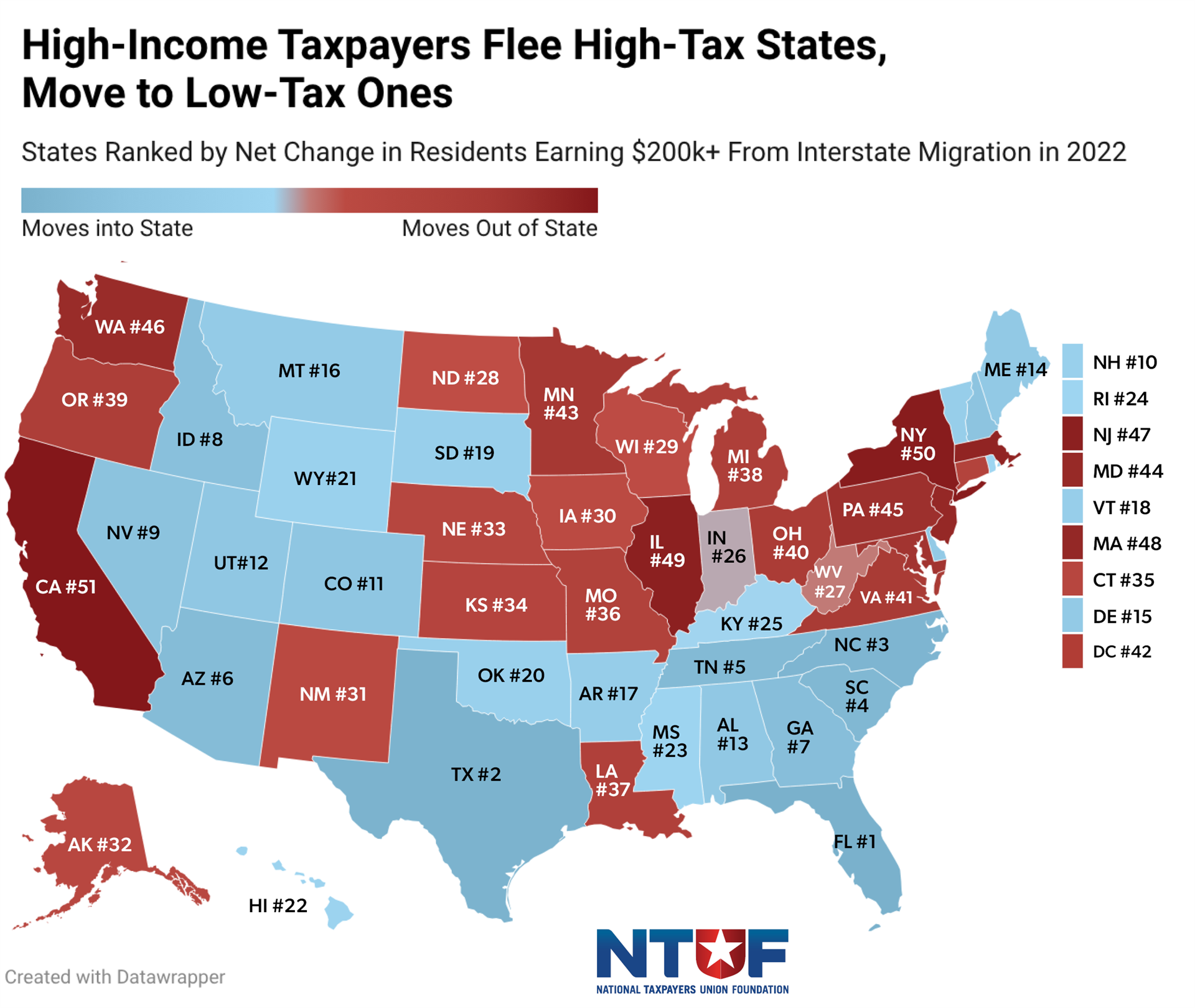
There’s little mystery behind these trends. California and New York, the two states at the bottom, have two of the three highest income tax rates in the country, while Massachusetts and New Jersey each have a top rate of 9.75% or higher.[1] On the other hand, three of the five top states have no income tax at all. North Carolina had a flat income tax rate of 4.99% in 2022, which has since dropped by a full percentage point. South Carolina had a relatively high top rate of 7% in 2022, but has since dropped the rate to 6% and may soon be on a path to full income tax elimination.
Washington stands out for losing the sixth-most higher-income residents, despite nearly breaking even over all income levels (losing just 29 net residents in 2022). Given the efforts the Evergreen State has made to expand taxation of higher-income individuals since 2021, it is little surprise that this group has been heading for the exits at a disproportionate rate.
Younger Americans Are Headed to Low-Tax States as Well
Particularly at a time when young people are embracing more flexible work arrangements, states are understandably concerned about attracting and keeping young people. But, despite popular perception that big cities in high-tax states (such as New York City, L.A., or San Francisco) are youth magnets insulated against tax debates, California and New York remain the biggest interstate migration losers even among the youngest working generations.
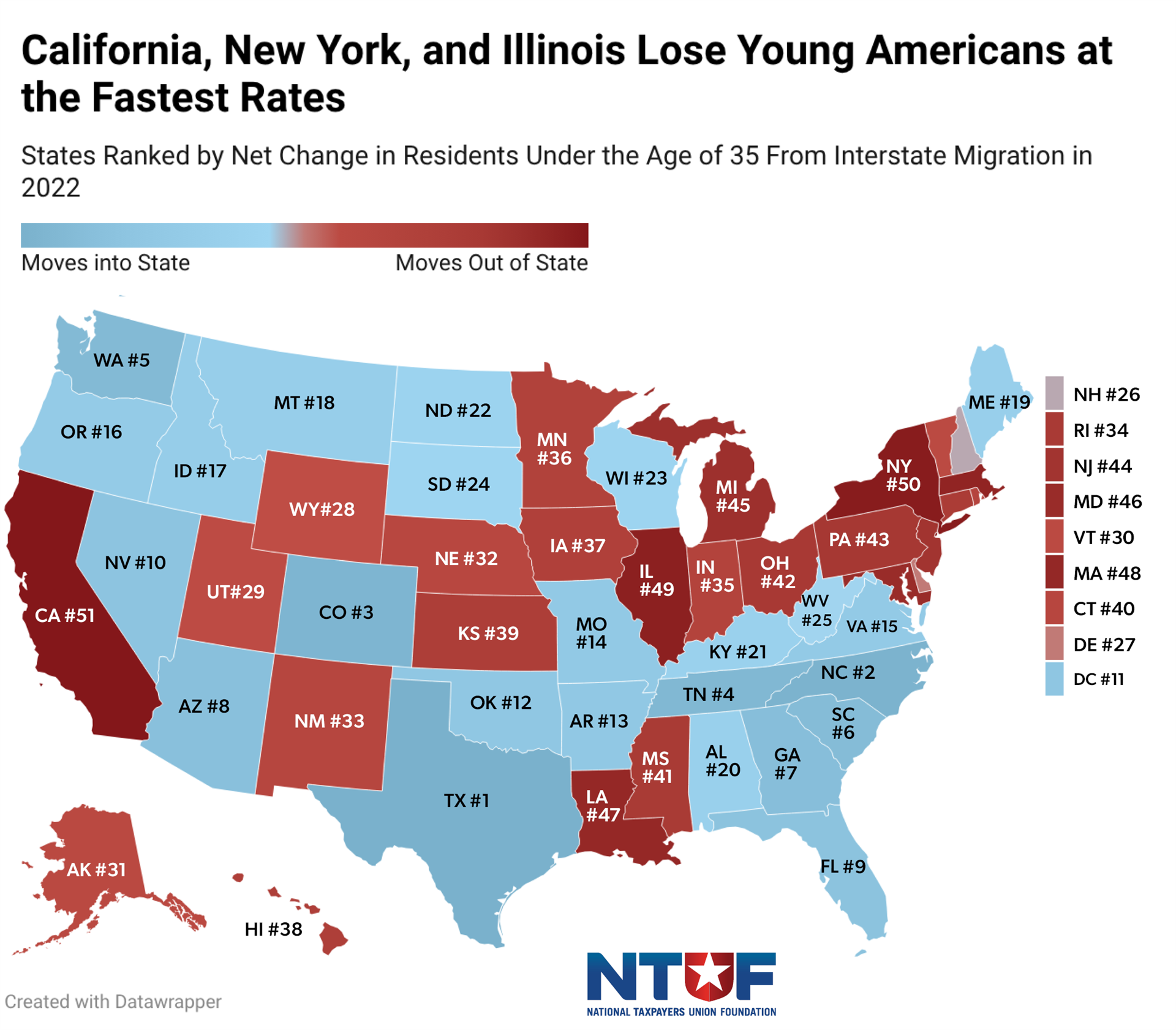
A note of caution, however: for some states, appearances of being interstate migration winners (or losers) among young people are deceiving. Part of what makes young people so mobile is that many have not set down roots yet — they have not married, had children, bought a house, established a community, and so on. This can make them less sensitive to taxes and the cost of living than older generations.
We can see this clearly with certain states that are net winners among the under-35 cohort, but net losers in every other age group — or vice versa. In states like Colorado, Washington, DC, and Oregon (and, to a lesser extent, North Dakota), we can see that either some or all of the net gain among the under-35 cohort is immediately counteracted by outmigration among the next age groups. Bringing in young people is not much good if many of them head for the exits once they are ready to truly settle down.
This works the other way as well, particularly for Indiana, but also, to a lesser extent, for Utah, Iowa, and Mississippi. Indiana suffers a net loss of 1,147 residents under the age of 35, but gains nearly five times that number in the next age group. This suggests that while Indiana is not gaining young people, it is siphoning off the next generation from nearby states with higher taxes and costs of living.
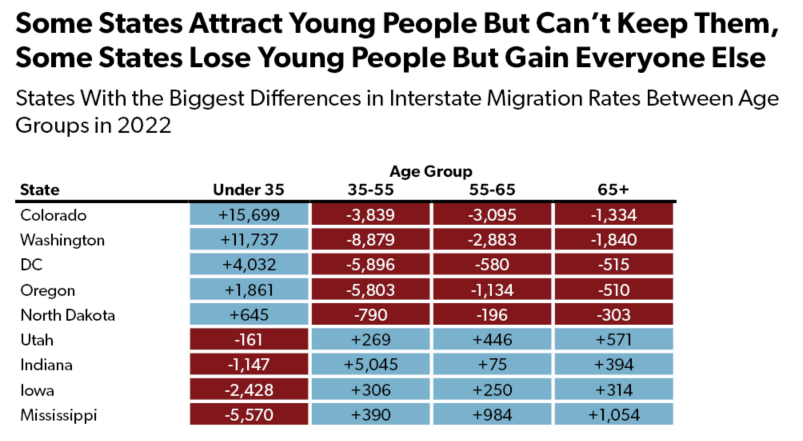
Likewise, Florida’s poor showing among the under-35 cohort should not be taken as proof of the myth that Florida’s interstate migration gains come from retirees. Of Florida’s 113,494 net new residents, just 16,481 were over the age of 65, while 51,893 were between the ages of 35 and 55.
The Shift toward Low-Tax States Is Nothing New
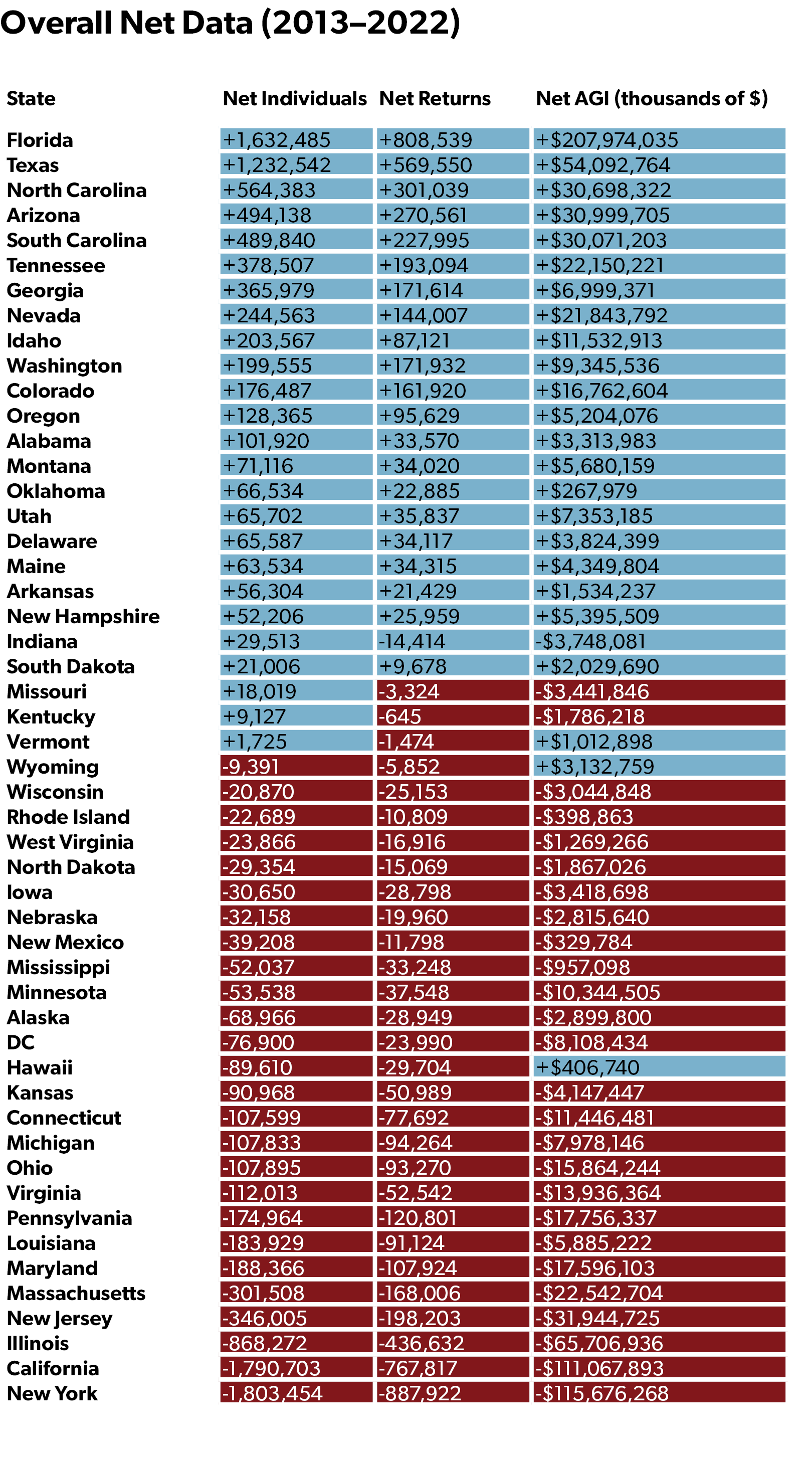
While migration rates can ebb and flow in a given year due to temporary factors such as mortgage rates or storms, trends are steadier over the long term. Between 2013 and 2022, Florida and Texas have siphoned 1.6 million and 1.2 million new residents from other states, respectively, while California and New York have each lost about 1.8 million residents.
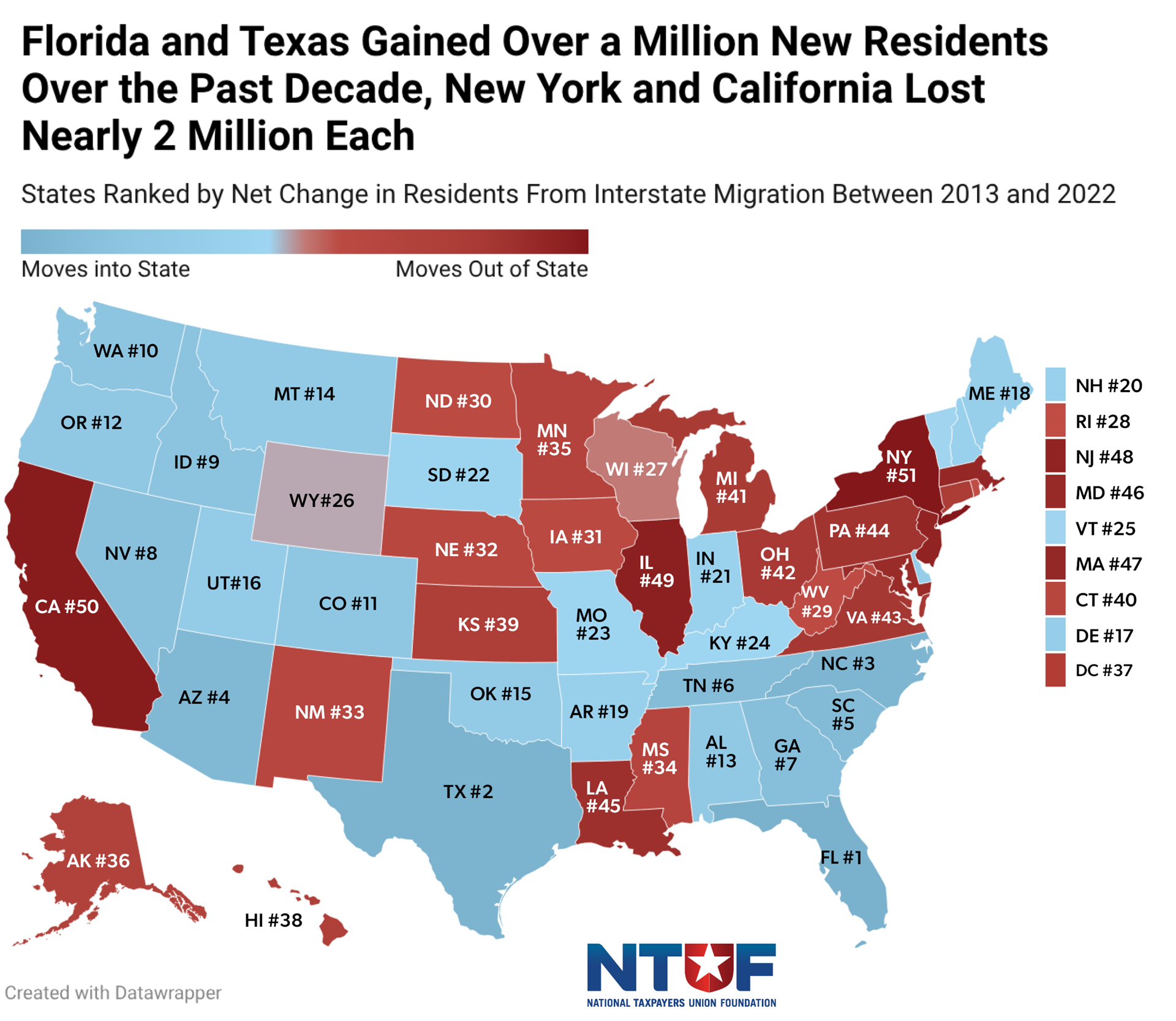
Not only do these kinds of massive, sustained shifts have a substantial impact on tax bases, they also affect states’ power to impact federal policy. In the 2020 census, California, New York, Pennsylvania, Illinois, Ohio, Michigan, and West Virginia all lost a congressional seat and an electoral college vote, while Texas, Florida, North Carolina, Oregon, Colorado, and Montana gained seats. As interstate migration rates rise, the Brennan Center currently predicts even more significant changes to congressional apportionment in 2030.
Exceptions to the rule do exist. Oregon and Washington have gone from being net migration winners to net losers in recent years, thanks to a relatively recent shift toward high tax burdens. But, generally speaking, significant policy shifts need to occur to move a state from green to red, or vice versa.
Revenue Impacts
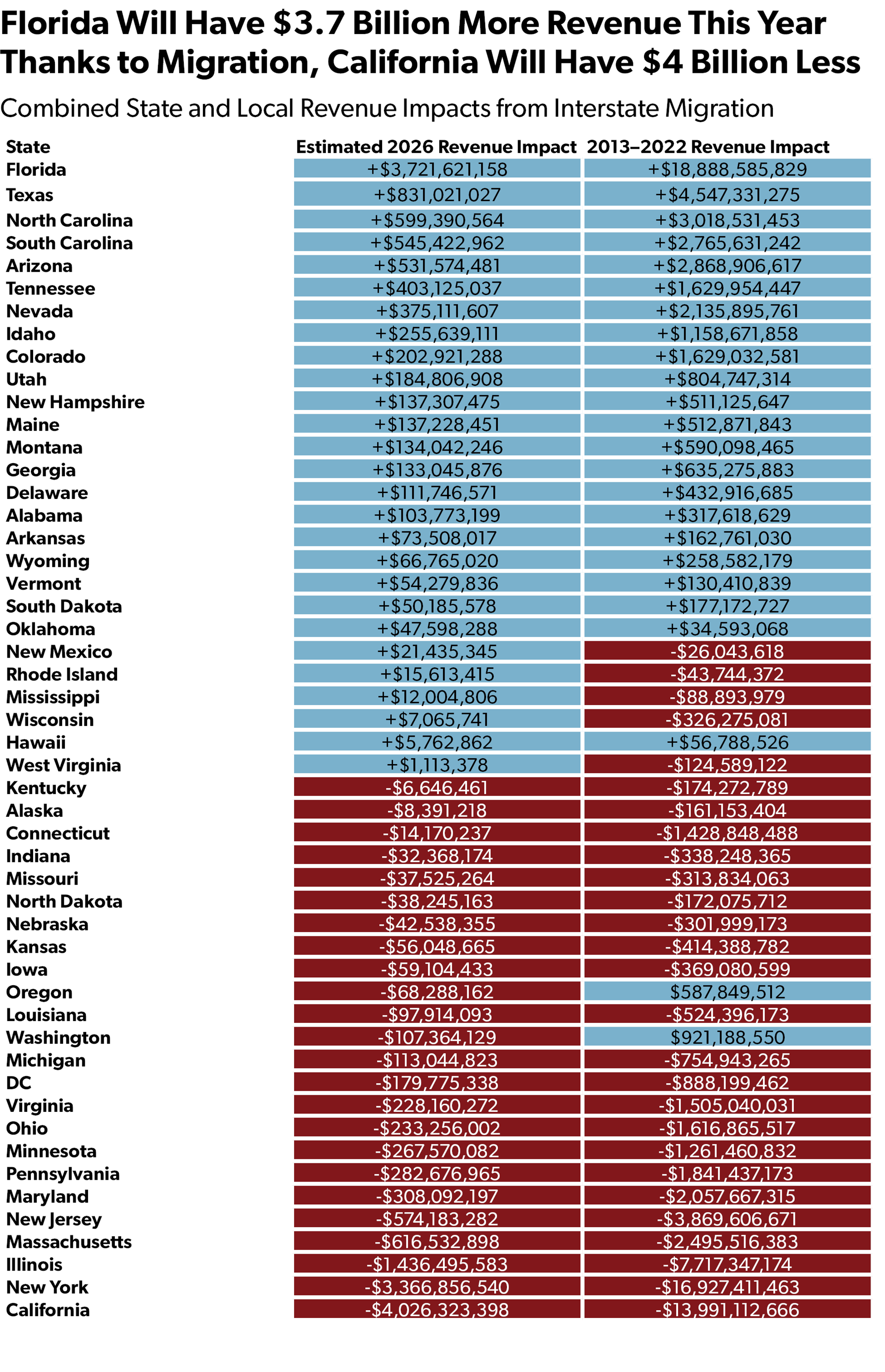
Often understated is how substantial the impact of migration can be on state and local revenues. Residents who relocate to another state usually no longer pay tax to their former state, leaving schools to be funded, infrastructure to be maintained, and government officials to be paid, all without the help of their tax dollars. A steady loss of taxpayers to other states can pose a real problem to a state’s budget over the long term.
After all, a taxpayer who moves from California to Florida in 2013 does not merely stop paying taxes to California in 2013 — their tax dollars go to Florida for every subsequent year that they stay in Florida. This compounding effect can make the long-term impact of migration quite devastating (or, in the winners’ case, enriching) to a state’s budget.
Using Tax Foundation’s effective state/local tax burden data, we can get an idea of just how much impact interstate migration has on states. The chart below shows states ranked by the estimated impact on state and local revenue in 2026.
 Conclusion
Since the pandemic, states around the country have been active in trying to make their tax codes more competitive to prospective new residents. Since 2021, 26 states have reduced their income tax, with more tax cuts being discussed in state legislatures in multiple states this spring.
In this environment, states that are not reducing taxes are falling behind, and states that are increasing taxes are standing out in a bad way. States hoping to compete in the migration battles of the latter half of the 2020s should look first and foremost at updating their tax codes to be more competitive with their neighbors.
[1] Hawaii has the second-highest income tax rate, but tends not to have a high volume of migration due to its small population and physical distance from the mainland.