

Earlier this month, Canada’s government announced a “Productivity Mega Deduction.” Building on a previous “Super Deduction,” the Liberal government, which has apparently been watching too many Marvel movies, will now pledge to permanently offer full expensing to roughly two-thirds of capital investments.
If the term “full expensing” (or “bonus depreciation”) rings a bell, it has been a central, if somewhat wonky, element of the two major federal tax bills over the last decade.
The Tax Cuts and Jobs Act first introduced full expensing on a temporary basis in 2017, while the One Big Beautiful Bill Act (OBBBA) made it permanent in 2026.
Just like any other expense, businesses are allowed to deduct the value of investments from their taxable income. But, prior to the introduction of full expensing, businesses had to use complicated depreciation schedules to do so—with the depreciation period ranging from 3 to 50 years.
Full expensing changed that. Instead of being able to deduct a small portion of an investment each year over a long period of time, businesses can now simply deduct the value of the investment in year one. That’s not only simpler, it means more money that businesses can use now on further productive investments.
The best part of full expensing? It has basically zero impact on the government’s revenue in the long term—it just turns a spread-out tax benefit into year-one tax benefit.
So this is a no-brainer that states immediately conformed to with their own business tax regimes, right? Well, hold on.
Government budgeting is often, to use a technical term, gobbledegook. Full expensing, for example, takes business deductions that previously could have been claimed over time and shoves them into year one. The size of the deductions isn’t changing, the foregone revenue is the same. But on government balance sheets, it appears to be a large “cost” in year one.
This has led many states, unable to look beyond that year-one figure, to panic and decouple from OBBBA’s full expensing provisions. That’s a mistake.
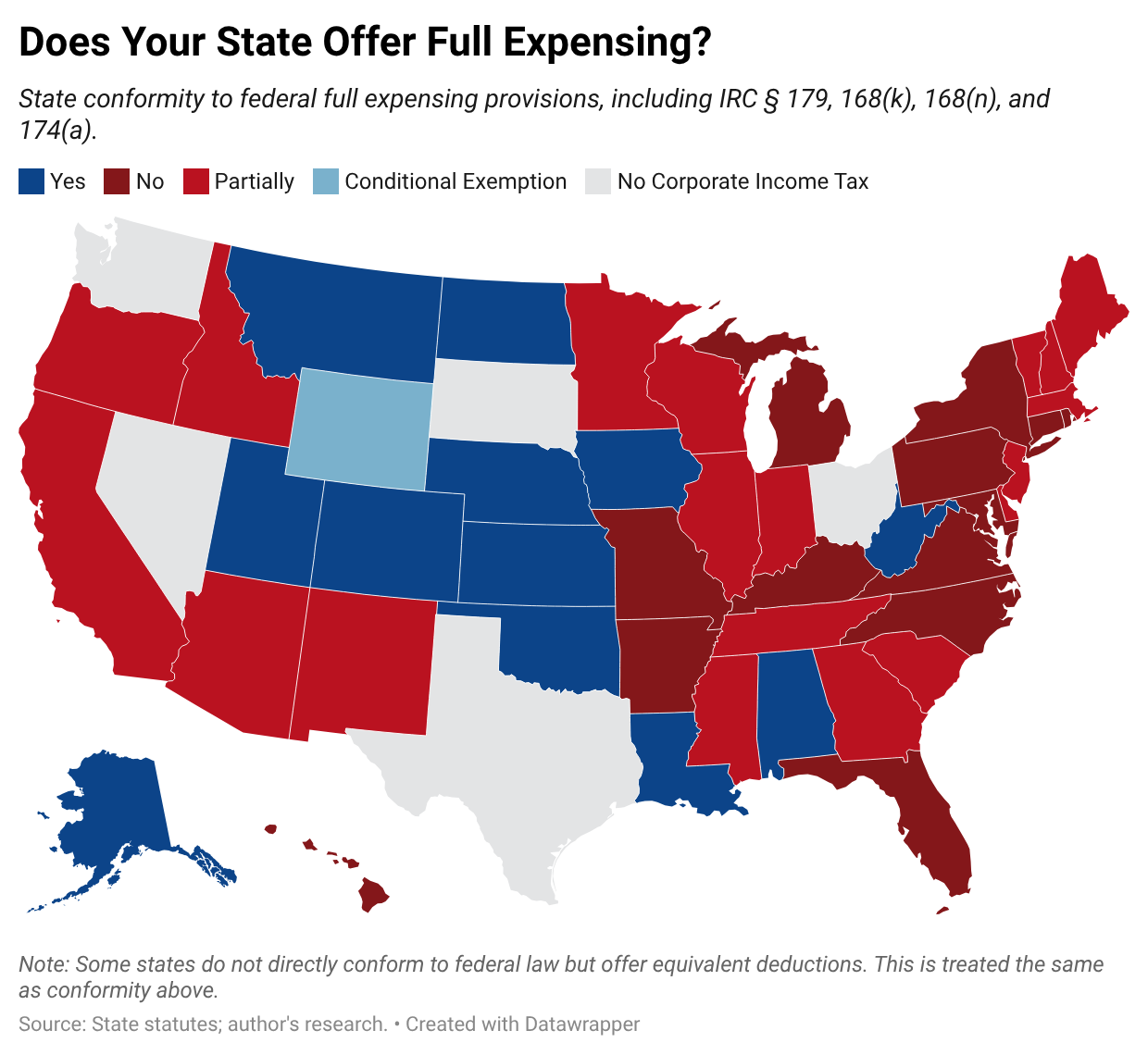
States that are not light blue above are at a competitive disadvantage when it comes to new investment opportunities. That’s a heck of a price to pay to make the budget voodoo easier right now.
We’ll be out with a more in-depth analysis of state conformity with these provisions soon.