

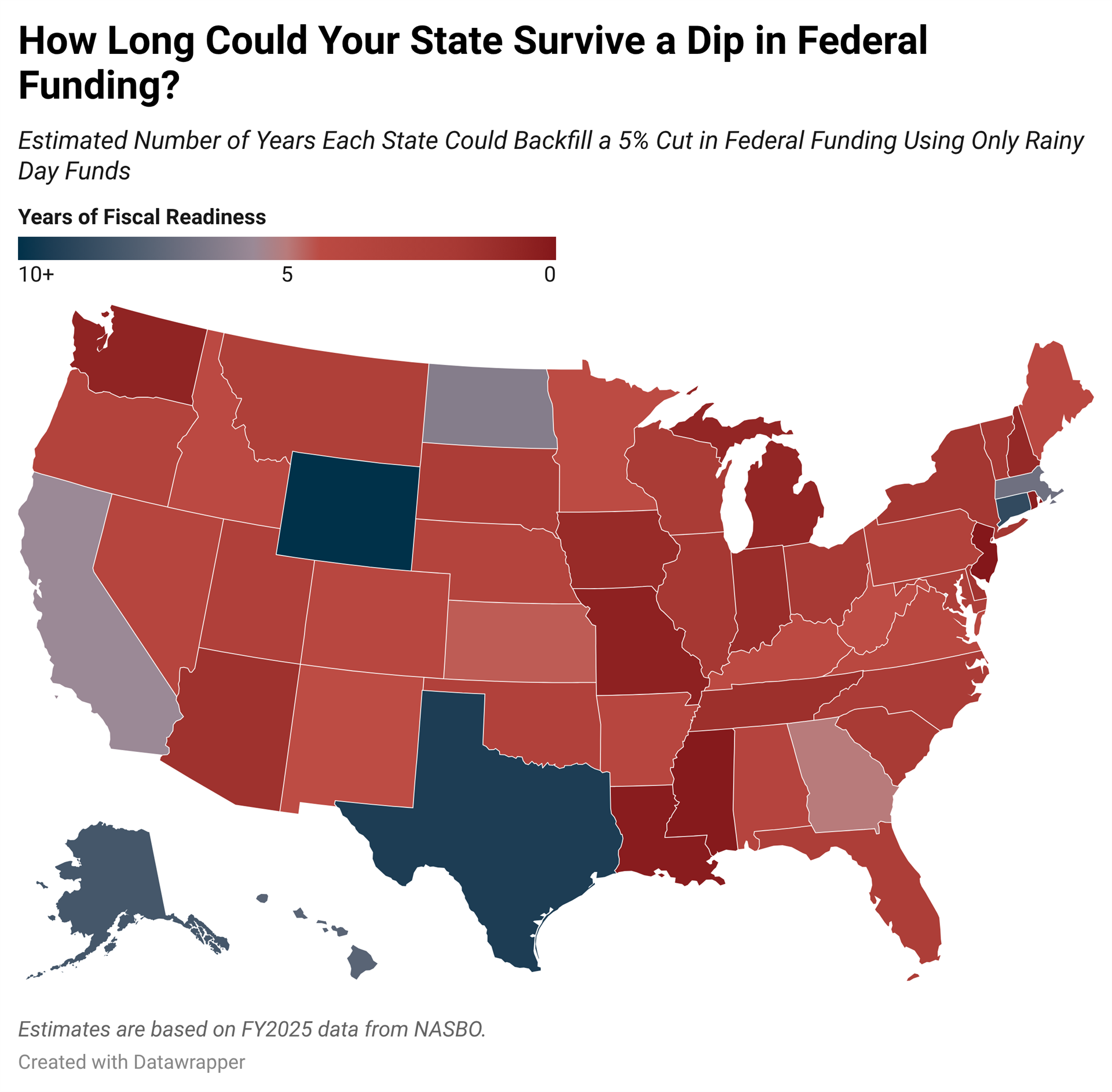
A couple of months ago, we took a look at how prepared states were for future federal aid cuts. Specifically, we asked how many years each state could absorb just a 5% cut in federal aid by dipping into its rainy day fund.
The answer was downright scary in the vast majority of states, where the rainy day fund would only cover such a minor dip in federal subsidies for a few years. Texas was a rare exception, with its sizable rainy day fund capable of backfilling such a reduction in federal aid for almost a decade. Only Wyoming could last longer.
Now, Texas Democrats, suddenly set to take over the state House and governor’s mansion for the first time in well over two decades, want to change that. The plan: raid the state’s $28 billion rainy-day fund, squandering over 60% of this carefully gathered reserve in one fell swoop to send $1,500 checks to every Texas household.
The justification is the a-word we’re all at least a little bit guilty of indiscriminately tossing in the faces of our political opponents (“affordability,” of course). Governor-elect Gina Hinojosa argued during her gubernatorial campaign that Texans need the check to help with affordability woes.
Those woes are real, but sending out one-time checks to fight inflation makes about as much sense as trying to douse a fire with gasoline. I’d tell you what economists think about such an idea, but all I could get from them was strangled groans and the sound of heads banging against desks.
Rainy Day Funds Aren’t “Corruption”
Bizarrely, Hinojosa did more than just argue that Texas should spend its rainy day fund—she argued that a $10 billion rainy day fund was all that was needed to be “fiscally responsible” and insinuated (in the same way that I’m insinuating that this whole plan is a very bad idea) that a larger rainy day fund represented “corruption.” You know, the kind of corruption where a state prudently sets money aside and doesn’t touch it.
It’s true that rainy day funds won’t, by themselves, save states from some sort of permanent, structural fiscal crisis like a cut in federal aid. What they do provide is a longer runway to absorb a short-term crisis or adapt to a long-term one. If legislators doing their best to prepare for future problems and not just leaving taxpayers on the hook for fiscal mismanagement is what qualifies as corruption in Texas . . . Texas sounds pretty great!
Hopefully this half-baked idea doesn’t get past the brainstorming stage in the Lone Star State. But whether it does or not, Texas’s unusually robust rainy day fund is a reason for other states to be more like Texas—not a reason for Texas to be more like other states.