


Key Facts
- Since 2009, Congress has voted to freeze their own pay, blocking automatic cost-of-living adjustments, saving taxpayers hundreds of millions of dollars.
- A handful of current and former members of Congress contest that many of those pay freezes violated the 27th Amendment. They have filed suit for damages arguing that their salaries were unconstitutionally suppressed.
- If the class action lawsuit is successful, the real damage will be done to taxpayers: retroactive pay hikes could trigger not only back pay for former members, but also higher congressional pension costs, increased federal debt, and additional debt service costs.
- The plaintiffs should withdraw the lawsuit, and Congress should clarify through legislation or a resolution that the 27th Amendment applies to pay increases, not voluntary pay freezes.
Introduction
A handful of members are seeking damages in court, arguing that a series of laws that blocked automatic pay increases unconstitutionally suppressed their salaries. If they are successful, real damage will be done to taxpayers.
The plaintiffs, represented by former Virginia Attorney General Ken Cuccinelli, include Reps. Jim Clyburn (D-SC), Rick Crawford (R-AR), and Steny Hoyer (D-MD), along with former Reps. Rodney Davis (R-IL), Tom Davis (R-VA), and Ed Perlmutter (D-CO), and former Sen. Mark Kirk (R-IL).The plaintiffs argue that annual congressional cost-of-living adjustment (COLA) freezes violated the 27th Amendment and are seeking back pay.
If successful, the lawsuit could cost taxpayers tens of millions of dollars in back pay—and potentially hundreds of millions more if higher salaries are retroactively incorporated into congressional pension calculations.
Background: Congressional Pay and COLAs
Article I, Section 6, Clause 1 of the U.S. Constitution requires that members of Congress be compensated for their service, an important point of debate during the drafting of the document to ensure that public office would not be limited to the independently wealthy.
Since 1992, congressional salaries have been governed by a statutory formula under the Ethics Reform Act of 1989. That law provides for automatic annual cost-of-living adjustments (COLA) tied to changes in the Employment Cost Index, subject to caps.
However, Congress retains the authority to block those adjustments and did so six times between 1992 and 2008, according to the Congressional Research Service. Beginning in 2009, lawmakers have annually voted to freeze their pay for the subsequent year. As a result, the base salary for rank-and-file members has remained at $174,000 for the past 16 years saving taxpayers hundreds of millions of dollars.
This long-standing practice is now being challenged in court. Plaintiffs argue that blocking COLAs violates the 27th Amendment.
Origin and Purpose of the 27th Amendment
The 27th Amendment states:
“No law, varying the compensation for the services of the Senators and Representatives, shall take effect, until an election of Representatives shall have intervened.”
James Madison proposed this in 1789 as part of the original Bill of Rights, to prevent lawmakers from granting themselves immediate pay raises without accountability from voters.
It remained unratified for more than two centuries until 1992, when a grassroots campaign led by University of Texas student Gregory Watson revived the amendment following a class paper arguing it could still be ratified. After receiving a low grade on the paper, Watson launched a nationwide effort to persuade state legislatures to adopt the amendment.
As noted by GianCarlo Canaparo, former Senior Legal Fellow at the Heritage Foundation, the timing was opportune: between 1982 and 1991, Congress raised members’ salaries from approximately $70,000 to $125,000. These frequent salary increases and apparent self-dealing sparked growing public anger, and the states would soon support the amendment.
This history underscores that the 27th Amendment was introduced and eventually enacted nearly two centuries later to prevent lawmakers from increasing their own pay without accountability to voters.
The Legal Fight over COLAs and Congressional Pay
The lawsuit, Davis et al. v. United States (No. 24-364 C), is pending before Judge Eric Bruggink in the U.S. Court of Federal Claims. The Court has already narrowed the case, dismissing claims related to pensions benefits and limiting damages to claims dating back to 2018.
At the center of the case are two related questions: whether blocking a COLA “varies” congressional compensation, and whether the timing of those decisions satisfies the requirements of the 27th Amendment.
On the first question, the Department of Justice says no. Preventing a COLA doesn’t “vary” compensation because it keeps salaries exactly where they are. Members are paid the same amount before and after a freeze.
The plaintiffs’ argument is that COLAs are effectively part of members’ baseline compensation because of the 1992 law, and that blocking them amounts to a reduction in pay. In other words, each freeze is treated not as maintaining the status quo, but as denying compensation that should have been received.
The case also turns on a separate timing question under the 27th Amendment’s requirement that a change in compensation can only take effect after an “intervening election.” Plaintiffs contend that some votes to block COLAs occurred after early voting had already begun in certain states.
Implications for the 27th Amendment
A strict reading of the text suggests the 27th Amendment could apply to decreases in pay, a point the government appeared to concede in oral arguments before Judge Bruggink last February. However, its historical purpose provides important context.
As Madison himself argued in support of his amendment:
“I do not believe this is a power which, in the ordinary course of government, is likely to be abused, perhaps of all the powers granted, it is least likely to abuse; but there is a seeming impropriety in leaving any set of men without controul [sic] to put their hand into the public coffers, to take out money to put in their pockets; there is a seeming indecorum in such power, which leads me to propose a change. We have a guide to this alteration in several of the amendments which the different conventions have proposed. I have gone therefore so far as to fix it, that no law, varying the compensation, shall operate until there is a change in the legislature; in which case it cannot be for the particular benefit of those who are concerned in determining the value of the service.”
The amendment was debated in the House in 1789, where, as Canaparo notes, only two members spoke. Rep. Theodore Sedgwick of Massachusetts, cited by Cuccinelli in oral arguments, warned that restricting compensation would leave only wealthy elites able to serve, mirroring the English system the colonies had rejected. Rep. Jacob Vining of Delaware supported the amendment, arguing that lawmakers should not be in a position to set the value of their own work. The Senate approved the measure without recording any official debate. Public outrage over congressional self-dealing has resurfaced over time. Most notably, in 1873, Congress passed a law that included a retroactive 50% pay increase for its own members. This soon was known as the “Salary Grab Act,” triggering widespread backlash regarding Congress’s ability to line its own pockets by giving itself salary raises. More recently, as noted above, pay hikes in the 1980s fueled similar public anger, helping pave the way for ratification of the 27th Amendment.
Extending the Amendment to cover pay freezes would turn that purpose on its head, and, ceteris paribus, increase federal costs that ultimately burden taxpayers.
The Plaintiffs’ Own Votes
Setting aside the legal theory, the voting record is difficult to ignore.
As the Department of Justice notes, the plaintiffs repeatedly voted for the very laws they now challenge. The legislative record confirms that they had multiple opportunities to oppose annual COLA freezes but instead supported appropriations bills and continuing resolutions that included those provisions. None consistently opposed them.
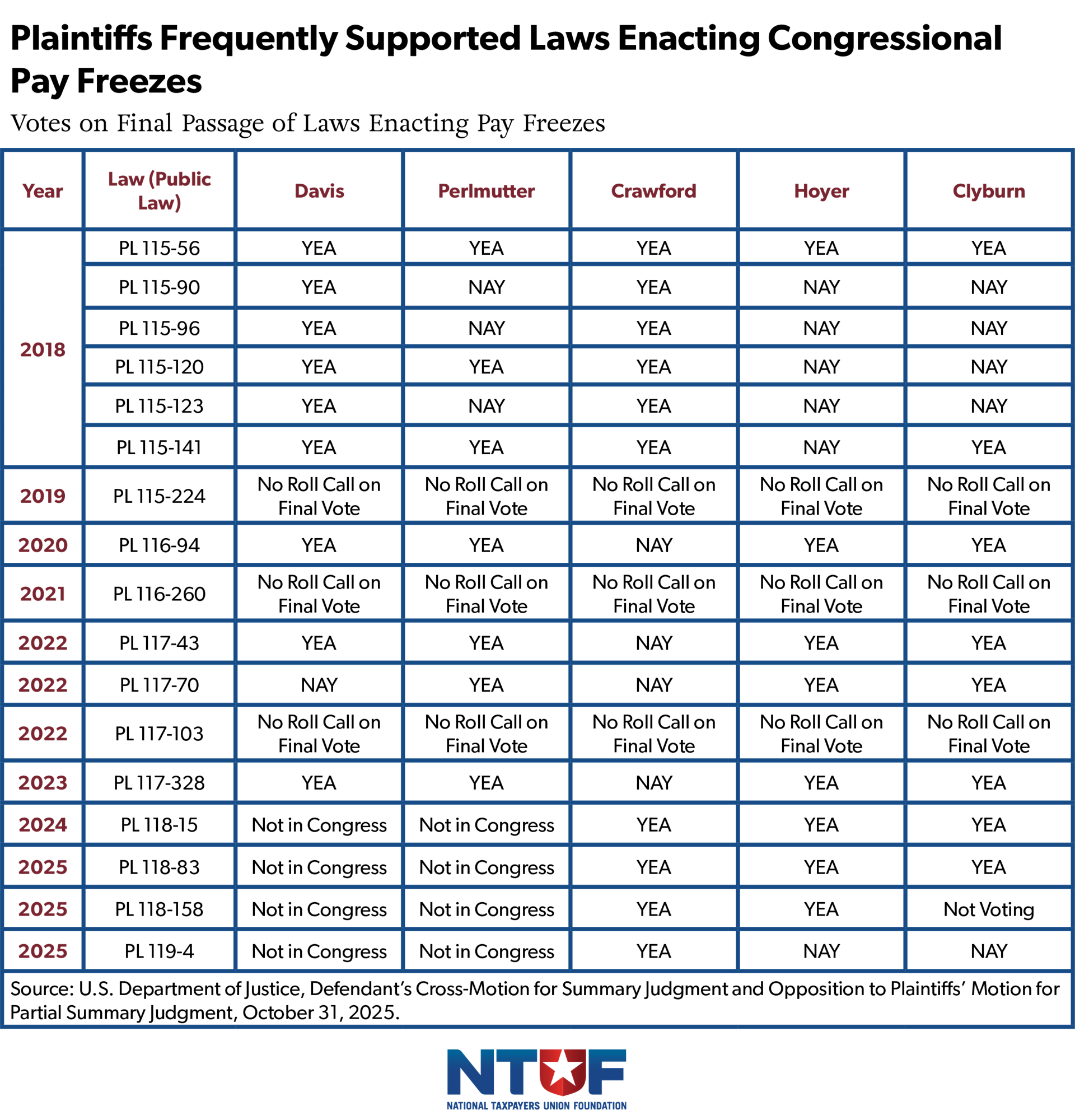 One limitation of the votes above is that they occurred on large appropriations bills, where COLA freezes were included along with broader funding measures. However, NTUF identified a House vote where the primary focus was the COLA issue.
In 1995, the House voted 387 to 31 in Roll No. 648 in favor of a motion to instruct conferees on an appropriations bill to support a Senate amendment extending the congressional pay freeze for another year. Speaking on the floor, Rep. David Obey (D-WI) framed the decision to freeze members’ salaries as voluntary and fiscally responsible in light of ongoing budget cuts and deficit reduction efforts at the time.
He also emphasized that Congress had repeatedly chosen to deny itself cost-of-living adjustments even as other federal employees received them, particularly in light of ongoing budget cuts and deficit reduction efforts at the time.
Of the three plaintiffs serving at the time, Reps. Davis and Clyburn voted in favor. Rep. Hoyer opposed the measure and argued that COLAs were not traditional pay raises but adjustments to keep pace with inflation. He warned that repeated freezes would create pressure for a future “catch-up” increase—one that could provoke public backlash once a larger adjustment was eventually proposed.
While the legislative proposal he predicted has not materialized, the lawsuit to which he is a party serves as a proxy—one that risks provoking the same public ire.
What Is at Stake
The fiscal implications for taxpayers extend beyond the immediate claims.
Because the lawsuit is filed as a class action, other current and former members could seek damages, expanding the potential cost to taxpayers. Even within the Court’s narrowed timeframe, back pay liabilities could reach tens of millions of dollars.
Plaintiffs’ counsel Cuccinnelli suggested in oral argument that former members would need to opt in to receive back pay. But that structure raises a broader question about uniformity. If the alleged constitutional violation affected all members equally, it is unclear why any remedy would apply only to those who choose to participate in the litigation. A constitutional injury, if established, would apply across the board.
In 2024, NTUF estimated that, even with the statute of limitations limiting claims to 2018, total liability could reach roughly $69 million for all current and former members who served during that period. However, if the plaintiffs prevail, additional disputes are likely over how to calculate the appropriate base pay for damages. Plaintiffs argue that compensation should be calculated as if COLAs had never been blocked, significantly increasing the potential cost.
Under that approach, congressional salaries would be substantially higher today. If Congress had not blocked annual COLAs, member salaries would be approximately 58% higher in 2024—$274,900 instead of $174,000. Over time, those 21 votes to block pay increases have saved taxpayers an estimated $603 million in avoided salary costs.
However, the plaintiffs are not challenging all of the COLA freezes. Instead, they argue that salaries were unconstitutionally “suppressed” in 20 of the 33 years since ratification of the 27th Amendment, which could lower the total damages claimed. Even so, the judge noted that determining the appropriate baseline for compensation while accounting for intervening freezes and compounding adjustments could prove complex if the plaintiffs prevail.
But the secondary effects may be more significant: congressional pensions are calculated using a formula based on a member’s highest three years of salary and length of service. Retroactively increasing salaries would therefore increase not only direct back pay, but also long-term pension obligations. The two retirement programs available to former members of Congress cost $38 million in 2022, the latest available year of date.
There is also a third-level effect to take into account: providing retroactive pay hikes to former members of Congress would also add to the cost of financing the federal debt, which now exceeds $39 trillion. Even relatively small increases in spending can have compounding effects. For example, using the Congressional Budget Office’s newest interactive worksheet, a $69 million expenditure in 2027 would increase debt service costs by an additional $29 million over the following decade.
This comes at a time when the federal government’s fiscal outlook is already deteriorating. A new report by the Government Accountability Office warns that the current fiscal path is unsustainable, with rising debt and interest costs projected to outpace economic growth in the years ahead. As borrowing increases, a growing share of federal resources will be devoted to servicing the debt rather than funding core priorities.
Against that backdrop, adding new long-term liabilities for retroactive pay increases would further strain federal finances and increase the burden on taxpayers.
A Path Forward to Protect Taxpayers
To protect taxpayers from additional harm from deeper deficits and risks, the plaintiffs, as statesmen, should withdraw their lawsuit. Success on their part would worsen the public’s already poor opinion of Congress while significantly adding to debt burdens. Short of that, and to preclude an overly broad interpretation by the Court that would harm taxpayers with added debt, the current Congress should provide clarifying guidance—through legislation or resolution—that the Amendment applies to pay increases, not pay freezes. This would preserve Congress’s ability to rein in excessive pay hikes rather than locking them in place.
Conclusion
The legal questions in this case are significant, but the underlying facts are straightforward. Members of Congress repeatedly chose to freeze their own pay. Now, a handful of members seek to undo those decisions through litigation that could impose significant costs on taxpayers and add to the long-term debt.
Moreover, most members have significant personal wealth. The median congressional net worth is around $1 million, with the average net worth substantially higher.
At its core, this dispute runs counter to the purpose of the 27th Amendment. As James Madison recognized, the Amendment was intended to prevent lawmakers from using their authority to increase their own pay without accountability, not to guarantee automatic pay increases or enable retroactive claims.
The best outcome for taxpayers and for Congress would be to withdraw this case. Allowing it to proceed risks new fiscal burdens and further erosion of public trust at a time when that confidence is already in short supply.