


Last month, the Supreme Court handed down its ruling in Pung v. Isabella County. In doing so, it failed to administer the coup de grace to the practice of home equity theft in the few states that still allow some form of it.
The good news: lawmakers in those states can and should solve this problem themselves.
Home equity theft occurs when local governments seize properties to cover unpaid property tax debts, but then keep the entire proceeds of the sale, even when it exceeds the tax debt, penalties, and interest.
In theory, the Supreme Court put an end to this practice with its decision in the 2023 case Tyler v. Hennepin County. In this case, a 94-year-old woman, Geraldine Tyler, moved into an assisted living facility and neglected to pay the property taxes on her Minneapolis condo. After she accumulated $2,300 in unpaid property taxes (and an additional $13,000 in penalties and interest), Hennepin County seized her condo and sold it for $40,000, keeping the $25,000 surplus for itself.
In a unanimous decision, the Supreme Court ruled that this practice represented an unconstitutional taking of Ms. Tyler’s property without just compensation. An additional two justices concurred with NTUF’s argument that Hennepin County also was violating the Eighth Amendment’s prohibition against excessive fines, though the majority declined to rule on that specific issue.
So that was the end of an odious, unconstitutional practice, right? Unfortunately not. While most states have since passed laws outlawing the practice of home equity theft, a few retain practices that clearly violate the spirit of the Tyler decision and, ultimately, the Constitution. One such example is Michigan.
The Pung Case
Thus the Pung case. The facts of the Pung case are unbelievable enough to be worth relating in full, as they involve a township assessor who apparently thought she worked for the KGB.
In 2010, Marc Pung was assessed additional property tax on his home by a Union Township town assessor who wrongly believed that the Pung family owed the additional tax on second residences for tax years 2007 through 2011. Marc Pung challenged this additional assessment and won before a Michigan tax tribunal.
It should have ended there. But instead, the township assessor declared of the judge who decided in favor of the Pungs, “I don’t care what he says,” and continued to wrongly impose additional, second-residence property taxes of $2,242 in tax year 2012. Not only that, but this additional tax was not included on the Pungs’ initial 2012 tax bill, apparently in an effort to make the Pungs delinquent.
When the Pungs refused to pay the exact additional assessment that an arduous legal process had just established that they did not owe, Union Township and Isabella County declared them delinquent and initiated foreclosure proceedings. The Pungs allege that the County failed to send notice of their intent to foreclose until after the deadline for the Pungs to redeem the property had passed.
Having seized the Pung’s property on the basis of what appears to be the whim of a vindictive township assessor, Isabella County then sold the property in a slapdash auction for $76,008, well under the assessed value of $194,400. Less than two years later, the auction purchaser sold the property for $195,000. Initially, Isabella County tried to keep the entire $76,008 proceeds of the sale, but a subsequent court decision forced it to pay the Pungs the roughly $74,000 difference between their “unpaid” tax bill and the property sale.
Unfortunately, in last month’s decision, the Supreme Court refused to rule that Isabella County did not need to further compensate the Pungs. The result is that the Pungs lost the home they had no desire to sell because of an assessment that the assessor who imposed it knew had no basis in law—and the only remedy was that they received less than half of fair market value in return.
What Can You Do?
If that sounds like a miscarriage of justice, well, we tried to tell the Supreme Court that. But now it’s the turn of states that still allow these kinds of things to crack down.
According to our friends at the Pacific Legal Foundation who have been fighting home equity theft for decades, five states—Alabama, Arizona, Michigan, New Jersey, and New York—still allow “shadow home equity theft,” or home equity theft that takes place because of byzantine rules and procedures that lead to taxpayers accidentally losing their right to receive compensation. Seven more—Alaska, Iowa, Louisiana, Montana, Nevada, Rhode Island, and Texas—retain loopholes allowing home equity to be stolen under certain circumstances.
Any of those 12 states stand out in a bad way for continuing to violate taxpayers’ rights. There’s no better time to fix it than before another taxpayer in your state loses their property without just compensation.
NTUF at ALEC
While a few members of the NTUF team, including yours truly, were at ALEC, it was our Policy Manager Matthew Putnam who probably felt like he was presenting on every panel, even if it ended up actually only being three. It’s his own fault for choosing to be an expert on data centers.
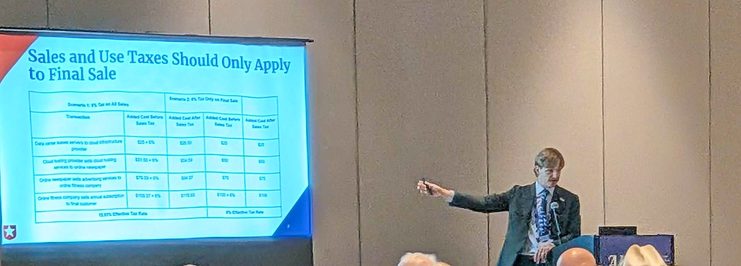
So if you’re in one of the 50 or so states where data centers are a hot topic, Matthew is happy to present on the issue. He’s had a whole weekend to sleep at this point; how much more could he need?