


Key Points
- The BUILD America 250 Act would authorize $580 billion over five years, continuing the elevated surface transportation spending levels established by the Infrastructure, Investment, and Jobs Act.
- The Department of Transportation has $160.7 billion in unobligated IIJA funding, including $74.9 billion backed by the Highway Trust Fund.
- The Highway Trust fund, already spending more than it collects, required a $118 billion general fund transfer under the IIJA, and, even with a new revenue stream, is projected to become insolvent by 2028 without further taxpayer support.
- Before approving another major highway bill, Congress should determine whether prior funding is being used efficiently, and align further spending with sustainable user-based revenues.
Introduction
Congress is well along in the process of advancing a major surface transportation bill to fund America’s highways and transportation systems. In the interest of fiscal discipline, lawmakers should first take stock of the money they have already approved.
The surface transportation authorization enacted under 2021’s Infrastructure, Investment, and Jobs Act (IIJA) is scheduled to expire on September 30. In its place, Congress is considering the Building Unrivaled Infrastructure and Long-term Development for America’s 250th (BUILD America 250) Act, a five-year surface transportation reauthorization that would authorize $580 billion for highways, bridges, transit, rail, safety, and related transportation programs.
However, that proposal comes while a substantial amount of transportation funding provided in the IIJA and last year’s appropriations law remains unobligated or is not yet fully paid out. Some of the outlay delay reflects the long timelines for major infrastructure projects, which can take years to move from awarding a grant to outlay. But it also illustrates a key budget issue: before increasing surface transportation spending yet again, Congress should account for the existing $160.7 billion in unspent and unobligated balances, assess how effectively prior funding is being used, and avoid worsening the Highway Trust Fund’s persistent shortfall.
The slow pace of obligations and outlays does not mean every dollar is wasteful, but it does weaken the case for automatically extending IIJA-era spending levels before Congress has a full accounting of how prior funds are being used. These levels of spending also represent a large departure from previous surface transportation authorizations. The Moving Ahead for Progress Act in 2012 authorized $105 billion over two years, and the FAST Act in 2015 allocated $305 billion over five years. Compared with the two previous authorizations, The IIJA and BUILD Act represent a substantial increase in surface transportation funding.
If spending continues at current levels, the Highway Trust Fund is projected to run dry by 2028, and require additional general fund transfers.
Background on the Highway Trust Fund
Surface transportation reauthorizations are periodic laws that create, modify, eliminate, or continue federal transportation programs, set funding levels for those programs, and determine how revenues from the Highway Trust Fund and other federal revenue sources are distributed.
The Highway Trust Fund (HTF) was established in 1956 to finance federal highway spending and later expanded to support mass transit and other surface transportation programs. Its revenues are primarily collected through federal excise taxes on motor fuels, including an 18.4 cents per gallon tax on gasoline and 24.4 cents per gallon for diesel, with the remaining 16% of revenue collected through taxes on truck tires, heavy vehicles, and truck/trailer sales. Since 1993, the tax rates have remained constant and have not been indexed to inflation.
However, increasing expenditures and declining revenues means that the HTF regularly spends more than it collects. Consequently, since 2008, Congress has transferred general revenues to the HTF to keep the fund solvent. That approach undermines the original user-pay model and shifts more of the cost of surface transportation onto taxpayers broadly, rather than tying those costs to direct users. Without change, the HTF is set to run dry by 2028, and will require new transfers to keep the fund solvent.
Source: Bureau of Transportation Statistics, Government Transportation Revenues and Expenditures: Highway Trust Fund.
Source: Bureau of Transportation Statistics, Government Transportation Revenues and Expenditures: Highway Trust Fund.
Current Status of the Highway Trust Fund and Expiring Funding
The IIJA authorized $659.9 billion for the Department of Transportation (DOT), of which $379.3 billion was available for highways. Funding for surface transportation was provided in three main ways: contract authority from the HTF, authorizations from general funds, and advance appropriations. It provided for $382.9 billion in total contract authority from the HTF (which allows DOT to promise payments), covered by funding from both the Highway Account and the Mass Transit Account. To maintain this spending level and solvency, Congress transferred $118 billion from general funds.
The BUILD America 250 Act Would Lock In Higher Spending
The BUILD Act would authorize $580 billion from FY 2027 through FY 2031. Of that total, $474.4 billion would be for HTF contract authority, while roughly $106 billion would be authorized from general fund transfers and remain subject future annual appropriations, for programs including the Federal Railroad Administration ($65 billion), Capital Investment Grants ($15 billion), the Competitive Highway Bridge Program ($10 billion), and the Mega Grant Program ($10 billion).
The IIJA paired a five-year highway and transit reauthorization with large amounts of advance appropriations and other infrastructure spending. The BUILD Act is narrower in scope, but it would still lock in the higher spending levels established under the IIJA and increase pressure on a Highway Trust Fund that is already dependent on general transfers.
To reduce the need for additional general transfers, the BUILD Act proposes the Highway Trust Fund’s first major new revenue source in decades. The proposal would impose a $130 annual registration fee on electric vehicles and a $35 annual registration fee on plug-in hybrid vehicles. The inclusion of these new annual fees would account for the wear and tear that electric vehicles contribute to federal highways while previously avoiding motor fuel taxes. This represents a return to the user-pay model. While a step in the right direction, a flat annual fee still does not directly measure road usage. NTU suggests a vehicle miles traveled (VMT) tax instead, to better reflect a “user benefits, user pays” model.
The Committee for a Responsible Federal Budget estimates that the new EV tax would collect $30 billion over ten years (the Tax Foundation notes that adoption rates of these vehicles can be a major source of uncertainty in such estimates). The BUILD Act therefore still would require additional appropriations or general transfers to keep the HTF solvent. Current spending rates are set to increase the HTF deficit to as much as $121 billion by 2031.
Before Congress increases surface transportation authorizations again, lawmakers should account for the funding that has already been approved but not yet obligated or paid out. The remaining funds from recently enacted infrastructure laws give Congress an opportunity to reassess the topline before committing taxpayers to another major surface transportation authorization.
DOT Still Has $106.7 Billion in Unobligated Transportation Funding
Since IIJA was enacted, DOT’s available IIJA funding has been reduced by adjustments, rescissions, and transfers. DOT’s April 30, 2026, financial summary lists $567.2 billion in enacted budget authority, reduced to an adjusted total of $545.6 billion. Within the HTF-backed portion, adjusted authority fell to $361.2 billion. Funds not allocated from the HTF are generally sourced from the Treasury’s General Fund, and many of these authorizations are tied to the September 30, 2026, expiration of the current surface transportation authorization.
Table 1 below summarizes the status of all IIJA funding for DOT. The table illustrates decreases in budget authority following transfers of funds. DOT has announced grants equal to roughly 89.8% of the adjusted budget authority, while 70.5% has been obligated. This leaves $160.7 billion in funding that remains available but has not yet been legally obligated.
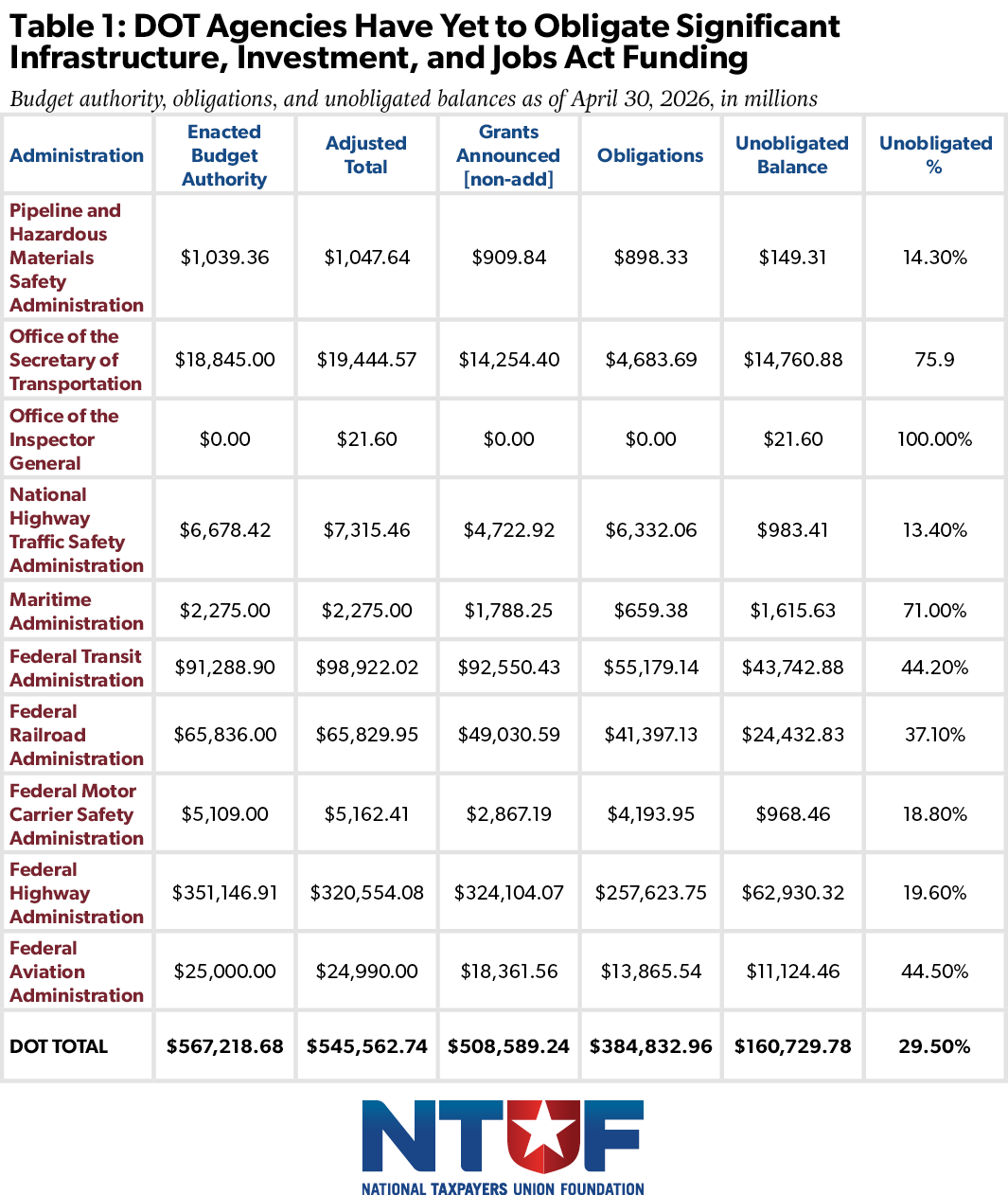
Source: United States Department of Transportation, 2026, Infrastructure Investment and Jobs Act (IIJA) Funding Status report, 04/30/2026
The tables illustrate IIJA funding for the Department of Transportation.
Enacted Budget Authority shows the amount of funding provided in IIJA
Adjusted Total reflects current spending authority after adjustments, rescissions, and transfers.
Grants Announced represents funding that DOT has publicly announced for projects, but is not necessarily committed. “Non-add” means the data are provided for information purposes only, and should not be added to the other financial columns when calculating totals because the values overlap.
Obligations represent funding that has been legally committed through grants, contracts, or agreements.
Unobligated Balance represents funding that remains available but has not yet been legally committed to specific projects.
The table below represents the Highway Trust Fund spending authorization. The table shows a total of $361.19 billion in HTF authorized spending. The table shows that grants announced exceed adjusted authority. Although the Grants Announced column exceeded adjusted authority, DOT labels this column as non-additive, meaning it should not be used to calculate remaining funds. The relevant account measure is obligations, which leave $74.94 billion in unobligated spending, representing 20.8% of the overall HTF authority. The HTF’s primary ongoing revenue source remains federal motor fuel excise taxes, supplemented during the IIJA period by the $118 billion general fund transfer.
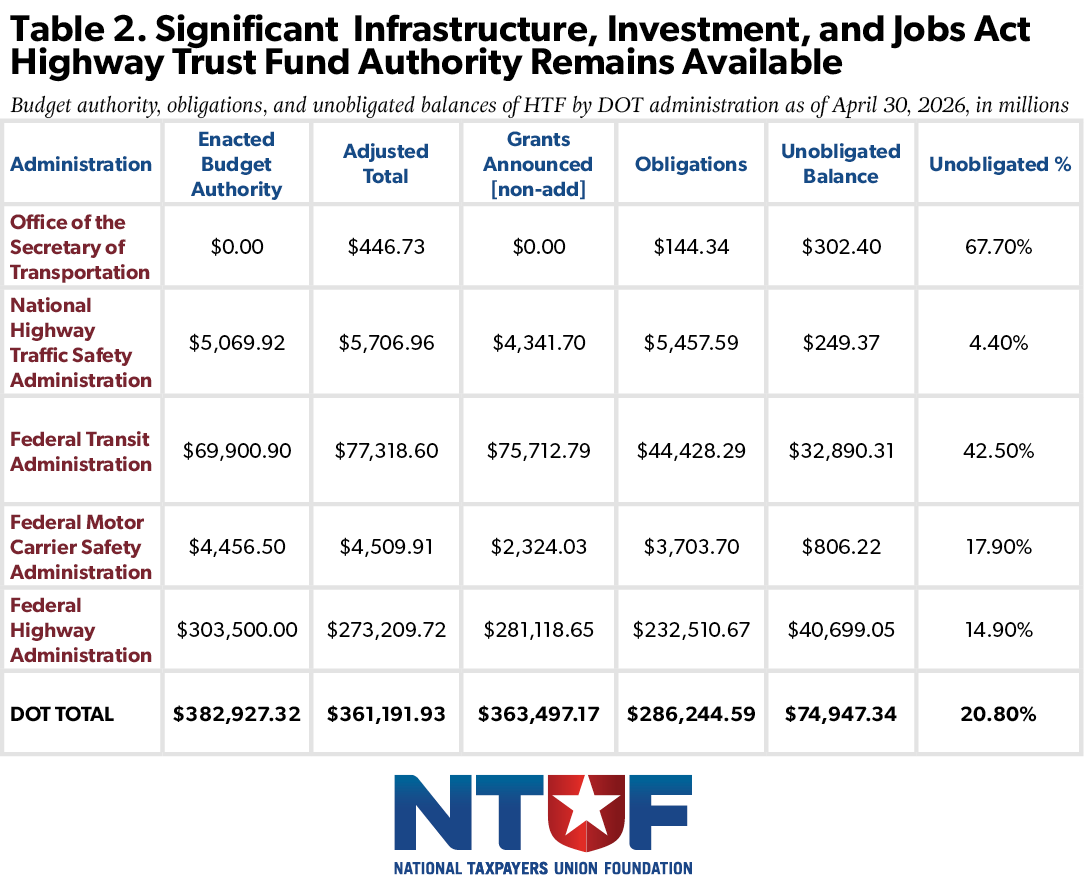
Source: United States Department of Transportation, 2026, Infrastructure Investment and Jobs Act (IIJA) Funding Status report, 04/30/2026
What the Remaining Balances Mean for BUILD
Together, these two tables show $160.7 billion in unobligated DOT funding under the IIJA. Of that amount, $74.9 billion is HTF-backed funding, while approximately $85.8 billion is non-HTF funding. Because the current surface transportation authorization expires on September 30, 2026, Congress will need to decide how to treat remaining balances and future HTF contract authority in the next reauthorization.
The existence of these remaining funds raises questions about the BUILD Act’s proposed $580 billion in spending. The unobligated percentage of authorized spending has remained relatively steady across recent reporting periods, at 27.3% in January, 30.4% in March, and 29.5% in April. While much of this spending has had grant announcements, the consistent level of unobligated funds suggests that DOT and recipients have not yet converted a substantial share of available authority into legally committed projects.
Conclusion
The BUILD America 250 Act arrives at a moment when Congress should be cautious expanding surface transportation spending without first accounting for existing balances and the Highway Trust Fund shortfall. The Infrastructure, Investment, and Jobs Act provided for significantly higher spending in the wake of the pandemic downturn, and the BUILD Act would reinforce higher spending levels and increase pressure for future deficit financed transfers.
The IIJA reflects $160.7 billion in unobligated funds, including $74.9 billion in Highway Trust Fund backed authority. While some unobligated funds reflect long-term spending, the persistence of these balances suggests Congress should evaluate whether previously authorized funds are being used efficiently and whether higher funding levels are justified.
The Highway Trust Fund’s deficit spending makes this review especially important. While the IIJA required a $118 billion in general transfers to sustain authorized spending, the BUILD Act would require even more because it increases HTF authority from $361.2 billion to $474.4 billion. The proposed electric vehicle taxes would moderately promote the user-pay structure, however it would only generate $30 billion over ten years.