

Introduction
Ronald Reagan once quipped that a government program is “the nearest thing to eternal life we’ll ever see on this earth.” Unfortunately, decades later, his warning still holds true.
Thanks to recent progress by the Office of Management and Budget (OMB), we now know that there are over 3,900 programs, though major categories are still missing. Meanwhile, the Government Accountability Office (GAO) continues to flag widespread duplication and fragmentation across agencies, and the Congressional Budget Office (CBO) finds that roughly 457 unauthorized programs received nearly $500 billion in FY 2025 alone. These are symptoms of a structural issue in how Congress oversees the programs it creates.
To address this oversight gap, Rep. Michael Cloud (R-TX) introduced the Federal Agency Sunset Commission Act (H.R. 489), which would establish a formal process for a periodic review of all federal agencies and programs. Under the proposal, a bipartisan commission would examine selected agencies and recommend whether they should be continued, reorganized, or eliminated. This would bring greater accountability to programs that too often persist without meaningful scrutiny.
Background
Congress is formally responsible for overseeing federal programs, but, in practice, many programs are rarely evaluated on a regular basis.
As a result, three interconnected problems have emerged. First, policymakers lack a complete and reliable picture of the federal government’s programmatic footprint. Second, overlapping and duplicative programs continue to operate across agencies, reducing efficiency and increasing costs. Third, programs frequently receive funding even after their statutory authorizations have expired.
An Inventory Took Thirteen Years to Build—But Is Still Incomplete
It is difficult to reform what you cannot fully see. The GPRA Modernization Act of 2010 directed OMB to maintain a public inventory of all federal programs, but implementation lagged for years and OMB did not publish a meaningful version until 2024. That said, progress is real: the inventory now identifies 3,963 federal programs, up significantly from earlier counts, and reflects work carried forward across both the Biden and Trump administrations.
But gaps remain. A March 2026 GAO report found the inventory incomplete and inconsistent across agencies, with 17 recommendations still outstanding. Major categories like defense and foreign assistance are excluded, and GAO found that 13 of 20 statutory requirements remain unmet. Congress and the executive branch need a fully completed inventory before they can meaningfully evaluate what the federal government is actually doing.
Fragmentation, Overlap, and Duplication of Programs
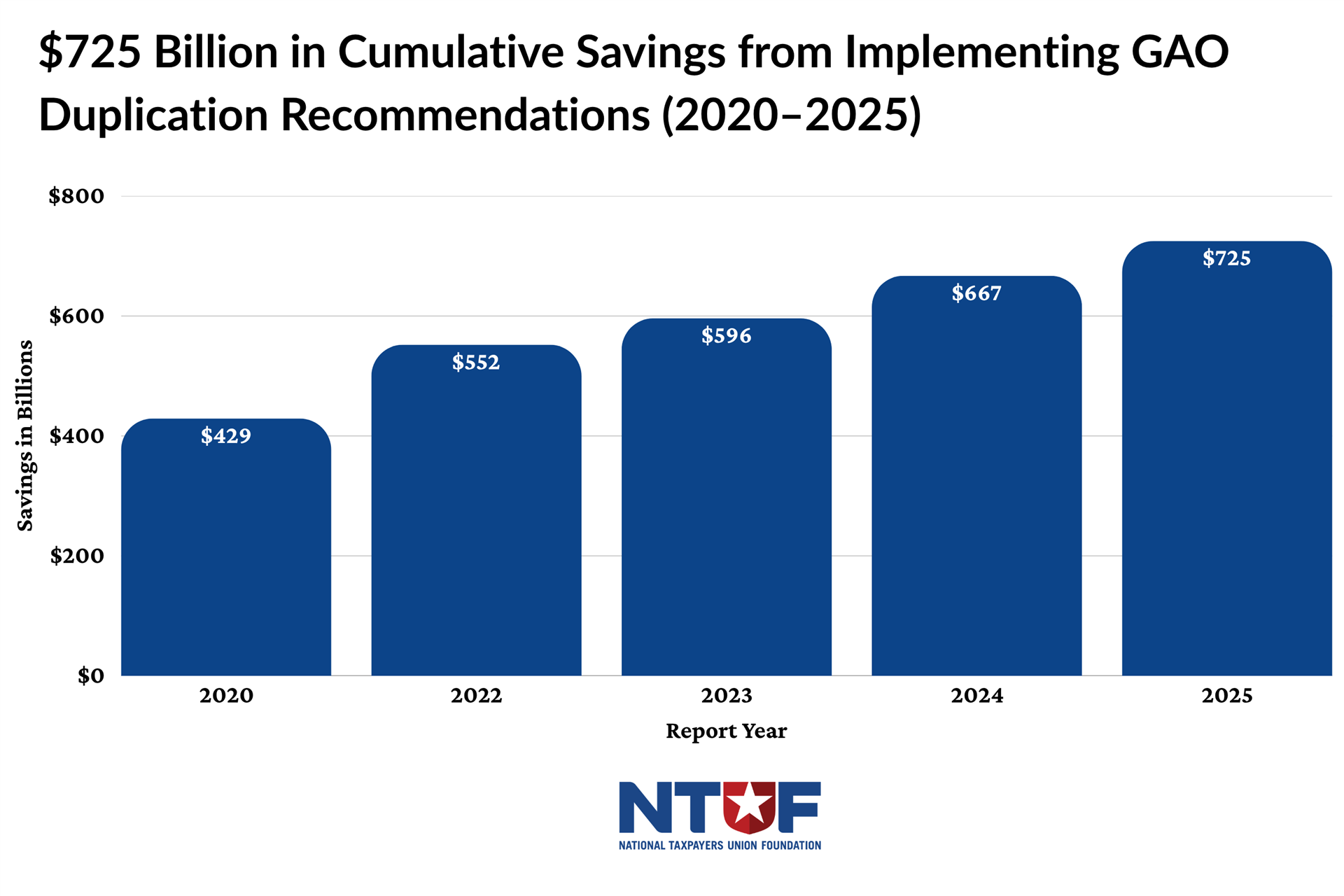
Since 2011, GAO has identified 2,049 instances of fragmentation, overlap, or duplication across the federal government. As of 2025, congressional and agency action on these findings has produced $725 billion in verified cumulative savings. Figure 1 tracks what happens when Congress actually acts on these findings: cumulative savings have grown from $429 billion in 2020 to $725 billion in 2025. Yet, 589 matters remain unresolved, with over $100 billion still available. Without a structured process to review federal programs and address duplication, many of these opportunities may remain unrealized.
Unauthorized Spending Persists
Under the Congressional Budget Act, appropriating funds for programs whose statutory authorizations have expired is technically disfavored. In practice, it happens routinely and at scale. CBO’s 2025 report found that $500 billion in FY 2025 spending went to programs operating without current authorization, with just 23 laws accounting for $450 billion of that total. Some of these authorizations lapsed more than a decade ago; the oldest expired in 1980.
A Model for Regular Program Evaluation: Texas’s Sunset Review Process
One way to address these oversight challenges is through periodic program review. Several states have adopted “sunset” systems, which require agencies or programs to undergo regular evaluation to determine whether they should continue operating.
Texas maintains one of the most well-known sunset review systems. Since its creation in 1977, the Texas Sunset Advisory Commission has abolished 42 agencies and consolidated 54 others out of roughly 600 agencies reviewed. The process has also generated measurable fiscal benefits. Since 1985, the Commission has produced more than $1.1 billion in savings and revenue gains, generating an estimated $17 return for every $1 appropriated to the Commission. The Texas experience demonstrates how structured, periodic program reviews can help policymakers reassess government activities and eliminate outdated or duplicative programs.
What the Federal Sunset Commission Act Would Do
Building on these notable results in Rep. Cloud’s home state, his Federal Agency Sunset Commission Act of 2025 (H.R. 489) establishes a 13-member bipartisan commission to periodically review and examine agencies’ effectiveness.
Under this bill, every federal agency would be placed on an at-least 12-year review schedule. During each review, the commission would evaluate agency performance and examine whether agencies duplicate existing government functions or exercise authority not clearly authorized by statute. Based on these evaluations, every year, the commission would submit a schedule of review and abolishment to Congress in the form of a joint resolution. Agencies would be abolished unless Congress votes to reauthorize them following their scheduled review.
The bill also addresses the inventory problem directly. The commission would be required to work with CBO and GAO to compile a comprehensive inventory of federal programs—a task that is more achievable than it might sound. CBO already tracks a large share of federal programs as part of the annual budget process, and OMB has already made significant progress through its existing Program Inventory. The bill would build on that foundation rather than start from scratch.
Conclusion
Rep. Cloud’s Federal Agency Sunset Commission Act of 2025 offers a straightforward response to a long-standing oversight failure. By requiring every federal agency to periodically justify its continued existence, the bill creates a structured process for Congress to reduce duplication, eliminate programs that have outlived their purpose, and ensure taxpayer dollars are spent where they are actually needed.
Decades after Reagan warned that government programs tend to endure, that tendency remains unchecked. Without a mechanism for regular review, wasteful and underperforming programs persist. A sunset process would ensure that ineffective or duplicative programs are not carried forward, but allowed to pass into what Reagan called the “ash heap of history.” Longevity in government should be earned, not assumed.