

Introduction
When lawmakers consider new proposals, Congressional Budget Office (CBO) cost estimates show how legislation will affect federal spending and revenues. But those estimates leave out a critical piece of the fiscal picture: they typically exclude the impact on debt service costs.
That omission can significantly understate the true fiscal impact, especially as interest costs become one of the fastest-growing parts of the federal budget. A new interactive tool from CBO helps close that gap by showing how quickly borrowing costs compound over time.
Representative Michael Cloud’s (R-TX) Cost Estimates Improvement Act (H.R. 991) would go a step further, requiring CBO to incorporate debt service effects directly into its official cost estimates.
CBO’s Budget Transparency Tool
Since 2023, CBO has released an interactive reporting tool annually that allows users to test how changes in federal revenues and spending affect deficits and debt over time. The tool has become a valuable resource for improving transparency in federal budgeting, giving the public a clearer view of how fiscal decisions play out beyond the initial price tag.
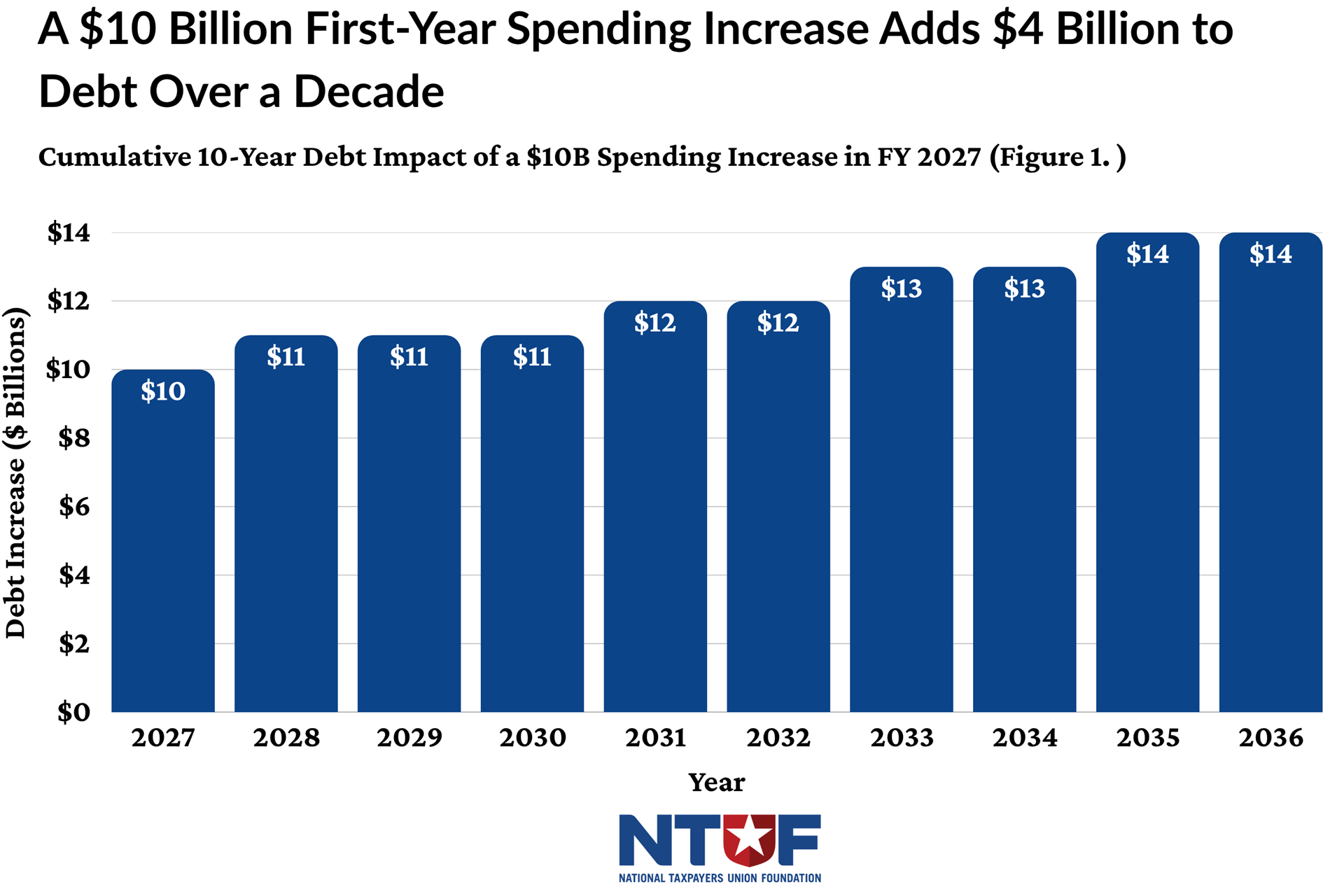
In its latest update this March, CBO shows that a $10 billion increase in spending in 2027 would cost roughly $14 billion over the ten-year budget window once borrowing costs are taken into account.
The difference comes from interest payments, which accumulate as the government finances that initial increase through debt. As shown in Figure 1, even a one-time policy continues to add to the debt over time, reflecting the persistent cost of servicing that borrowing.
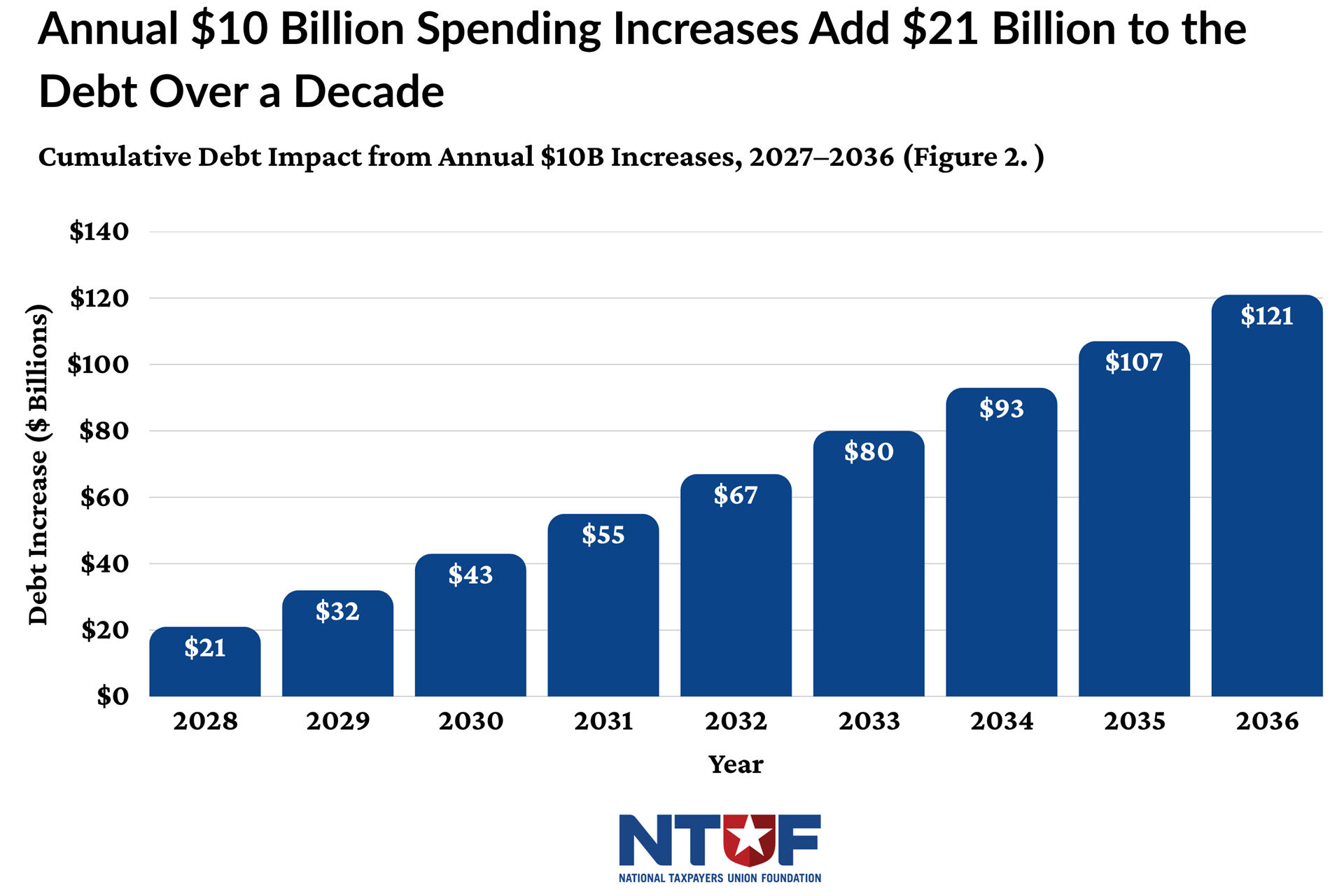
The dynamic becomes far more pronounced when the same policy is repeated. If lawmakers increase spending by $10 billion each year from 2027 through 2036, total outlays rise to $100 billion. However, including interest, the cumulative increase in debt reaches roughly $121 billion, with about $21 billion attributable to debt service alone. Figure 2 illustrates how quickly these costs compound.
This example reflects a broader trend in the federal budget. According to CBO‘s report Budget and Economic Outlook: 2026 to 2036, net interest payments are projected to grow rapidly over the next decade, exceeding $1 trillion annually and doubling to about $2.1 trillion by 2036, making them the fastest-growing category of federal spending. As borrowing continues, what appears as a secondary cost at the policy level becomes, at the macro level, a central driver of long-term fiscal pressure.
Under current scoring rules, official CBO cost estimates for legislation exclude debt service effects. This omission can make policies appear less expensive than they truly are, particularly in today’s higher-interest-rate environment. Without this information, policymakers lack a complete picture of how new spending or potential savings actually affect the federal balance sheet.
To close this gap in cost estimates, Rep. Cloud’s Cost Estimates Improvement Act proposes a straightforward fix: requiring CBO to incorporate debt servicing into its formal cost analyses. By codifying this requirement, the bill ensures that the long-term interest implications of every piece of legislation are transparent and available to the public before a vote.
Conclusion
Ultimately, reducing spending up front lowers future debt service costs, compounding the savings over time. The adoption of reforms like H.R. 991 is a necessary step toward fiscal transparency. Moreover, this would also count for proposals that reduce outlays, showing how immediate savings will have long-term positive impacts by reducing debt costs that are otherwise kicked down the road. Incorporating the effect of debt service costs is both feasible and necessary for a complete picture of how policy choices impact the nation's long-term financial health.